Get Full Government Meeting Transcripts, Videos, & Alerts Forever!
Get email alerts on the Power Outage topic
No spam. Unsubscribe anytime.
Mono County pushes for clearer SCE communication, resiliency after multi‑day winter outages
Summary
County supervisors pressed Southern California Edison to improve local messaging and resiliency after a late‑December storm left parts of Mono County without power for days; SCE described transmission and distribution damage and said claims for business losses are handled case‑by‑case.
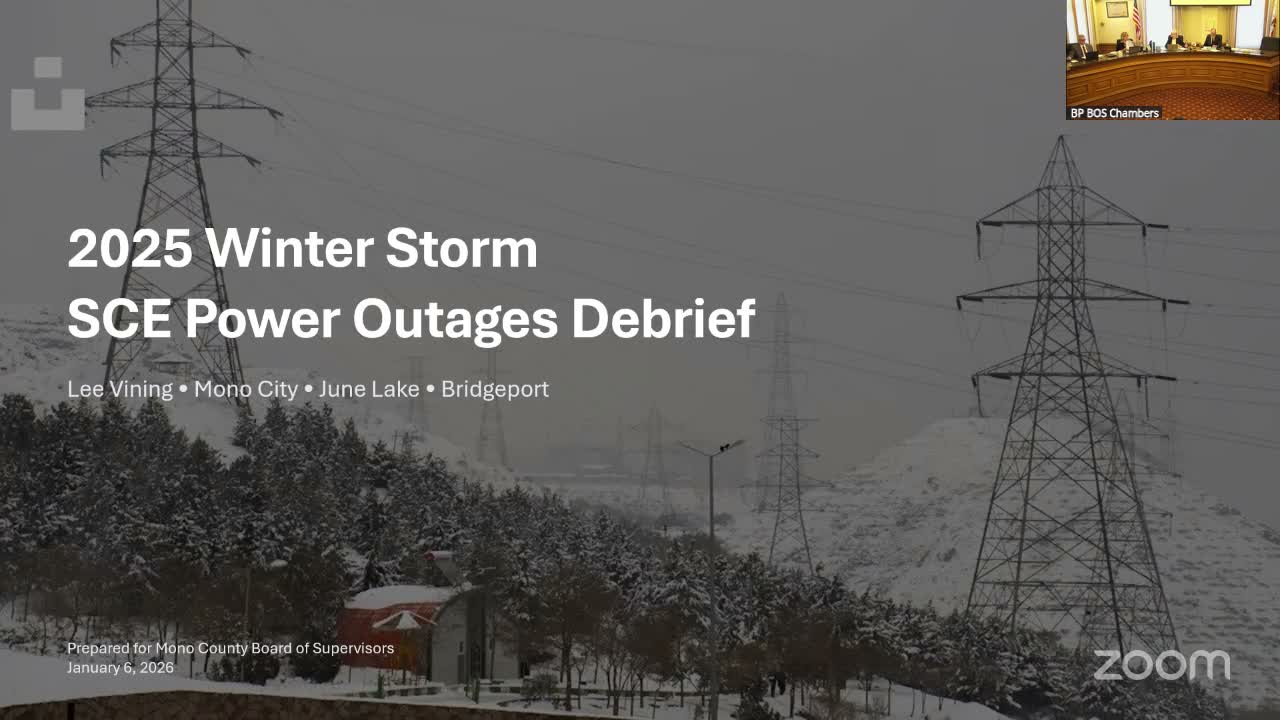
Mono County supervisors on Jan. 12 pressed Southern California Edison (SCE) and county staff for clearer, more localized communication and better contingency planning after late‑December storms left communities — including June Lake, Lee Vining, Mono City and Bridgeport — without power for multiple days.
“This was an outage whose duration was measured in days, not hours,” Supervisor McFarland said, urging SCE to provide a more detailed daily narrative to help residents and businesses make safety and economic decisions.
County Administrative Officer Marbelli opened the discussion with a summary of the county response: warming centers and an overnight shelter were opened, the sheriff’s dispatch served as an intake point for sheltering needs, and the county will produce an after‑action report to capture lessons learned and options such as improved backup power and communication playbooks.
Matt Perullo, SCE’s regional representative, told the board the company had seen “significant” damage to transmission and distribution lines during heavy, wet snow and wind, and that crews had to prioritize repair work to restore service safely. He described how SCE used local hydroelectric generation in an “islanded” configuration to bring power back to some areas and said crews worked around the clock over the holidays.
Perullo acknowledged customer frustration with estimated restoration times and said SCE shifted to broader daily messaging once damage assessments were under way. “In terms of communication, if there’s any fault…that can be directed, frankly, directly at me,” Perullo said, adding the company would work with the county to improve local messaging and templates.
Supervisors and residents pushed back on several points: whether SCE could offer rebates or simpler claims for business losses, the feasibility of siting standby generation at substations, and why some small or remote areas appeared to receive less inspection and earlier attention. SCE responded that claims are evaluated case‑by‑case and that generation is not the primary constraint in this event — the company cited broken poles, crossarms and other distribution damage that must be repaired in the field.
Public commenters described the human impact: customers who lost perishable food, hotels and businesses without lights or water, and residents disturbed by ongoing helicopter and inspection operations. County Health reported the county requested CalFresh (SNAP) benefit replacement for 57 affected households and was pursuing automated replacement at the state and federal level.
The board asked SCE to return with a regular briefing and for the company and county to explore options such as targeted local messaging, pre‑positioned crews during forecasts, and ways to speed damage assessment and reporting. Several supervisors also advocated for county investment in a more robust emergency management function and partnerships to train and sustain local first responders.
What’s next: county staff said an after‑action review will be compiled in the coming weeks and SCE agreed to provide more frequent localized updates to the board and county public information officers.