Get Full Government Meeting Transcripts, Videos, & Alerts Forever!
Get email alerts on the Public Safety Drones topic
No spam. Unsubscribe anytime.
La Mirada reviews proposal to use drones for July fireworks enforcement
Summary
City staff and a vendor described a nine‑day drone surveillance proposal for fireworks enforcement (June 26–July 5), including infrared imaging, address‑pinpointing and a proposed not‑to‑exceed cost of about $23,000; council asked questions about evidence, privacy and apartment unit identification.
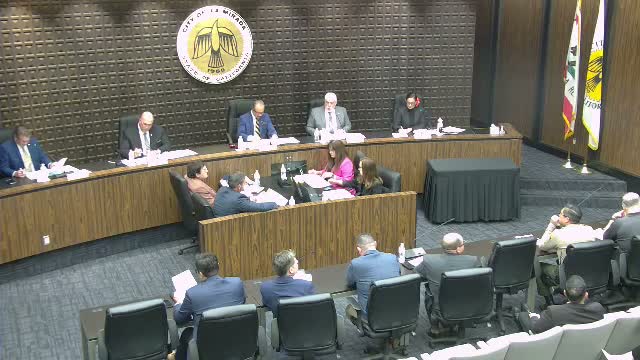
La Mirada city officials on Feb. 10 heard a staff presentation and vendor briefing on a proposed, short‑term contract to use drones for fireworks enforcement around the Fourth of July.
The administration described a proposal to contract with a vendor identified as FLI (Flying Lion Inc.) to operate “drone in a box” units and remotely piloted flights for about nine days (June 26–July 5). Assistant City Manager Anne Herrickson said the item is an administrative report to give council a chance to review operations before staff returns with an agreement for council approval, likely as a consent‑calendar item in early to mid‑March.
Steven Katz, the vendor’s representative, said the company would use remotely piloted drones with low‑light and infrared cameras, a laser overlay to validate locations, and a daily reporting package. “We have a large contingency of customers here in Southern California…what we're gonna be talking about is actually personnel and leasing is kind of combined into our fireworks solution,” Katz said during the presentation. Katz described a setup of two drones (one charging while one flies) and said the vendor would livestream flights so city staff and, if authorized, the sheriff’s office could monitor activity.
Councilmembers questioned who would receive citations and how reliable drone footage would be at administrative hearings. Staff and the vendor said citations would be issued to property owners under the city’s administrative process and that hearing officers in other cities have upheld video‑based citations when the package includes clear video, address overlays and supporting declarations. “As long as there’s clear video that the person has a nexus to that house…they're upheld,” the vendor said, describing past outcomes in other jurisdictions.
Council members also pressed the vendor on operational limits and privacy safeguards. Katz said the system is designed to avoid flying directly over private backyards, uses infrared to detect heat signatures rather than facial identification, and that remote ID rules now require drones to broadcast identifying information. Several councilmembers raised concerns about apartment and multiunit complexes, where identifying the specific unit or tenant would be more difficult; the vendor said it would make “best efforts” to validate the source property and work with staff to assemble a defensible evidence package.
No contract vote occurred at the meeting. Herrickson said staff would return with a proposed agreement and a not‑to‑exceed figure — the vendor’s presentation indicated an approximate cost of $23,000 for the nine‑day coverage — if council is supportive.
The council discussion closed with staff asking for direction to move the agreement forward; several members expressed support for a pilot aimed at deterring illegal fireworks and reducing public safety risks. The item will return to council for formal approval before deployment.