Lifetime Citizen Portal Access — AI Briefings, Alerts & Unlimited Follows
Planning board adopts turf standards aligned with new Florida DEP rules after state preemption limits local authority
Loading...
Summary
The board approved an ordinance aligning city synthetic‑turf rules with Florida DEP standards and acknowledging the state law that preempts local regulation for single‑family lots under 1 acre; members voiced environmental concerns but approved the staff recommendation for regulatory alignment.
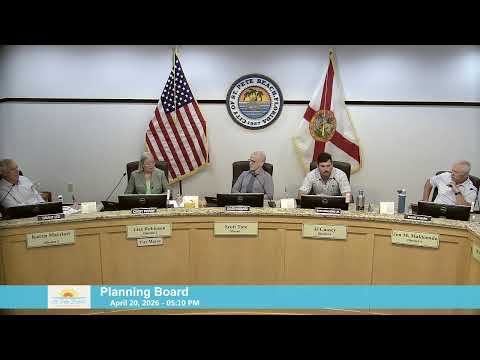
The St. Pete Beach Planning Board on April 20 voted to adopt land‑development code updates that align the city’s synthetic‑turf requirements with newly published standards from the Florida Department of Environmental Protection and reflect a state law that preempts local regulation of artificial turf on single‑family lots under 1 acre.
Brandon Berry, planning staff, said DEP published product and installation standards in January and that the state law preempting local rules becomes effective for single‑family properties under one acre. Under the proposed local ordinance staff would adopt the state standards for single‑family lots while retaining and enforcing city standards for multifamily and commercial properties, including product specifications, permeability/subgrade requirements, and siting limits (for example: turf may not be in drainage swales, in dunes or adjacent to ponds without a seawall).
"These are preemptions, again, only on single family properties under an acre in size," Berry said, adding that the city would continue to require product specifications, recyclable materials and measures to prevent runoff impacts on non‑single‑family parcels.
Member Perry, who identified himself by profession as a scientist during discussion, raised ecological and human‑health concerns about turf: "It doesn't support any habitat biodiversity... the chemicals that they use, I think many of them are carcinogenic," he said, urging caution even as he acknowledged staff must follow state law.
The board discussed whether retaining advisory language encouraging natural turf would be appropriate and whether the city could keep stricter standards for non‑single‑family properties. The city attorney warned that keeping incompatible local language could risk attorney's fee exposure; staff recommended aligning the code with state law while preserving local authority where the law allows.
A motion to adopt the turf updates as proposed carried on a roll‑call vote. Staff said further refinements and site‑specific setbacks could be considered for non‑single‑family properties in future code amendments.
The ordinance clarifies where the city can still regulate turf (commercial and multifamily sites) and documents the limits of local authority for single‑family parcels under the new state standards.