Get Full Government Meeting Transcripts, Videos, & Alerts Forever!
Get email alerts on the Renewables Policy topic
No spam. Unsubscribe anytime.
Evanston technical committee debates how buildings can meet 100% renewable-electric target
Summary
The Healthy Buildings technical committee discussed options for meeting the ordinance’s 100% renewable-electricity goal — on-site solar, community solar/PPAs, RECs, and staging interim EUI targets — and asked staff to test reporting fields in Beam/Energy Star and to host expert Q&As.
The City of Evanston’s Healthy Buildings technical committee spent its meeting focused on how covered buildings could meet the ordinance’s 100% renewable-electricity target and interim energy-use-intensity (EUI) goals, debating on-site solar, community solar, power purchase agreements (PPAs) and renewable energy credits (RECs).
“We're going to depart a little bit from the syllabus, and we're gonna focus on renewables,” said Chair (S2), introducing benchmarking data for three sample properties and asking the group to identify realistic compliance “lanes” rather than engineering solutions.
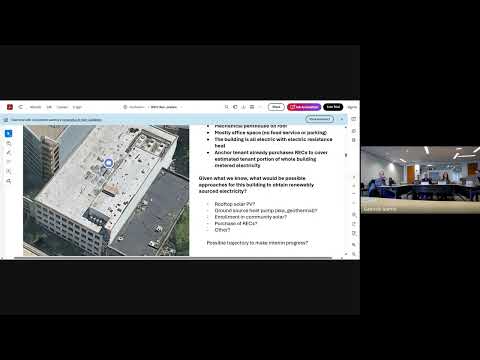
Committee members and technical participants reviewed Beam and Portfolio Manager data for three representative sites — 820 Davis (a five‑story building with limited roof area and adjacent shading), 1560 Sherman (a mixed high‑rise/low‑rise with rooftop mechanicals) and Lincolnwood School (ample roof and grounds) — and discussed what each site could reasonably achieve on‑site.
Staff member (S4) outlined the main procurement pathways under consideration: partial on‑site PV where roof space allows; subscribing to off‑site community solar fields; purchasing RECs (referred to in the discussion as “racks”); or entering PPAs. “So the only way to go, I would think, is purchasing community solar, purchasing racks, or … power purchase agreements,” S4 said, urging the group to decide which of those would count under the ordinance.
A presenter with building‑operator experience (Presenter S5) cautioned about rooftop risks: “There’s a lot of hesitation for solar to be placed on these roofs right now due to the fact that you're penetrating roofs … roofs are a large capital investment,” S5 said, noting owners may prefer buying RECs to avoid roof penetrations and added maintenance burdens.
The committee also considered load‑reduction measures and mechanical options. Several participants noted geothermal and ground‑source heat pumps are primarily load‑reduction or efficiency strategies and often impractical downtown; Lincolnwood School was singled out as a site where ground‑source options and on‑site PV were more feasible.
On tracking and verification, members asked whether Beam and Energy Star Portfolio Manager can capture REC/PPA ownership and suggested staff explore adding custom fields. S4 said Beam can accept added columns and Staff (S4) and others agreed to test whether renewables certificates and PPAs can be recorded in Portfolio Manager and pulled into the committee’s Beam account for verification.
Committee members discussed staged interim targets, mirroring Boston’s approach, with five‑year performance steps toward 2050. “If the building exceeds its carbon limit, buildings have a couple options: improve the building or pursue RECs/PPAs,” Presenter S5 summarized. Several members recommended a minimum purchase duration for out‑of‑site instruments (for example, multi‑year REC/PPA commitments) to prevent short‑term purchases timed to reporting cycles.
As next steps the committee agreed to: (1) test Beam/Portfolio Manager inputs and whether staff can add renewable‑procurement fields for verification; (2) invite Boston staff and an ASHRAE Standard 100 expert for a Q&A to inform acceptable procurement language and EUI alignment; and (3) draft clearer compliance language, staged interim targets and communication materials to help building owners plan upgrades or alternative‑compliance submissions. One member offered to schedule a Boston Q&A and a possible ASHRAE speaker for the committee’s upcoming meetings.
The procedural motions on the agenda — approval of the Feb. 18 minutes and a motion to adjourn — passed by voice vote. The committee adjourned after agreeing to pursue the technical follow‑ups and outreach plan.