Get Full Government Meeting Transcripts, Videos, & Alerts Forever!
Get email alerts on the Medicaid Hr1 topic
No spam. Unsubscribe anytime.
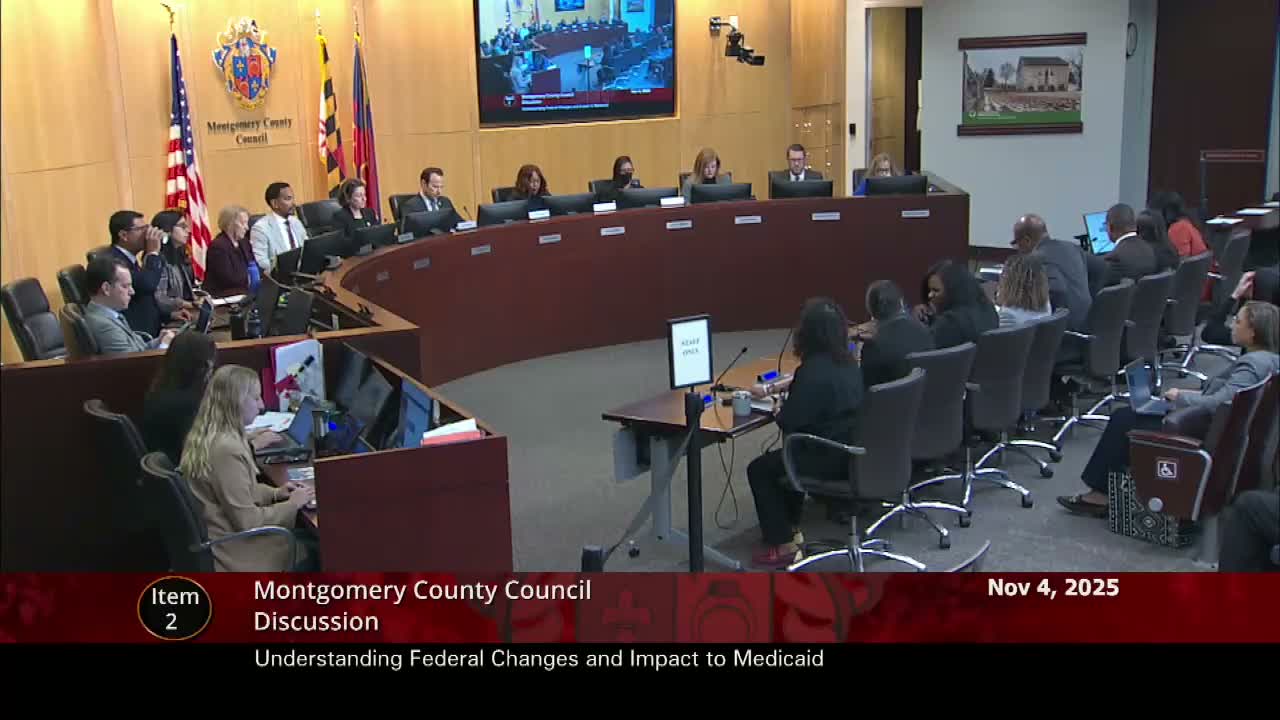
Montgomery County health leaders warn HR 1 could strip coverage from thousands and strain local safety net
Summary
County health officials told the Council Nov. 4 that federal HR 1 work requirements and other changes could cause administrative churn that may cut Medicaid for an estimated 23,000 Montgomery County residents and leave roughly 3,000 ineligible, and outlined county preparations to limit harm.
County health officials warned the Montgomery County Council on Nov. 4 that federal changes in HR 1 could sharply reduce Medicaid coverage for many local residents and add major administrative strain to county services.
In a presentation to the full council, Health and Human Services Director James Bridgers and DHHS public‑health leads laid out worst‑case scenarios, operational impacts and outreach plans. DHHS estimated roughly 19% of county residents (about 205,000 people) are on Medicaid; depending on state rules and implementation, about 23,000 residents could lose coverage because of increased administrative requirements, and about 3,000 could be removed entirely because they do not meet new work or documentation rules.
"We anticipate that about 44,000 people are in the expansion population and approximately 3,000 of those may become ineligible," DHHS health insurance manager Sean Gibson said, describing verification and re‑enrollment burdens if the federal changes take effect as written. DHHS officials explained the effective policy shifts that concern them: more frequent renewals (every six months instead of annually for the expansion group), reduced retroactive coverage windows, and new work and documentation verification requirements that can create so‑called "churn."
The department described concrete scenarios. Nina Ashford, DHHS Chief of Public Health Services, said work‑requirement and verification changes would primarily affect adults ages 18–64 enrolled through the ACA Medicaid expansion, including many small‑business workers, students, and self‑employed residents. Laurie Garabe Aquino outlined a family scenario in which refugee children could lose CHIP coverage because of changed noncitizen eligibility rules, with downstream impacts on immunizations and school readiness.
DHHS also warned of system impacts: fewer federal Medicaid dollars could reduce funding for community health centers (DHHS noted Medicaid supported more than half of some centers' revenues in 2024) and increase emergency‑department use and ER wait times. The department estimated potential statewide federal funding losses of about $2.7 billion annually and outlined county figures it said represented plausible outcomes between 2026 and 2028.
Council members pressed DHHS on planning and capacity. Vice President Will Giordano and Councilmember Katz asked whether Montgomery Cares clinics could expand primary‑care capacity and what the county would need to cover newly uninsured people. DHHS said clinics have some capacity but not the budget to absorb all displaced enrollees and emphasized that Montgomery Cares provides primary care, not comprehensive insurance.
Officials described multiple mitigation steps: intensified outreach and enrollment assistance at libraries, rec centers and schools; navigators in hard‑hit ZIP codes; coordination with the state for systems and policy guidance; standing up an access‑to‑care work group with hospital partners; and investment in community partners and nonprofit coalitions. Bridgers asked council members to join work groups and to help coordinate philanthropic and corporate partners to supplement county and federal funding.
DHHS repeatedly cautioned that many details will depend on Maryland’s implementation and guidance from the Centers for Medicare and Medicaid Services, and that the county is preparing action plans that will likely evolve. "We are ready to address as much as we can," Bridgers said, "but there will still be gaps — and some people will lose coverage."
What happens next: DHHS said it will return with further analyses and cost estimates as state rules and federal guidance are issued; the council scheduled further budget and policy reviews with HHS staff and emphasized the need for proactive outreach to protect eligible residents.