Get Full Government Meeting Transcripts, Videos, & Alerts Forever!
Get email alerts on the Transportation Master Plan topic
No spam. Unsubscribe anytime.
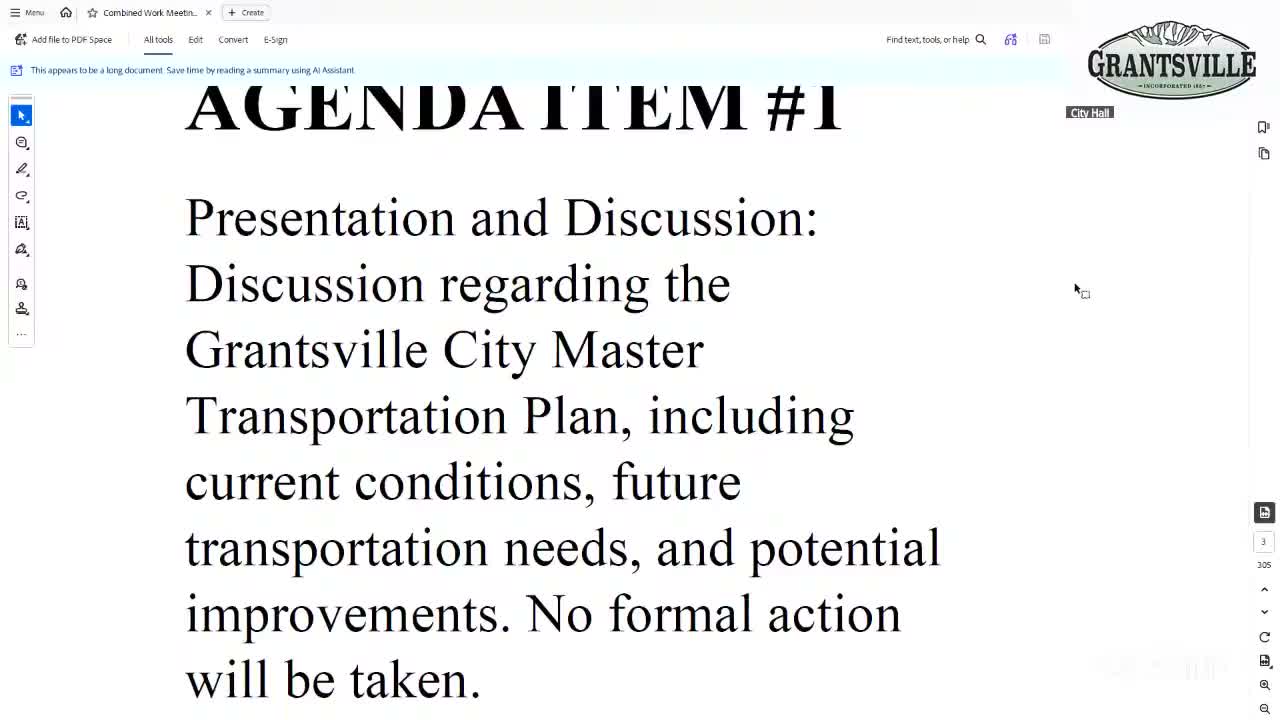
Consultants lay out Grantsville transportation master plan, urge rights‑of‑way and developer‑built corridors
Summary
Consultants presented a draft transportation master plan that models traffic to 2050, shows failing corridors under a do‑nothing scenario, recommends preserving wider rights‑of‑way in key locations and schedules a public open house and a comment period before hearings and adoption.
McLean Farmer, a consultant with Jones & DeMille Engineering, told the Grantsville City Council and Planning Commission on April 14 that a draft transportation master plan modeled traffic conditions for 2035, 2042 and 2050 and maps the lane configurations and right‑of‑way widths the city would need at full build‑out. Farmer said the study used UDOT regional plans, recent traffic tube counts, and calibrated modeling with university data and that most proposed roads would be built by developers if growth occurs as projected.
The plan’s website and mapping tools will be available to the public, and Farmer said the project team will hold a public open house in two weeks, leave the record open for two weeks of comment, then take comments to the Planning Commission and the City Council before adoption. "If we do nothing and let the city grow, these roads are gonna be failing," Farmer said, contrasting a do‑nothing future with scenarios that add the recommended roadway network.
Why it matters: The draft maps show several corridors becoming congested without targeted improvements, including parts of Main Street that would be difficult to widen because of existing buildings. Preserving wider rights‑of‑way now — even if not immediately paved — would keep options open and avoid later property‑acquisition problems, the consultants said. Council and commission members expressed concern about the legal and fiscal implications of requiring larger rights‑of‑way, noting takings and compensation risks if the city asks for more right‑of‑way than models justify.
Key details and tradeoffs: Farmer walked the group through roadway classifications (local to arterial), average daily traffic (ADT) points, and a pavement assessment produced from imagery captured by an automated vendor, Violytics. He said the city’s pavement inventory and an automated condition score let staff see photos, manhole heights and recommended treatments. The consultant noted some discrepancies in ADT data on Main Street and cautioned that KMZ files and some state data may be out of date.
On lane widths and cross sections, consultants showed typical sections for 66‑, 90‑ and 108‑foot rights‑of‑way and described how those dimensions translate into two‑, three‑ and five‑lane configurations. Farmer recommended retaining wider rights‑of‑way in some areas so the city can add lanes or change cross sections as development occurs. "It doesn't hurt to get wider right‑of‑ways, but there is a chance a developer could come to you and say, 'you require too much right‑of‑way,'" Farmer said, noting the legal and negotiation risks.
33rd Parkway and rail crossings: A sustained discussion focused on the proposed 33rd Parkway alignment and how it would cross an existing rail corridor in a triangular parcel. Consultants said routing that stays north of the triangle would reduce the number of rail crossings; other alignments would require additional at‑grade crossings or later grade separation. Commissioners and council members debated tradeoffs between grid connectivity, cost, and impacts to existing property and the Lakeview Business Park master development exhibits.
Cost and funding: Farmer presented high‑level, inflation‑adjusted cost estimates and said full build‑out of the proposed network — counting city, county, UDOT and developer responsibilities — was on the order of hundreds of millions of dollars (consultant estimate cited about $835,000,000). He said developers would shoulder most of that cost and suggested that narrowing lane widths would reduce cost but produce more failing corridors in model projections.
Next steps: The consultants will post the full report and a 300‑page appendix, host an open house in two weeks and accept two weeks of public comment before Planning Commission public hearings and a council adoption vote at a later date.