Get Full Government Meeting Transcripts, Videos, & Alerts Forever!
Get email alerts on the Tenant Protections topic
No spam. Unsubscribe anytime.
Novato council advances broader tenant-protection ordinance after hours of testimony
Summary
After more than three hours of testimony and detailed council questioning, Novato—ity Council voted to advance a staff-drafted just-cause tenant protections ordinance with amendments including a small-operator exemption aligned with state law and a per-diem relocation payment for short-term displacements.
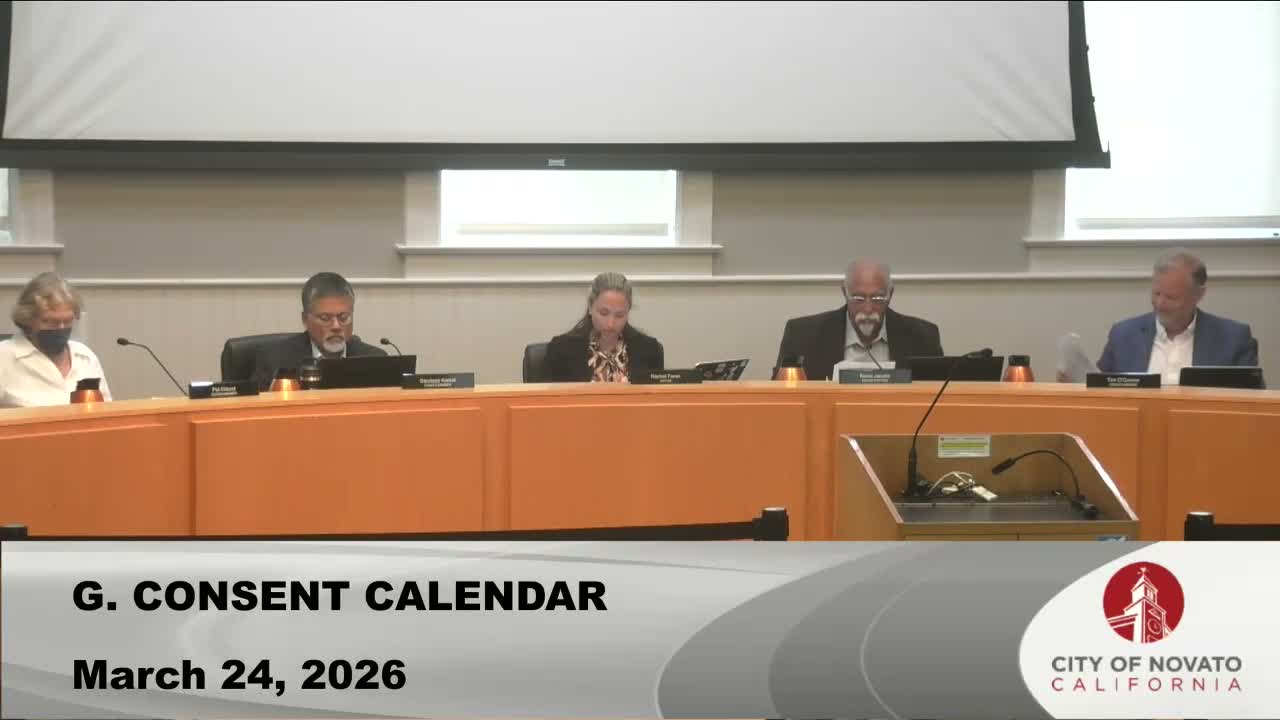
Novato—ity Council moved forward on March 24 with staff raft language for a "just cause" tenant protections ordinance, after an evening of technical staff presentations, extensive public comment from tenants and landlords, and detailed council questions about exemptions and relocation payments.
Claire Hartman, the city—mployee leading the presentation, told the council the draft is focused on expanding protections for "no-fault" evictions — including withdrawal-from-market, owner-move-in, red-tag code enforcement orders and substantial renovations — and would add a day-one tenant protection in many cases. Hartman said the proposal also adds a right of return for displaced tenants, a staged relocation-assistance program (a per-diem for short-term displacement, HUD fair-market-rent compensation for months 2—, and a permanent-relocation payment if displacement endures), and a set of exemptions that the city could align with state law.
"The purpose of the draft is essentially to create stronger tenant protections, but specifically for no fault," Hartman said during the staff presentation.
The public-comment record that followed included sustained testimony from tenants displaced at Romar Court and from housing advocates, who urged stronger relocation levels and day-one coverage so tenants feel safe reporting habitability problems. Several Romar Court residents described immediate displacement on a few days' notice and the high personal cost of finding temporary housing.
"We were kicked out with only 4 days or 5 days of previous notice," said Jesus Portillo, a former Romar Court resident, urging the council to adopt protections for families forced out by code-enforcement or owner neglect.
Tenant advocates and legal groups, including Legal Aid Marin and Public Advocates, recommended higher permanent-relocation sums and warned that too-small relocation payments could create incentives for landlords to withdraw units from the market rather than complete repairs.
At the same time, many local property owners and small landlords warned the draft as written risked disproportionate burdens on mom-and-pop providers, potentially shrinking Novato's rental supply. Speakers representing landlord groups and individual owners urged aligning exemptions with state law for separately alienable units and suggested tiered payment schedules to ease small-landlord burdens.
After deliberation, Councilmember O'Connor moved to advance the staff red-line draft with specific modifications: reinstate the state-style "separately alienable" (small-operator) exemption, adopt a flat per-diem approach to cover short-term displacement costs, and preserve state-law exceptions for red-tag orders (for example, natural disasters or tenant-caused damage). Councilmember Karkle seconded the motion.
The roll call on that motion recorded two recusals (Councilmember Eklund and Mayor Frack, each noted earlier to have rental-property interests), and three affirmative votes from participating members; the motion passed and the item was closed for the night. Laura, the city clerk, read the roll: Carcol ye; O'Connor ye; Mayor Pro Tem Jacobs ye; Eklund and Mayor Frack recorded as recused.
City staff said the draft reflects months of community outreach, five public workshops and more than 200 pages of written comments. Hartman repeatedly described the policy goal as balancing expanded tenant protections with reasonable landlord rights and giving the city a default relocation framework while preserving the option for landlords and tenants to negotiate alternatives.
Next steps: staff will prepare ordinance language that incorporates the council irection and return it for final readings and adoption at a future meeting. The council vote to advance the draft does not by itself adopt the ordinance; it directs staff to revise the draft per the motion and prepare the formal ordinance for a subsequent hearing and vote.
The hearing included robust questioning about technical definitions and mechanics — how HUD fair-market rent would be applied, when a displacement becomes "permanent," and how "right of return" notice would be delivered — and a broad public record capturing a sharp divide between households that experienced sudden displacement and property owners worried about new regulatory costs.
The council adjourned the item after the vote and directed staff to return with the updated ordinance text and the recommended implementation timeline.