Get Full Government Meeting Transcripts, Videos, & Alerts Forever!
Get email alerts on the Climate Policy topic
No spam. Unsubscribe anytime.
City administrator outlines Climate Commitment Act implications for municipal gas utility; council asked to consider policy choices
Summary
City Administrator Chris Searcy told council Uniontown is marginally above the CCA 25,000 metric-ton threshold, described allowance mechanics and potential customer bill impacts, and suggested policy options including full cost recovery for new connections and coordination with other municipal utilities.
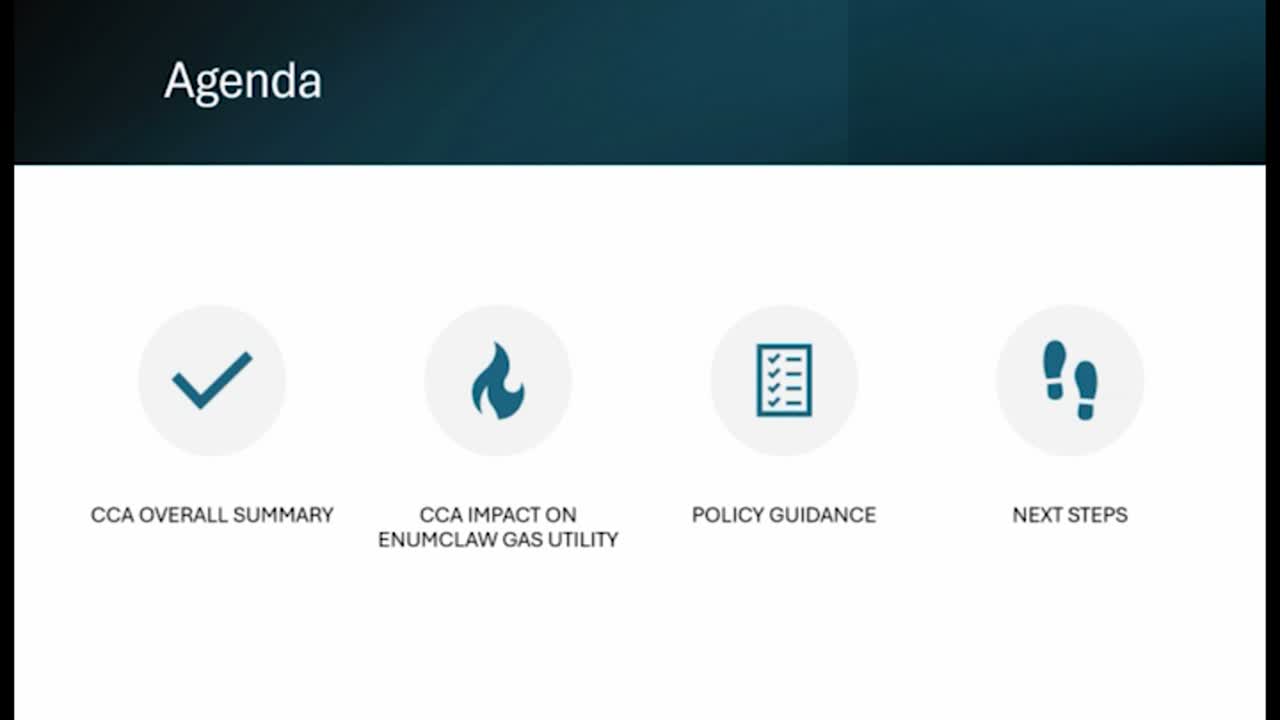
Uniontown — City Administrator Chris Searcy briefed the City Council on March 9 about the state Climate Commitment Act (CCA), what it means for the city’s municipal natural-gas utility and possible policy steps the city may take.
"The CCA was enacted by the legislature back in 2021," Searcy said, explaining the program is a cap-and-invest approach that requires covered entities to obtain annual carbon allowances equal to their greenhouse-gas emissions. He told council the city’s average emissions from 2023 through 2025 were a little over 25,000 metric tons — just above the program’s threshold.
Searcy described how the Department of Ecology provides a portion of allowances at no cost that step down annually, how some allowances are consigned to auctions and how the city must purchase additional allowances at auction to cover any shortfall. "We started out at about 6¢" per CCF for legacy customers, he said, while new (non-legacy) customers initially faced a larger per-unit CCA charge; staff estimates and early examples have shown a larger bill impact for new connections.
Searcy warned of uncertainty ahead: linkage with California’s market, litigation over Initiative 2066 and incomplete state greenhouse-gas reporting mean future allowance prices and demand are hard to forecast. He said one practical target would be to get below 22,500 metric tons to create a 10% buffer under the threshold, but noted Ecology has discretion to re‑include entities within 10% of the threshold.
On policy responses, Searcy offered options for council consideration: pursue full cost recovery for new development to discourage new gas connections; explore a restricted local account or an alternative compliance path with peers (Ellensburg was cited as a nearby municipal utility pursuing alternatives); and consider seeking grant funds for decarbonization planning. He stressed there were no decisions requested that night but asked council to consider policy direction and return to the matter in May.
Councilmembers asked for clearer projections; Searcy agreed to provide detailed figures. He noted the city’s CCA-related costs began around $250,000 in 2023, rose in subsequent years and could exceed $1,000,000 annually in some scenarios depending on allowance prices and linkage.
The workshop concluded with council requesting staff follow up with more precise financial projections and options for legislative or regional coordination.