Lifetime Citizen Portal Access — AI Briefings, Alerts & Unlimited Follows
House Tax Committee hears dozens of local-option sales tax requests from Minnesota cities
Loading...
Summary
The House Tax Committee spent an extended session hearing requests from cities and counties to place or extend local-option sales taxes for projects ranging from parks and libraries to fire stations and wastewater work; members repeatedly questioned statutory limits and laid bills over for possible inclusion in the omnibus tax bill.
The Minnesota House Tax Committee heard a slate of local-option sales-tax proposals on a packed agenda, with municipal officials and elected leaders urging lawmakers to let voters decide whether to fund regional capital projects.
Chair Davids opened the afternoon session, confirmed a quorum and approved the April 21 minutes before the committee heard introductions from a group of high‑school pages in attendance. The committee then moved through more than a dozen local-option proposals from cities and counties, most of which were renewed by motion to be laid over for possible inclusion in the omnibus tax bill.
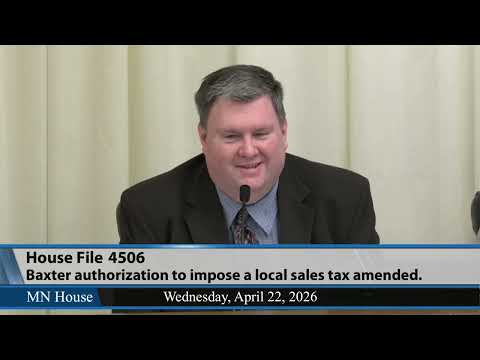
City officials framed the requests as tools to fund large capital needs without placing the full burden on local property taxpayers. For example, Bradley Chapluis, city administrator for Baxter, asked legislators to authorize an extension that would support about $77 million in capital work including $51 million for water and wastewater improvements, $16 million for regional transportation safety projects and $10 million for a public safety facility. Ian Rigg, city manager for Albert Lea, told the committee his city uses sales tax to fund water-quality projects and argued the approach spreads costs among nonresident users as well as local taxpayers.
Several members pushed back on the scope of permitted uses under Minnesota statute, noting the 2021 changes that narrowed allowed capital projects to freestanding buildings, trails and similar uses. Chair Gomez and other members raised repeated concerns that items such as interior equipment purchases, routine street work, wastewater renovations and water‑system improvements may not fit the statutory definition. For multiple requests committee members asked whether collections would require a new referendum or whether the proposed timing complied with the one‑year gap statute intended to prevent perpetual sales taxes.
A number of communities emphasized regional benefits: Alexandria sought up to $30 million for expansion of the Prime West Health/Runestone Community Center, Douglas County requested $18.5 million for a new regional library, and Plymouth proposed a package of projects intended to serve the West Metro and attract sports tourism. Several requests focused on public-safety facilities — Elk River asked to add a fire‑station replacement to an existing authorization, and Audubon sought a smaller tax to shore up a volunteer fire hall.
The committee also heard sustained debate over a high‑profile dispute in Rochester (see separate story). Representative members called for careful oversight when planned projects change after a voter-approved authorization. Several representatives expressed concern about transparency and whether cities had fulfilled promises made to voters.
Most bills were not voted on for final passage; committee members typically renewed motions to lay each house file over for possible inclusion in the omnibus tax bill, a routine next step that preserves legislative consideration during the tax‑bill drafting process. The committee adjourned after completing the afternoon’s lengthy list of presentations.
What’s next: Most local-option sales tax requests heard by the committee were laid over for possible inclusion in the omnibus tax bill. Petitioning cities will generally return to voters if the committee requires a new referendum or if the local legislative language changes the scope of the authorization.