Get Full Government Meeting Transcripts, Videos, & Alerts Forever!
Get email alerts on the Pack Fire Debris Removal topic
No spam. Unsubscribe anytime.
Mono County weighs county‑run cleanup, hybrid approach as Pack Fire phase 2 funding remains uncertain
Summary
County staff told supervisors Phase 2 debris removal could cost $1.3M–$2.6M, that state (CDAA) reimbursement is still pending, and recommended options ranging from owner‑managed cleanup to a county‑run program; supervisors directed staff to develop a hybrid plan, right‑of‑entry process and homeowner outreach.
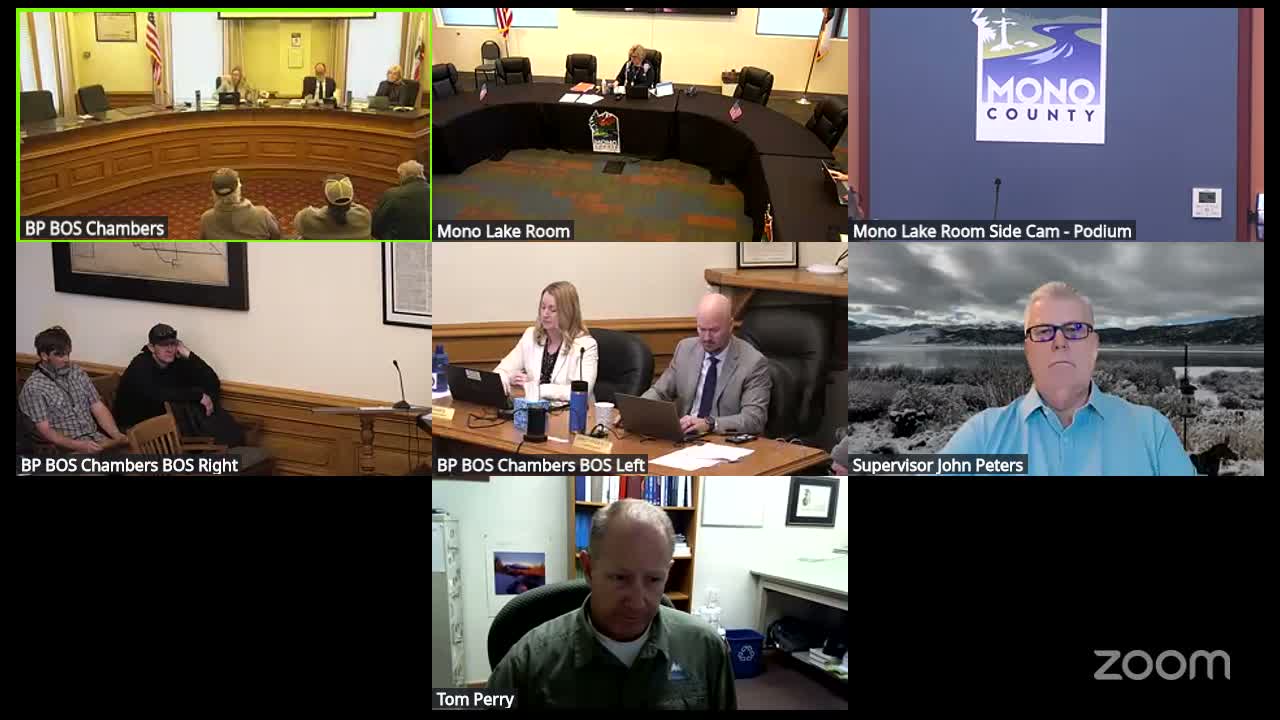
Assistant County Administrative Officer Christine Bouchard presented the Board of Supervisors on Feb. 3 with options and risks for Phase 2 debris removal following the Nov. 13 Pack Fire, saying the work to make properties safe for rebuilding includes soils testing, licensed hazardous‑material removal and regulated disposal.
"Phase 2 debris removal is a process of removing all remaining fire‑related debris from the burn area after hazardous materials have been removed," Bouchard said. She told the board that the state ran Phase 1 hazardous‑materials work but crews could not finish higher‑elevation parcels because of snow and access, and that the county faces the most expensive tasks — hauling and disposing of contaminated soil — if state funding does not cover Phase 2.
Bouchard gave a working cost range of $1.3 million to $2.6 million for the cleanup and said the county’s unrestricted reserves are approximately $2.7 million, with $1.3 million in a restricted disaster assistance fund. She said the county had asked Cal OES about CDAA (California Disaster Assistance Act) reimbursement but had not received a final determination. "Without the CDAA approval, that means there's no reimbursement from the state for a Phase 2 cleanup," she said.
County Counsel Chris Beck told supervisors the county must weigh whether spending public money on private property cleanup serves a public purpose under Article XVI, Section 6 of the California Constitution. Beck said courts give legislative bodies broad discretion if an expenditure primarily advances a public purpose — for example, protecting public health, safety or watersheds.
Public Works Director Paul Rotana described a soils testing plan using local geotechnical consultants to establish baseline conditions and cautioned that removal cannot proceed while soils are too wet: "With the snow amount and the dampness of the ground right now, it cannot be removed and hauled the way it is at this moment," he said. Rotana and Bouchard also noted that Mono County does not have a permitted hazardous‑waste disposal site; crews would likely have to travel to Lancaster for disposal, adding substantial trucking costs.
Dozens of residents and property owners from McGee Creek and the surrounding area urged the supervisors to act quickly. Thomas, who manages the damaged RV park, asked the county to "commit county funding for cleanup" to expedite recovery and protect the local economy. Others detailed the emotional and financial toll of displacement and asked for a transparent path back to rebuilding.
Supervisors discussed several policy options: leave cleanup to property owners (owner‑managed), establish a county‑run program that would accept insurance assignments and cover gaps, or pursue a hybrid model in which homeowners who can proceed do so and the county manages cleanup for households that lack sufficient insurance. Several supervisors expressed support for a hybrid approach as a way to balance equity, speed and fiscal risk.
Supervisor John Peters urged immediate operational steps: a formal right‑of‑entry process, property‑by‑property needs assessments and a cost estimate spreadsheet to guide budgeting and contractor selection. Bouchard said DRC (a disaster‑recovery contractor) will perform a site assessment on Feb. 11 to refine cost estimates and logistics.
The board directed staff to: develop a hybrid program framework; create a right‑of‑entry and permitting process for owners who want to proceed; compile lists of licensed hazardous‑material haulers and local contractors; and schedule homeowner outreach (staff booked a Crowley Community Center meeting for Thursday evening to begin individualized assessments). Bouchard said staff will continue to seek CDAA or other state reimbursement while preparing county options.
The board did not make a final funding commitment at the Feb. 3 meeting. Staff emphasized the timing of any county‑run deployment will be weather‑dependent and that starting work during wet conditions could increase costs.
What happens next: DRC site assessments the week of Feb. 11; staff to prepare the right‑of‑entry process, contractor lists, property tracking and an outreach session at Crowley Community Center to begin one‑on‑one assistance and needs assessments.
Quote: "A county run program may speed the recovery and improve equity across the properties," Bouchard said, "but the county would assume financial and operational risks and there's no guarantee of reimbursement from the CDAA."