Get Full Government Meeting Transcripts, Videos, & Alerts Forever!
Get email alerts on the Zoning topic
No spam. Unsubscribe anytime.
San Anselmo council passes first reading to limit restaurant live entertainment to 10 p.m.; CUP required for later hours
Summary
The Town Council approved on first reading a zoning amendment that allows restaurants to offer live entertainment without a conditional use permit only until 10:00 p.m. in C2/C3 zones and requires a conditional use permit (CUP) to continue entertainment later; council endorsed revised wording to cover restaurant-hosted activities and will review impacts after implementation.
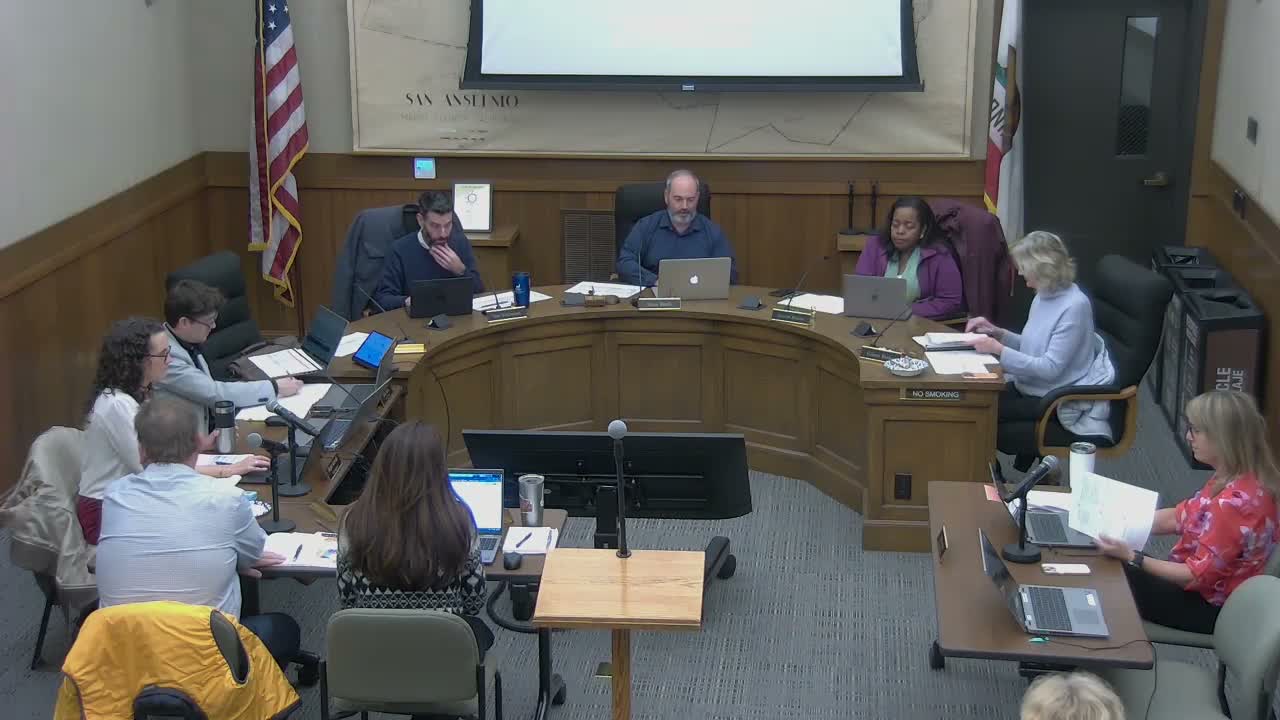
San Anselmo’s Town Council voted on Jan. 27 to pass the first reading and waive the second reading of a zoning ordinance amendment that would allow restaurants in the town’s C2 and C3 commercial zones to provide live entertainment or restaurant-hosted activities by right until 10:00 p.m., and require a conditional use permit (CUP) for entertainment or activities after that time.
Staff planner Heidi told the council the amendment is intended to balance neighborhood compatibility with economic vitality: “This would allow streamlined permitting for restaurants to have live entertainment until 10 p.m., and then, if they want to go beyond that, the CUP process would evaluate impacts on a case-by-case basis and include mitigation where necessary,” she said.
The ordinance would align the land‑use rules with the town’s noise code, which staff said uses a 55‑decibel threshold for daytime/evening enforcement; the change is slated as CEQA‑exempt because it does not increase development intensity. The Planning Commission forwarded the amendment on a 3–2 vote after noticing commercial properties in the affected zones and publishing a courtesy notice in the local paper.
Residents who live near the downtown commercial district urged tighter limits. “We moved to San Anselmo 20 years ago and we like the quiet, small‑town charm,” said Bill Murray of Lincoln Park, urging the council not to permit seven nights of amplified music or frequent late‑night events. Several Lincoln Park neighbors told the council the primary concern is spill‑out noise and late‑night congregations that push vehicles and activity into adjacent residential streets.
Owners of local restaurants said they want to comply and avoid disturbances. Serafim Miranda, who identified himself as the operator of Marinitas, said his restaurant has installed soundproofing and that police noise checks have not shown exceedances: “We comply with permit conditions and keep noise below 50 decibels,” he said.
Councilmembers debated two main compromises: (1) whether to narrow CUP eligibility to certain nights (Councilmember Burke proposed Friday and Saturday) and (2) whether the ordinance should broaden the phrase 'live entertainment' to explicitly cover other restaurant-hosted activities that can create neighborhood disturbance. Several members supported replacing or augmenting the term with language allowing “activity or entertainment that is secondary and subordinate to the restaurant use,” and staff proposed a final phrase that would read, in part, “such activities or entertainment are allowed until 10 p.m., and after 10 p.m. only with a conditional use permit.”
Councilmember Shantel urged a short check‑in after adoption to evaluate impacts: “I’d like a pretty short turnaround — six months — to see how this is going,” she said, citing the need to track whether the CUP process produces consistent outcomes for similarly situated businesses and neighborhoods.
On formal action, the council voted to read the ordinance by title only and then passed the first reading and waived a second reading; the council announced the motion carried unanimously. The ordinance will return to the council for a subsequent meeting for final action as required by the town’s process.
What happens next: staff will update the ordinance language to reflect the council’s edits (adding activity‑language examples and the check‑in provision), prepare final ordinance text for the next meeting, and continue coordinating the town’s outreach and enforcement protocols tied to noise and CUP review.