Get Full Government Meeting Transcripts, Videos, & Alerts Forever!
Get email alerts on the Ethics Ordinance Review topic
No spam. Unsubscribe anytime.
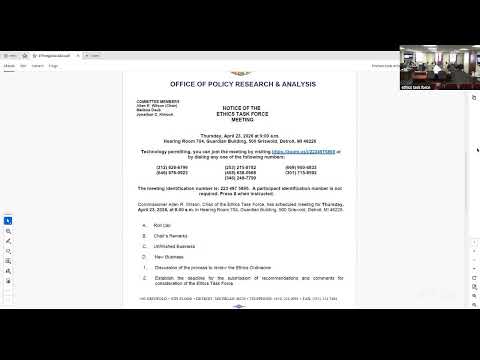
Wayne County ethics task force launches ordinance review, sets meeting schedule and two 30-day public comment windows
Summary
The newly formed Wayne County Ethics Task Force began a section-by-section review of the county ethics ordinance, with Chair Wilson outlining enforcement and disclosure gaps; commissioners voted to meet after full-board sessions and opened two 30-day public comment periods (front-end and post-draft).
Wayne County’s newly convened Ethics Task Force opened its inaugural meeting with Chair Wilson outlining what she called “structural weaknesses” in the county’s existing ethics ordinance and a plan for a section-by-section review intended to strengthen enforcement, disclosure and whistleblower protections.
In remarks that lasted more than an hour, Chair Wilson said the current ordinance—unchanged for more than 13 years—has “minimalistic” penalties, pointing to the largest civil fine of $500 as inadequate for deterring serious misconduct. She flagged several specific concerns: the ethics board’s appointments by elected officials, a lack of independent subpoena or investigative authority, a complaint process that requires signatory identification and notarization (preventing anonymous filings), vague conflict-of-interest language, gift-rule loopholes that exclude campaign contributions from gratuity rules, short post-employment restrictions, and the absence of proactive audit or disclosure triggers.
“The ordinance looks strong on paper,” Wilson said, “but it is structurally weak in its enforcement, its independence and real deterrence.” She argued the task force should consider stricter penalties, clearer disclosure triggers tied to decision points such as contract awards and hiring, stronger whistleblower protections, and options for third‑party or more independent selection of ethics board members to reduce political influence.
County Counsel told the task force that staff had grouped the ordinance’s topics to allow prepared legal research and comparative examples from other jurisdictions; counsel also recommended the task force hear the ethics board’s proposed revisions before conducting line-by-line changes to the ordinance.
Commissioners then debated meeting cadence and public participation. After discussion about calendar conflicts, Commissioner Kenlock moved that the task force meet at 1 p.m. after full-board meetings (a biweekly cadence tied to the board schedule). The motion was supported and accepted by voice vote.
Kenlock also proposed, and the task force adopted, two public comment windows: a 30-day front-end submission period beginning immediately for suggestions from the public, county employees and elected officials, and a separate 30-day public comment period to begin after staff publish an initial draft of recommendations. County staff were directed to post notice and consider a press release to publicize the comment windows.
Keitra Lewis, chair of the county Ethics Board, joined by Zoom and thanked the task force, noting her subcommittee had prepared observations. Lewis said she was not available for the April 30 meeting and asked the task force to accommodate the ethics board’s availability for meetings where their input would be needed.
The task force adjourned after the scheduling and comment-period motions were approved. The group’s next meetings will follow the schedule determined during the session; staff will post details and instructions for submitting comments.