Get Full Government Meeting Transcripts, Videos, & Alerts Forever!
Get email alerts on the Invasive Species topic
No spam. Unsubscribe anytime.
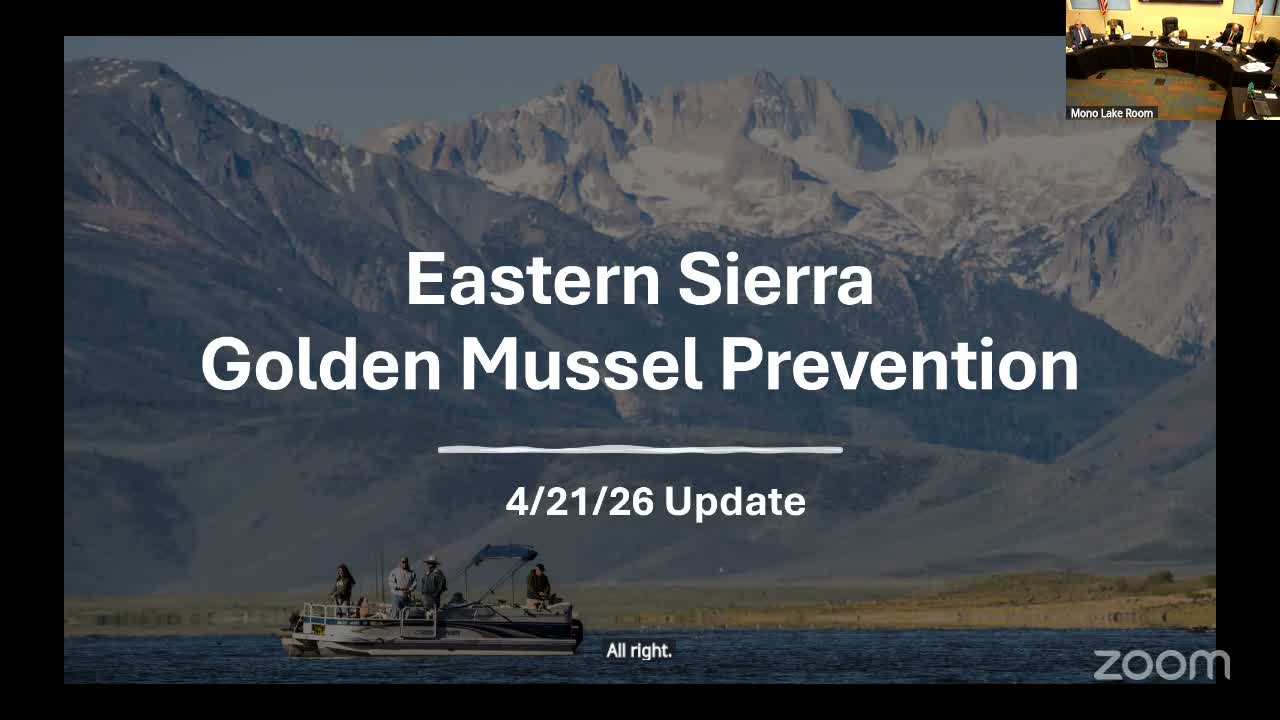
Mono County funds inspection effort as agencies rush to stop spread of invasive golden mussels
Summary
Mono County approved a $7,500 Fish and Game Fine Fund contribution and joined regional partners in launching mandatory watercraft inspection and decontamination stations (WIDs) to prevent the spread of invasive golden mussels; county staff say full program costs are about $82,000 and staffing shortfalls remain.
Mono County supervisors voted to allocate $7,500 from the Fish and Game Fine Fund to support staffing at local watercraft inspection and decontamination (WID) stations as part of a multi‑agency effort to prevent the arrival of invasive golden mussels.
"They can attach to almost anything," said Liz, the county outreach lead on the response, describing how mussels can travel on boats, gear and even muddy equipment. Staff and partner agencies described the species as highly resilient, able to reproduce multiple times per year and capable of surviving in small amounts of water or on wet equipment.
County staff outlined a prevention strategy built on mandatory inspection, decontamination (high‑pressure, hot‑water boat washing), and a sticker/attestation system. Residents must be inspected at least once per year; visitors must be inspected monthly. Decontamination is required if visible mussels are found, and CDFW (California Department of Fish and Wildlife) would take the lead if quarantine is necessary.
"Prevention is our only option," Marcella Rose, Sustainable Recreation Superintendent for Mono County, said during the presentation. She told the board the county and its partners are trying to make inspection as convenient as possible while protecting waterways and infrastructure.
County staff estimated that running two staffed WID stations through the boating season would cost roughly $82,000. Partners and funding sources include LADWP (a major staff and equipment contributor), the Inyo National Forest (pending grant), town contributions, Mammoth Lakes Recreation grants for low‑power self‑serve decon units, Sierra Forever/El Trot and other nonprofit support. With currently committed funds, staff said the program was about $21,000 short of the estimated need to run two staffed stations through October; county staff described contingency plans including appointment inspections, roving inspectors, and promoting Bishop as a staffed hub.
The board voted in favor of a separate, related Fish and Game Fine Fund application from Sierra Forever for $7,500, which the county paired with its $7,500 to reach the $15,000 staffing contribution outlined in the presentation.
County staff also described site selection constraints (drainage, water supply, land‑use agreements) and special handling needs for large wake‑boat types that require more intensive decontamination equipment. Bishop and the Bridgeport county ball fields off Aurora Canyon Road are planned as the two primary staffed stations; Crowley Lake is limited to certain vessel types. Existing inspection stations at Klondike and Diaz can issue stickers under defined circumstances.
Board members praised the rapid coordination and asked staff to continue state and federal advocacy for sustainable funding. Supervisor Peters urged continuing outreach and follow‑up after opener to reassess staffing and compliance.
The board approved the Fish and Game allocation request and expressed support for continuing multi‑agency coordination; staff said they would return with updates on compliance, staffing and funding progress after the opening fishing weekend.