Get Full Government Meeting Transcripts, Videos, & Alerts Forever!
Get email alerts on the Strategic Plan topic
No spam. Unsubscribe anytime.
Stafford County schools report steady progress on most strategic-plan tactics; resource gaps flagged for instruction
Summary
Division leaders told the school board the five-year strategic plan is on track in most areas but identified objective 3.4 — providing adequate resources for high-quality instruction — as the only objective without year-over-year growth, citing missing needs-assessment processes and funding limits.
Division officials presented a year-three progress update on the Stafford County Public Schools strategic plan, saying the governance structure has been strengthened and most tactics are moving forward.
"All in all, we have maintained progress and increased progress across the goal areas," said Abby Wicker, director of research, evaluation and strategic improvement, as she summarized year-three ratings for 164 tactics. Wicker described a four-step scale for tactics (0=planning through 3=complete/ongoing) and explained how tactic-level scores are rolled up to provide goal-level snapshots.
Staff and goal chairs focused the presentation on Goals 3 and 4, which address conditions that support safe, welcoming learning environments and investment in staff. Dr. Sharon Shubridge reported that, under Goal 3, eight of eight tactics in Objective 1 (safety and social-emotional supports) are on track; other objectives showed mixed progress. For Objective 3.4 — "Provide adequate resources to facilitate high-quality instruction" — presenters said the team recorded no growth over the last year.
"3.4 is the one that we did not have growth in," a trustee asked, and staff said that gap largely reflected process issues (the absence of a formal needs assessment) and, in some cases, funding constraints rather than a claim that school buildings lack necessary resources. "We believe we have the resources, but we don't yet have a formal needs-assessment process," the goal chair said, noting the steering committee is building a needs-assessment tool that will support more equitable allocations.
Board members pressed for clarity about how "adequate" is defined and whether staffing standards could be implemented without additional positions. Staff warned that many tactics are contingent on funding and that several measures remain complex to track across elementary, middle and high levels. Trustees asked for more granular documentation to accompany tactic ratings and suggested adding a column that flags long-term stagnant items and their impediments (for example, funding vs. measurement issues).
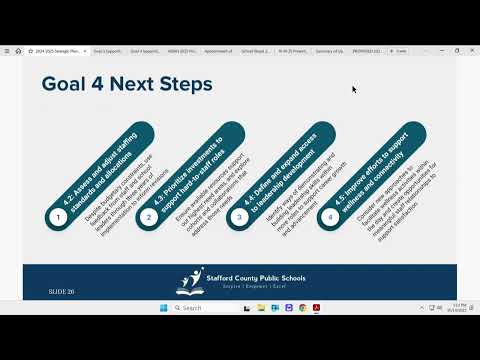
On Goal 4 (support and invest in staff), presenters reported progress in four of five objectives, including completion of a compensation and classification study, expansion of professional-learning infrastructure and apprenticeship partnerships. Division leaders noted the roll-up represents a midterm snapshot (three of five years complete) and said they expect additional movement before plan completion.
The presenters said steering committees and goal chairs will return with refined measures, clearer definitions of key terms such as "adequate resources," and tactical reports that can be used in budget prioritization. No formal board action was taken; staff said they will bring more detailed documentation and follow-up to future work sessions and the next regular meeting.