Get Full Government Meeting Transcripts, Videos, & Alerts Forever!
Get email alerts on the Rezoning 501 W 8th topic
No spam. Unsubscribe anytime.
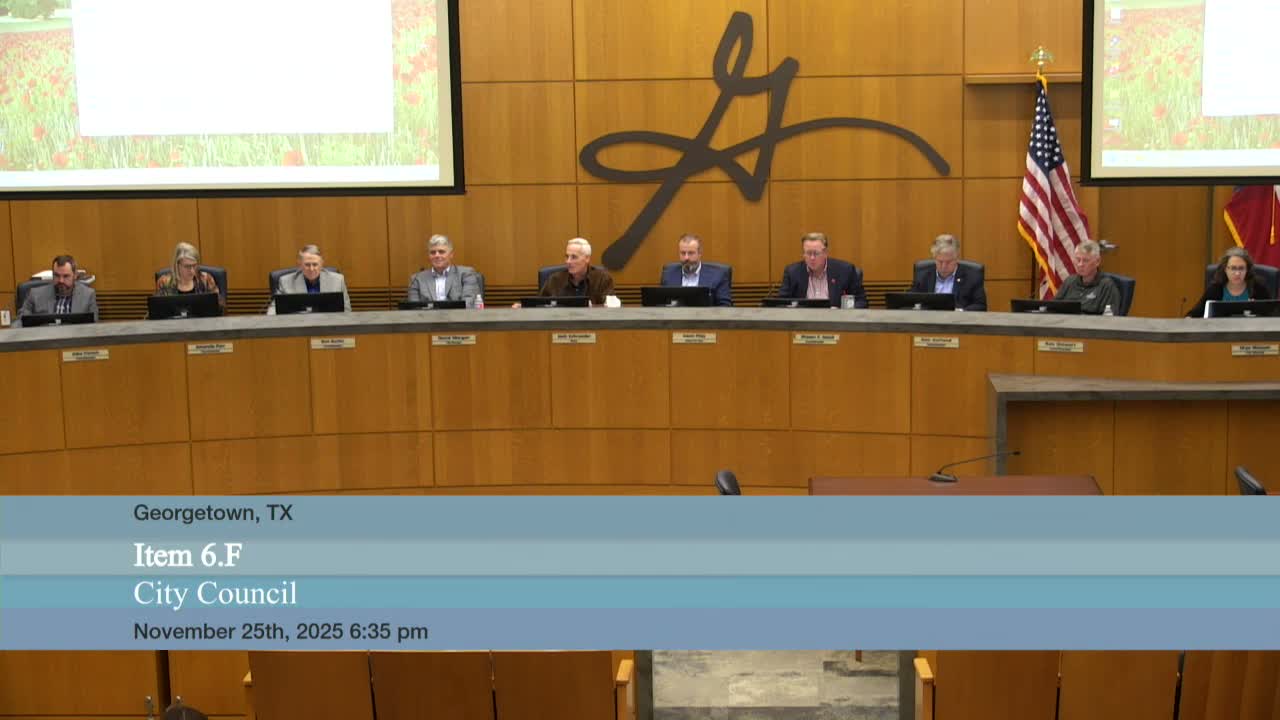
Georgetown council approves downzoning for 501 West 8th Street after heated public hearing
Summary
After a lengthy public hearing with strong neighborhood opposition, the City Council approved rezoning 501 W. 8th St. from C3 to the less intensive C1, a move council members said reduces future development intensity though residents warned of displacement and drainage and parking impacts.
Edgar Garcia, Georgetown’s director of planning, presented a request to rezone Lot 4 Block M at 501 West 8th Street from general commercial (C3) to local commercial (C1), telling council staff found the request consistent with the comprehensive plan and Unified Development Code and noted the change would limit permitted uses and reduce floor‑area ratio limits.
The council opened a public hearing that drew multiple residents and TRG Neighborhood Association members. Judy Hume, the property owner at 505 West 8th Street, said she feared retail or two‑ to three‑story development would encroach on the neighborhood’s residential character and privacy. Paulette Taylor urged preservation of the TRG plan and long ties to the neighborhood. Shonti Sethridge, speaking for St. Paul, and other speakers cited the lot’s small size (about 0.18 acre), drainage and environmental concerns, and potential safety and parking impacts. Carlos Basias and other neighbors urged keeping the site residential.
The applicant’s representative, Gary, said the owners plan a modest, owner‑occupied building compatible with the neighborhood and noted they had designed smaller options after discussion with city staff. He acknowledged that, as of right under the current zoning, taller buildings could be built, and said the intent of the application—and of staff guidance—was to limit future intensity.
Council members debated alternatives. Several said they preferred residential but emphasized they could not act on that because the current application requested C1. Supporters of the rezoning argued a move from C3 to C1 reduces the number of allowed commercial uses, caps floor‑area ratio and height to more neighborhood‑friendly standards, and limits risks from more intense future owners. Opponents warned that either zoning could lead to a large house or other development that would change the block.
After discussion, a councilmember moved to approve the rezoning to C1; the council voted in favor and the ordinance passed (supermajority threshold applied due to a formal protest). The council and applicant agreed to encourage follow‑up meetings between the owners and neighborhood leadership to try to reconcile design and operational concerns.
The ordinance will take effect per the caption and applicable noticing rules; the council record shows a protest filing triggered a supermajority requirement for approval.