Get Full Government Meeting Transcripts, Videos, & Alerts Forever!
Get email alerts on the Austin Avenue Bridges topic
No spam. Unsubscribe anytime.
Council presses for a lower‑cost pedestrian bridge after 90% design cost spike; staff and Friese Nichols offer alternatives
Summary
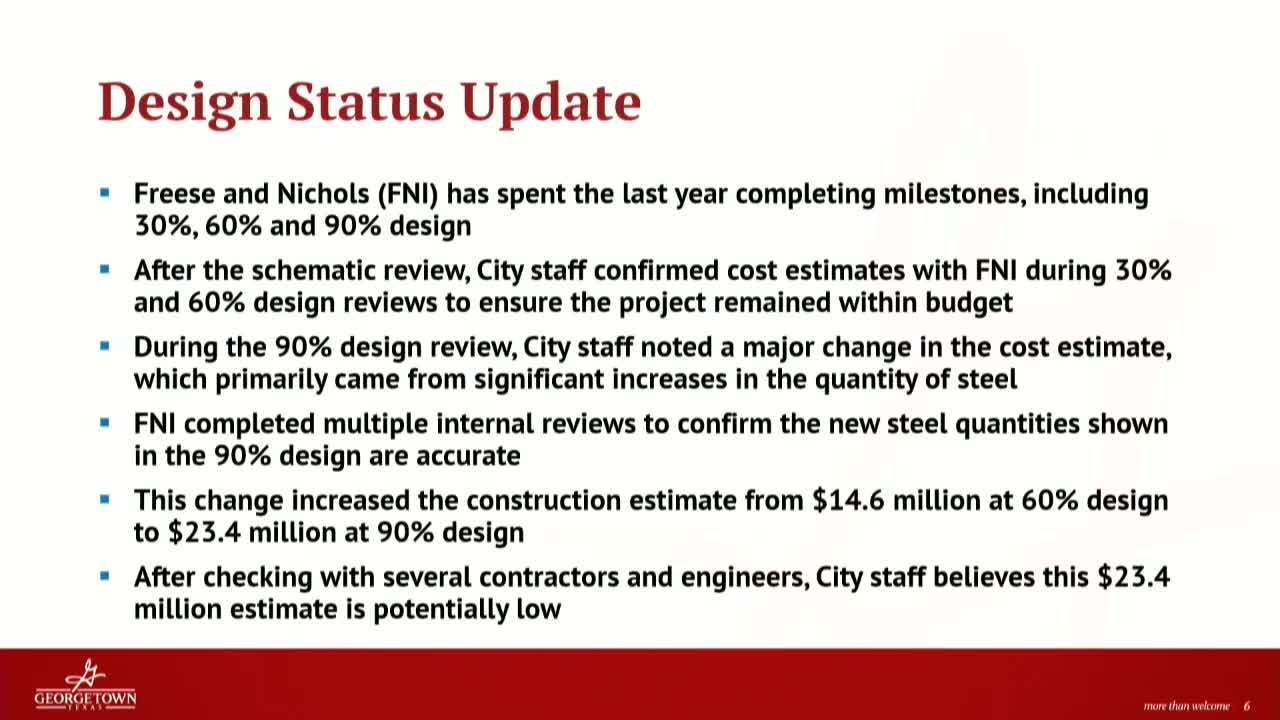
Friese Nichols reported a 90% design quantity error that raised construction estimates from about $14.6M to $23.4M. Staff presented three bridge options and two alternatives; council expressed a clear preference for Option 1B (prestressed concrete girder) and asked staff to return with costs for overlooks and lighting and a plan for temporary pedestrian access during vehicular bridge work.
City staff and design consultant Friese Nichols told the Georgetown City Council that a quantity error discovered at the 90% design stage substantially increased the estimated construction costs for the planned Austin Avenue pedestrian bridges.
Assistant City Manager Nick Woolery said the project's construction estimate rose from an earlier $14.6 million (60% design) to about $23.4 million at 90% design, driven largely by an increased quantity of steel rather than unit‑price escalation. Friese Nichols's Brian Coltharp addressed the council, apologized for the mistake, said the firm has revised its project team, offered value engineering options and a partial refund of design fees.
Friese Nichols presented three bridge options: a steel girder bridge (option 1A, roughly $20.2M), a prestressed concrete girder bridge (option 1B, roughly $14.7M), and a prefabricated steel arch bridge (option 1C, roughly $14.3M). Staff also identified two alternatives that avoid a separate pedestrian bridge: extending the Austin Avenue road diet across the bridges (estimated additional cost about $2.5M for barriers and trail connections but with long‑term traffic impacts) or narrowing lanes to 10 feet and retaining four lanes with a 6‑foot pedestrian path (minimal traffic impact but not ideal for shared use).
Council members questioned schedule, maintenance cycles, railing aesthetics and the feasibility and cost of overlooks and lighting. Several councilors said the current vehicular bridge sidewalks (about 3 feet wide) are unsafe for pedestrians and bicyclists; multiple members favored constructing a separate pedestrian bridge to preserve vehicle lanes and long‑term safety.
After discussion, a clear majority of council members expressed support for option 1B (the prestressed concrete girder bridge) citing lower long‑term maintenance and the ability to place an overlook over the river. Staff said the city's remaining construction funds and contingencies could cover a $14.7M option with some flexibility for selected lighting and railing enhancements; they committed to return with verified costs for overlooks, railing alternatives and illumination packages and to provide traffic modeling comparing bridge‑plus‑roundabout scenarios with the previously modeled road‑diet projection.
Staff also outlined temporary pedestrian solutions during the vehicular bridge rehabilitation, such as narrowing lanes with temporary barriers (Jersey barriers) to create a 6‑foot safe path until a pedestrian bridge is built. No formal procurement or contract award occurred at the workshop; council direction was to pursue option 1B and for staff to return with refined costings and implementation details.