Get Full Government Meeting Transcripts, Videos, & Alerts Forever!
Get email alerts on the Budget topic
No spam. Unsubscribe anytime.
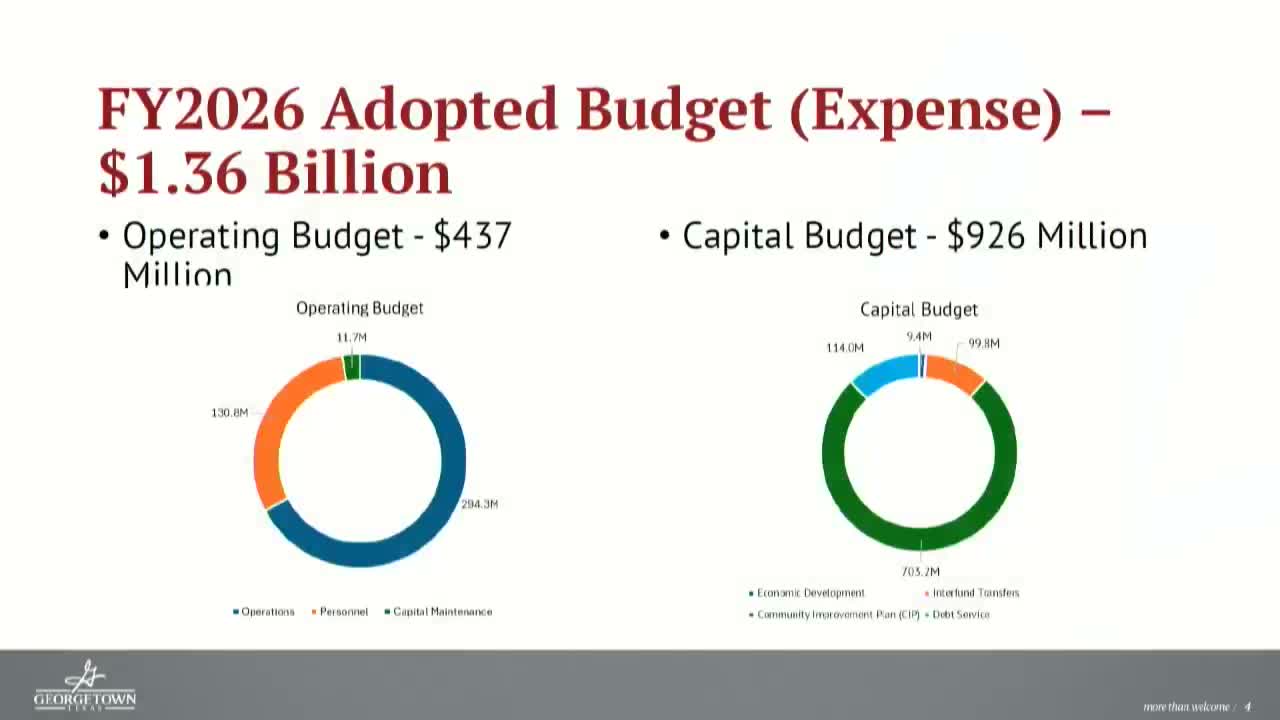
Georgetown officials say $1B budget is driven by utility capital; water acquisitions, rate changes expected
Summary
City leaders told District 6 residents the large 2026 budget largely reflects utility capital projects — including major water and wastewater plants — and said the city needs long‑term water acquisitions (about 41,000 acre‑feet) even after possible CCN reductions.
City Council member Jake, speaking at a District 6 town hall, said Georgetown’s headline budget totals reflect large enterprise‑fund capital projects for water and electric services rather than general fund operations and that the city is preparing rate and planning changes to match those costs. “A huge amount of that is utilities,” he said, noting the operating general fund is about $122 million while utility capital pushes the overall budget well above $1 billion.
Jake said the budget includes sizable investments in water and wastewater infrastructure. He initially cited two treatment plants “about $250 million apiece,” later correcting figures: “that total water capital improvements is $215,000,000, and then wastewater is almost $300,000,000.” The councilmember said those projects and rising operating costs are a primary driver of recent utility rate increases.
On staffing, Jake said the largest personnel additions in the current budget were eight police officers and 13 firefighters, and that public safety represents the largest share of general‑fund spending (about 54 percent). He said the proposed property‑tax rate for 2026 is 35.3¢ and emphasized the role of sales and commercial tax bases in keeping residential rates lower.
Water supply was a central focus. Jake said Georgetown maintains a 400‑square‑mile service area and that about 40 percent of its water customers live outside city limits. The city is considering selling portions of its certificate of convenience and necessity (CCN) to shrink its service footprint; even with such reductions, he said, “we are gonna need 41,000 acre feet through 2070.” With the entire CCN retained the need would be far larger.
City staff described options under study, including groundwater from the Carrizo‑Wilcox aquifer and technologies for reuse. Staffer David said two planned wastewater plants are being designed for direct potable reuse, which could help supply the system, and that the city is also exploring taking treated effluent to the San Gabriel River and claiming state credit for downstream storage.
Jake and staff stressed conservation and staged infrastructure planning as immediate levers while pursuing long‑term supplies. Jake told residents, “The cheap water is the water that you're drinking right now,” urging conservation and noting the per‑lot capital cost for water infrastructure can be substantial. The council did not take formal action at the meeting; staff said acquisition negotiations and capital project timelines remain active and will return to council as proposals and funding are finalized.