Get Full Government Meeting Transcripts, Videos, & Alerts Forever!
Get email alerts on the Rezoning topic
No spam. Unsubscribe anytime.
Chelsea council holds first reading on rezoning of 114.5-acre Highway 11 parcel; public hearing draws traffic and school-capacity concerns
Summary
At a public hearing on Ordinance 10-45, residents urged the council to pause rezoning of about 114.5 acres on Highway 11 until traffic, school capacity and environmental impacts are addressed; the developer presented a reduced-density plan and council took no vote at the first reading.
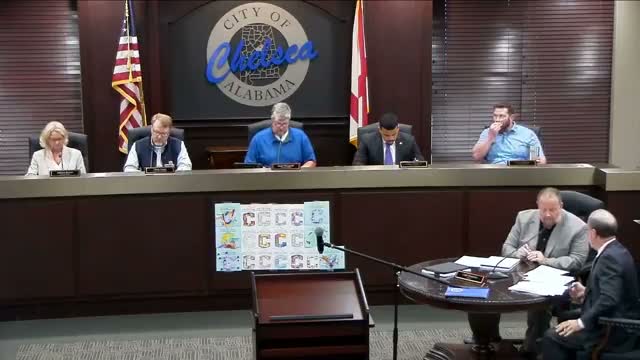
Chelsea — The Chelsea City Council on April 21 opened a public hearing and held the first reading of Ordinance 10-45, a request to rezone roughly 114.5 acres along Highway 11 from Agriculture-Residential (AR) to R2 Residential. The council did not vote; a final decision is scheduled for the next regular meeting in May.
Developer Jerry Howard of Harris (transcribed variously in the record as “Harris Dull Homes” and later as “Harris Doyle”) presented a revised plan calling for 158 lots, roughly 43 acres of green space and a minimum lot size of about 15,000 square feet. Howard said the project reduces density from a prior PUD proposal by 82 lots and estimated average sale prices “in the upper $400s” to about $550,000. He told the council the subdivision will connect to the existing Southwest water and sewer system and will include left- and right-turn lanes required by Shelby County.
Residents who signed in for the hearing pressed the council on traffic, school capacity and environmental impacts. “Highway 11 is already beyond capacity,” said Valerie Atchison of 9103 Highway 11. Atchison asked whether the road, schools and emergency services can safely absorb additional development, and urged the council to “pause all additional approvals along 11 until infrastructure can catch up.”
Several other speakers echoed those concerns. Louis Etchison Jr. warned that layered growth — including previously approved but unbuilt lots in Chelsea and developments in Pelham — will add thousands of daily trips to a two‑lane road and said the proposed development would remove “over 100 acres of undeveloped land that currently manages water, supports wildlife, and acts as a natural buffer.” John Friedman, an educator who said Chelsea High School already uses portables and lacks cafeteria space, said the schools are at or over capacity.
Not all speakers opposed the plan. Gary Jones of Chelsea Park said he supports the developer and called traffic problems a matter of driving behavior rather than volume. Eric Fry and other residents praised the builder’s track record and said the revised, lower-density plan addresses some earlier concerns.
Developer representatives and their engineer answered questions about buffers, tree preservation and trails. The team said the plan includes a 30‑foot undisturbed buffer along Sports Island Parkway and Grand Slam Road, that many lots along Highway 11 can retain existing large trees where grading permits, and that about 43 acres will remain undeveloped as green space. The engineer said revised traffic modeling submitted to Shelby County showed the highway would maintain its current level of service and that turn lanes at the entrance should prevent long backups onto the through lanes. The developers characterized the trails and connectivity as conceptual and said homeowners’ association maintenance would be expected for neighborhood trails.
Council President closed the hearing after the public comments and reminded the room that the ordinance had only received a first reading and would not be voted on until the next meeting in May.
Next steps: ordinance 10‑45 will return to the council for a vote at the next regular meeting, when council members said they will consider the Planning Commission record, submitted engineering and traffic studies, and any additional conditions suggested by staff or council.