Get Full Government Meeting Transcripts, Videos, & Alerts Forever!
Get email alerts on the Zoning topic
No spam. Unsubscribe anytime.
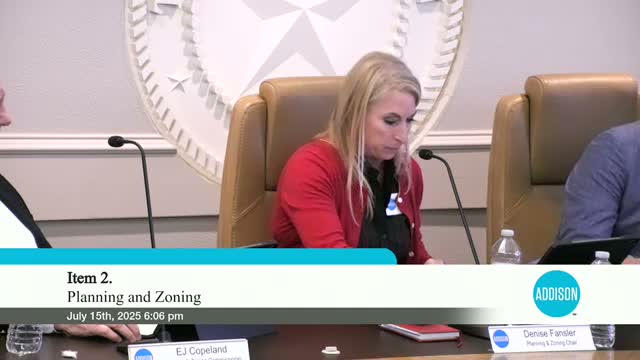
Addison Planning & Zoning approves new zoning map after rejecting dedicated park-zone proposal
Summary
The Planning and Zoning Commission approved a rezoning map implementing Addison's Unified Development Code, set to take effect Sept. 1, after commissioners voted down a proposal to create dedicated park zoning and heard residents voice concerns about accessory dwelling units and small multiplexes near single-family neighborhoods.
The Addison Planning and Zoning Commission on July 15 approved a rezoning map that applies new districts created under the town's Unified Development Code (UDC), which the City Council adopted on March 25, 2025 and which takes effect Sept. 1. The decision came after commissioners defeated a motion to add dedicated park zoning categories and after residents raised concerns about accessory dwelling units (ADUs) and "smallplexes" near single-family areas.
Leslie Knight, director of development and neighborhood services, told the commission the UDC process began in October 2018 and was re-noticed for this hearing after a procedural vote-count confusion at the June meeting. "This project kicked off in 2018," she said, and staff recommended adopting the proposed zoning map to limit nonconformity and align parcels to compatible districts. Knight estimated that reopening the code to add park-specific districts would take roughly "8 to 10 months" and cost "probably at least $50,000 to $60,000," including consultant fees and additional public engagement.
Knight emphasized that parkland in Addison is protected by multiple legal layers. "A referendum would be required to sell or dispose of parkland," she said, noting the town charter and state law require public notice, hearings and voter approval before parkland could be sold or removed from public use. Knight also said deed restrictions and the town's long-range plans could add extra hurdles for any future change of use.
Residents who spoke during the agenda-item public comment period urged caution. Robert (Bob) Kantner, a 12-year resident of Wynwood Road, read sections of the plan and warned that permitting ADUs and smallplexes could alter neighborhood character and depress nearby home values. "Let's not convert them into quadplexes please," Kantner said. Robert Jacoby, a 30-year resident, said many neighbors do not understand the change and urged additional public education about the map and its implications for parks.
Commissioners debated whether the commission had authority to add new park zoning categories at this point. Commissioner (speaker 10) moved to amend the map to designate town parks as dedicated P1—P3 park/public-space zones and to incorporate that amendment before adoption, arguing that a distinct park district would better signal long-term protection and public trust. The motion was seconded but commissioners and staff noted that adding new districts would require reopening and amending the adopted UDC, which Knight said would restart the multi-step process and require Council action.
The amendment to create dedicated park zones failed on a voice vote. After subsequent procedural motions and a proposed amendment to limit permitted uses according to the Addison Recreation and Open Space Master Plan, the Commission voted to approve the rezoning map as presented. The record reflects voice votes and division requests; the transcript does not record a roll-call tally by name.
Knight said staff tried to minimize nonconformities during the matrix conversion from the old code to the UDC by mapping parcels to districts compatible with adjacent uses. Examples discussed included conversions near the Quorum/Landmark roundabout, the post office on Airport Parkway, and properties developed as offices that would be mapped to Light Industrial or Commercial General to avoid permitting heavy manufacturing uses.
On technical details raised by commissioners and residents, Knight clarified that ADUs would be permitted in certain districts (one ADU per property) and that ADUs that are rented would be subject to the town's rental registration program and applicable special-use standards. She also explained that special-use permits (SUPs) are tied to the land and generally transfer with ownership, though operation-specific SUPs can be limited if the use changes.
The meeting concluded with a brief general public-comment period (non-agenda) during which a resident who identified himself as Narendra Polipakka spoke and another attendee who said she is a civil engineer (Polly Parker) suggested clearer markings or outreach about parks during the process. Chair (speaker 1) adjourned the meeting after those comments.
The Commission's approval sends the recommended zoning-map changes forward as the formal recommendation; any future changes to park use, sales or deed restrictions would still require the legal steps Knight described (notice, hearings and, where applicable, referendum) and potentially additional charter or deed action.
Votes at a glance: - Approval of June meeting minutes: motion moved by Commissioner (speaker 2), seconded, approved by voice vote. - Motion to amend zoning map to create park-specific zones (P1—P3): moved by Commissioner (speaker 10), seconded; failed (voice vote). - Motion to approve the proposed rezoning map: motion carried after a failed amendment to restrict certain permitted uses; approval recorded by voice/division vote; no roll-call tallies are provided in the transcript.
What to watch next: staff will implement the new UDC and the map on Sept. 1; commissioners and residents who want dedicated park zoning would need to pursue a code amendment that Knight said would require consultant work, reengagement of advisory members and new public outreach (an estimated 8—10 months and consultant costs).