Get Full Government Meeting Transcripts, Videos, & Alerts Forever!
Get email alerts on the Economic Development Tirz topic
No spam. Unsubscribe anytime.
Council hears proposed 30‑year TIRZ for Addison Junction; staff seeks boundary and participation direction
Summary
Staff outlined a proposed 30‑year Tax Increment Reinvestment Zone (TIRZ/TIF) for Addison Junction, including boundary options, projected tax‑increment scenarios and possible DART participation via an interlocal agreement; council members voiced support for a smaller 'red' boundary and raised concerns about participation rates, administrative costs and long‑term impact on the general fund.
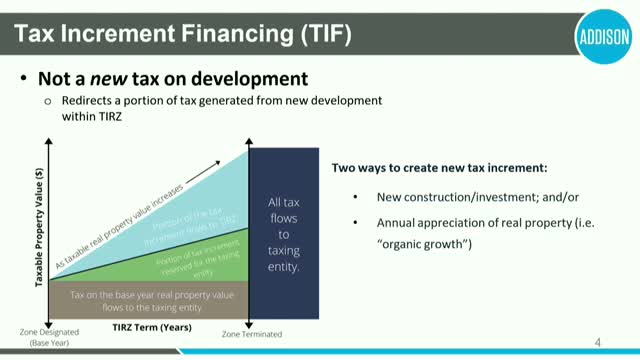
Wayne Emerson, the town's director of economic development, briefed the council on a proposed Tax Increment Reinvestment Zone (TIRZ) for the Addison Junction transit‑oriented development and related areas. He told the council a TIRZ is not a new tax on development but a mechanism to redirect a portion of incremental taxes generated within a defined boundary into a fund for targeted reinvestment.
Emerson described three boundary options (red, orange, yellow) and preliminary finance projections: across all taxing entities staff projected nearly $1 billion in incremental tax value over 30 years and roughly $300 million attributable to the town's share. Under sample participation rates staff showed that at 50% participation roughly $144 million would flow to the TIRZ and at 80% about $231 million. Emerson also said DART has proposed a synthetic participation approach by rebate in an interlocal agreement; DART staff indicated a 10‑year participation term and time sensitivity tied to approval by Jan. 1.
Council members pressed staff on several points: why some recent multifamily development was carved out of the proposed boundary (staff explained base values and strategic priorities), whether the county or other taxing entities could or would participate (county participation typically requires an affordable‑housing component), and how the TIRZ would be financed and administered. One council member said the administrative‑cost bucket "sounds like a slush fund," expressing concern about staff salary or consultant fees being paid from increment; staff responded that administrative costs are allowable under statute and that annual reporting and budget processes provide oversight.
Several council members voiced caution about long‑term commitments if other taxing entities do not participate; others favored the smaller red boundary, a 30‑year term and a stair‑step participation schedule (higher initial participation rates that reduce over decades) as a compromise to fund initial TOD infrastructure while preserving flexibility. Staff asked for direction to prepare a creation ordinance and a preliminary project and financing plan, hold a public hearing, and return with final documents for TIRZ board and council action.
Why it matters: The TIRZ would channel a portion of growth in property and sales taxes from a focused area into locally directed projects (infrastructure, parking, pedestrian improvements, economic development grants). The decision will affect municipal revenues and capital finance choices; council members requested more detail and emphasized the need to lock down outside participation (for example, DART and county) and the final boundaries before advancing the ordinance process.