Lifetime Citizen Portal Access — AI Briefings, Alerts & Unlimited Follows
Lake County planning commissioners continue decision on Lake Cocoa Farms cannabis permit amid water, road and wildlife concerns
Loading...
Summary
The Lake County Planning Commission continued a decision on a proposed major use permit for Lake Cocoa Farms (applicant Juan Gamino) to allow up to 205,800 sq ft of outdoor cannabis canopy and a Type 13 distribution license, citing outstanding questions about water supply, private road improvements and biological mitigation for Hendricks Creek and the Clear Lake Hitch. The item was continued to May 28, 2026, at 09:05.
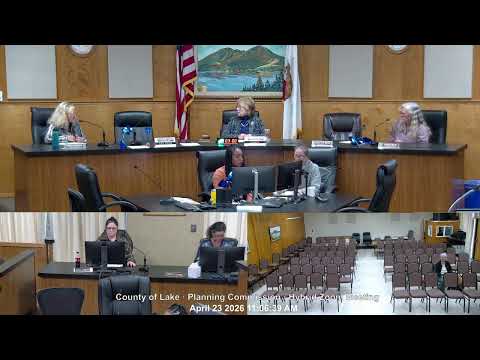
The Lake County Planning Commission on April 23 continued action on a major use permit for Lake Cocoa Farms after weeks of written comments and more than two hours of oral testimony about water, roads and potential impacts to local streams and wildlife.
Trish Turner, an associate planner with Lake County Community Development, told the commission staff is recommending adoption of the draft mitigated negative declaration and approval of use permit PL25155 / UP2058 with amended conditions. Turner summarized the project as proposing up to 205,800 square feet (4.72 acres) of outdoor commercial cannabis canopy within roughly 12 acres of cultivation on two parcels totaling about 228.77 acres, and one Type 13 distribution self-transport license at 3417 and 3547 Hendricks Road. Turner said mitigation measures and conditions had been added to address neighbor concerns and that tribal cultural-resources mitigations were included after consultation with the Scotts Valley Band of Pomo Indians closed on Sept. 10, 2025.
Commissioners, staff and the applicant’s consultant spent much of the hearing focused on water supply and hydrology. Turner summarized the hydrology report’s figures: an estimated peak daily use of about 19,117 gallons, an estimated average daily demand near 8,674 gallons, and a well-yield test showing the on-site groundwater well can produce about 102 gallons per minute — which the report concluded could meet the project’s maximum daily demand in less than three hours. Staff also reported proposed on-site irrigation storage of 20,000 gallons and a 25,000-gallon fire tank.
Several residents and environmental commenters told commissioners those numbers and the project’s cumulative effects merit deeper review. Margo Kambara, speaking from submitted public comments, urged the commission to require an Environmental Impact Report, saying the application "meets the California Environmental Quality Act, CEQA, fair argument standard that triggers an EIR" and citing concerns about probable impacts on domestic water supplies, potential effects on the Clear Lake Hitch in Hendricks Creek and flooding/runoff risks.
Donna Mackiewicz of Red Bud Audubon told the commission Hendricks Creek is a documented spawning area for the Clear Lake Hitch and asked the commission to consider larger buffers and seasonal construction limits; she also recommended monitoring during the hitch’s multiweek spawning period.
Nearby residents described current and past problems they attribute to cultivation on the site or to general activity in the area. Spencer Chuck said Hendricks Road is not designed for heavy commercial traffic and described prior problems with dogs, increased truck traffic and strong cultivation odors when larger outdoor grows were active. Rosa Hartzog, whose property includes the easement used to access the back parcels, told commissioners she had not been contacted earlier and said she is worried by increased traffic and large trucks passing close to longtime orchard trees and family activity.
The applicant, Juan Gamino, spoke in support of the project and described his agricultural background and existing irrigation infrastructure. "We're really hoping and depending on this project to go through for, you know, our livelihood and to, you know, see if we could create, you know, employment here, in Lake County," Gamino said, and he told commissioners the owners had offered to provide emergency water to neighbors and had performed outreach since receiving earlier written opposition.
Supporters including licensed cultivator Christian Hernandez urged approval, saying in their experience similar operations had not harmed upstream fish or wildlife.
Commissioners raised additional process and document concerns. Several members noted inconsistencies in the packet (examples cited during the hearing included cut-and-paste references to Sonoma County best-management practices and differing numbers for on-site vehicle speed limits) and asked staff to supply clearer, county-specific documentation. Commissioners also asked for better evidence about local road conditions and Public Works’ requirements: staff and the applicant’s representative said the shared private gravel access road and the 1,000-foot entrance from Hendricks Road will need improvements and a commercial encroachment signed off by Public Works and that certain road upgrades will be addressed at the building-permit stage.
On enforcement and monitoring, staff described annual mitigation compliance procedures: permittees are sent a monitoring packet and must submit reports and pay a fee (June 1 is the deadline for the reporting cycle so inspections occur during active cultivation). Trish Turner said the county schedules inspections following applicant coordination and fee payment.
After deliberation about water uncertainty, road improvements, odor setbacks and the need for clearer outreach documentation, Commissioner (speaker 4) moved to continue the item so staff and the applicant could assemble additional information and the commission could conduct follow-up (including a site visit). The motion was seconded; the commission voted to continue the matter to May 28, 2026, at 09:05. The motion passed 3–1.
Next steps: the commission will receive the additional documentation and bring the item back on May 28 for a decision. Staff also briefed the commission on the county’s Lake County 2050 general-plan process and upcoming local area advisory meetings. The meeting was then adjourned.
Questions and clarifications from the hearing
- CEQA status: staff recommended adoption of a mitigated negative declaration; several public commenters argued an EIR is required under the CEQA "fair argument" standard and asked the commission to consider an EIR. The commission did not resolve that dispute at the hearing and continued the item.
- Water: staff cited the project hydrology report (well yield 102 gpm; peak demand ~19,117 gpd; average demand ~8,674 gpd; proposed 20,000 gallons irrigation storage) and concluded the on-site well can meet anticipated demand per the report; commissioners requested additional evidence on cumulative groundwater effects in the area.
- Roads: staff and the applicant said the shared private gravel road and the entrance from Hendricks Road (about 1,000 feet) will require improvements and a commercial encroachment approved by Public Works; commissioners asked for clearer photographic and engineering documentation.
- Biological resources: mitigation measures in the initial study include pre-construction surveys, seasonal construction timing to avoid rainfall and pre-construction training for personnel; environmental commenters requested larger buffers and longer monitoring tied to the hitch’s spawning season.
The article is drawn from the April 23, 2026 public meeting of the Lake County Planning Commission and the commission’s staff report and attachments.