Get Full Government Meeting Transcripts, Videos, & Alerts Forever!
Get email alerts on the Public Safety Police topic
No spam. Unsubscribe anytime.
Council restores police gang‑unit and Montgomery Village positions after court ruling increases validation workload
Summary
After learning a circuit court ruling requires more technical validation and court presence for gang‑related cases, the council reversed planned cuts and restored six gang‑unit sworn positions and six Montgomery Village team positions. The debate exposed a large personnel lapse assumption and raised questions about hiring timelines and overtime pressure.
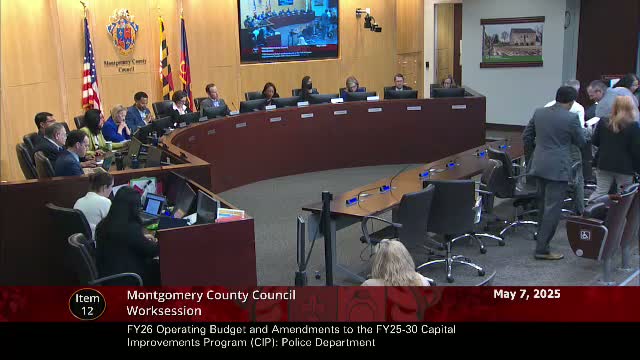
The Montgomery County Council voted unanimously Thursday to undo committee reductions that would have cut six sworn positions in the police gang unit and six positions assigned to the Montgomery Village central business district team, after department leaders described new legal and workload requirements that make those eliminations untenable.
Chief Hamada and investigative staff told the council a recent circuit court ruling requires much more detailed ‘‘gang validation’’ work. "Each validation packet takes approximately 80 hours of work for one detective," an MCPD investigator said, and the ruling now requires an additional peer or technical review and substantial court presence for those cases.
"That technical review will add additional man‑hours," the chief said, explaining the peer reviewer must also be prepared to appear in court for lengthy trials. Assistant chiefs and investigators warned that the added work — combined with an increase in complex gang‑related prosecutions — will sharply raise investigative time per case.
Budget staff told the council that the current lapse assumption in the police budget equals about $20.3 million, which they equated to roughly 187 officer positions. That broad lapse was used to accommodate vacancies across sworn and civilian roles but, council members were told, it leaves limited flexibility if key investigative posts are abolished.
Council members pressed department leaders on timing and hiring. The department said filling and training gang investigators is not instantaneous: new investigators need months of onboarding and specialized training, and they may not be court‑ready immediately. The department also noted current academy classes and attrition patterns limit how quickly vacancies can be filled.
Given the altered legal burden and the department’s staffing reality, the council amended the committee recommendation and restored the six gang‑unit positions; it later similarly restored the Montgomery Village team positions. Council members and OMB staff warned the change affects the lapse calculation and could require future supplemental appropriations if hiring and overtime trends continue.
What’s next: the department will finalize policy and procedural guidance to implement the court ruling and report back on training and staffing plans. OMB will continue to monitor vacancy and overtime spending and may seek a supplemental appropriation later in the fiscal year as hiring and workload realities unfold.
Provenance: council discussion and vote on police staffing and lapse assumptions (topic introduced SEG 4241; vote recorded SEG 5544–5548).