Get Full Government Meeting Transcripts, Videos, & Alerts Forever!
Get email alerts on the Special Use 4460 Beltline topic
No spam. Unsubscribe anytime.
Planning commission records 4–3 tally on hookah lounge permit after debate over parking, landscaping and noise
Summary
The Addison Planning and Zoning Commission debated and recorded a 4–3 tally on a motion to deny a special use permit for a proposed hookah lounge and late-night hours at 4460 Beltline Road, citing noncompliance with landscaping and parking rules and concerns about noise and parking-lot congregating; the transcript contains a wording inconsistency on the formal result (see audit).
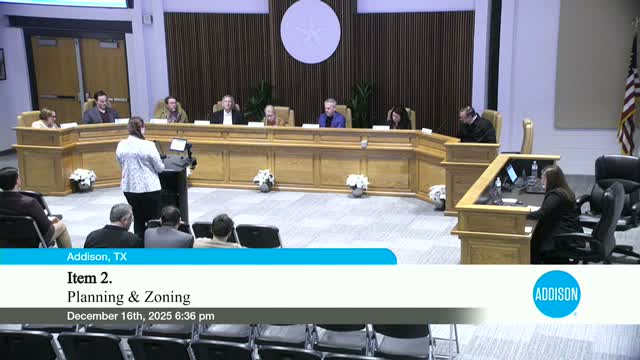
The Addison Planning and Zoning Commission heard a request on Dec. 16, 2025, to allow late-night hours and on-site hookah at 4460 Beltline Road and recorded a 4–3 tally on a motion to deny the applicant’s special use permit.
Staff presented the application and staff report. Corey Beck, assistant director for development services, told commissioners that staff found the proposal did not comply with the town’s Unified Development Code in two main areas: minimum landscaped area and perimeter parking-lot screening. Beck also said the rooftop bar increased parking demand and noted tree removal totaling 36 caliper inches that would trigger a mitigation fee of $192 per inch (roughly $768). "Staff has reviewed the proposal and determined that, it does not comply with town policies and development regulations," Beck said during his presentation.
Applicant representatives described site upgrades and business plans. Majid Khalaf, representing the owner, said the team had increased fire‑lane radii, added an internal fire lane, and planned a new on-site hydrant and improved utilities. Owner Mike Edwards said he is investing about $1,000,000 to renovate the long‑vacant building and described a restaurant-first operation with a rooftop bar and hookah service. "My number 1 priority is a restaurant," Edwards said, adding that weekend hours to 2 a.m. would be important to the business’s viability.
Commissioners questioned seating and occupancy calculations, the separation of smoking and nonsmoking areas, ventilation, and parking/taxiing behavior that can push patrons into parking lots late at night. Several commissioners raised enforcement and noise‑spill concerns tied to groups congregating in parking areas after closing. One commissioner suggested conditioning late hours on contracted security.
After discussion, Commissioner (speaker 12) moved to deny the special use permit. The recorded roll-call tally on the motion shows four votes in favor and three opposed. The transcript contains inconsistent phrasing immediately after the tally (the chair’s later remark appears to contradict the recorded count); the tally and related procedural wording are included in the meeting record and are noted in the official minutes.
The commission’s discussion focused on the site’s failure to meet the 20% minimum open‑space requirement and on screening requirements that staff said could not be met because of existing overhead lines. Beck noted staff believed some elements (ornamental trees instead of shade trees) met the ordinance’s intent but did not meet the literal standard.
Because the item was decided at the meeting, no further action is scheduled until an applicant chooses to revise the plan and return for reconsideration or seek a different approval path.
Actions and next steps: the motion to deny was moved and seconded; the record shows a 4–3 tally. The minutes and any formal decisions will reflect the official vote and the commission’s recorded findings.