Lifetime Citizen Portal Access — AI Briefings, Alerts & Unlimited Follows
Business & Insurance Committee narrowly advances bill authorizing regulated alternative disposition of human remains
Loading...
Summary
A proposal to allow licensed 'accelerated natural decomposition' as a voluntary alternative to burial or cremation passed the Senate Business & Insurance Committee 5-4 after lengthy debate over dignity, safety and implementation; the author added felony language banning farm use of processed remains.
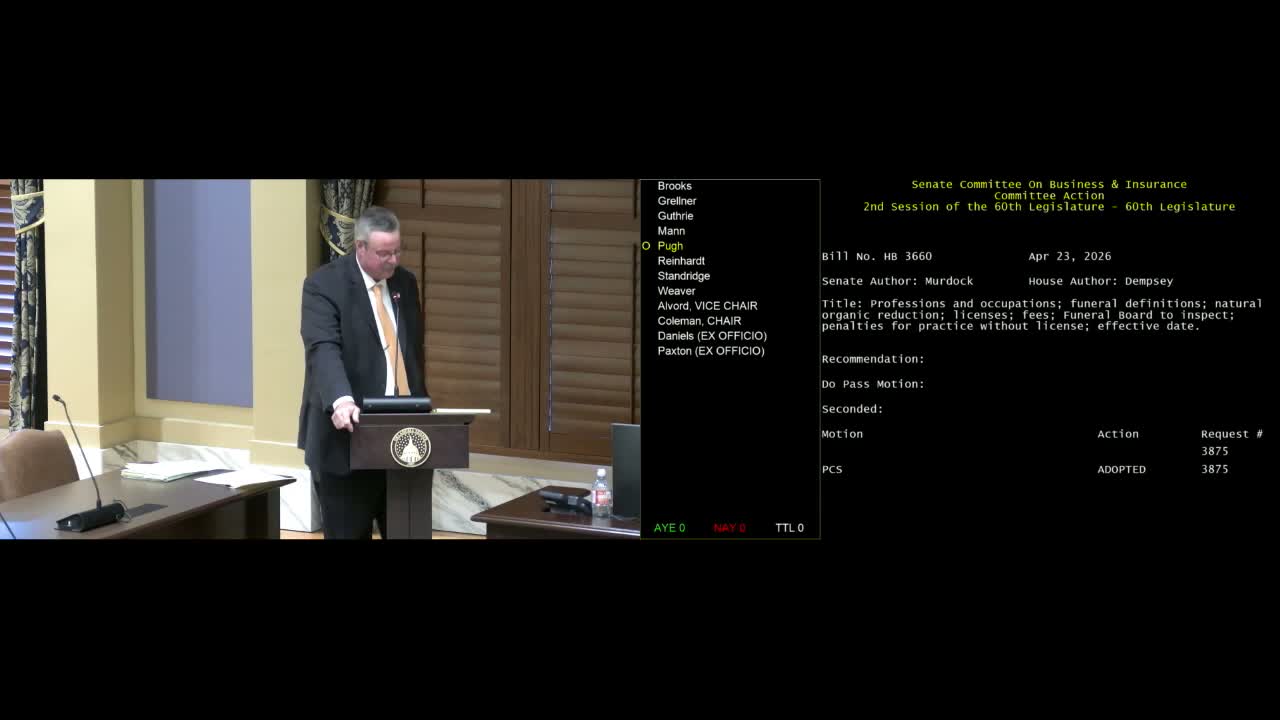
The Oklahoma Senate Business & Insurance Committee voted 5-4 to advance House Bill 3,660, authorizing licensed facilities to perform an accelerated natural decomposition process as an optional method of disposition for human remains.
Author Senator Murdock described the proposal as a voluntary choice for families who want an alternative to burial and cremation and said it includes regulatory safeguards and chain-of-custody protections. In testimony the author outlined the process in which remains would be placed in a chamber with organic material at raised temperatures (he cited an example temperature of about 131 degrees) and said the end product yields roughly 200 to 300 pounds that would be returned to families under regulated conditions.
"It's just another decision... This bill is not forcing people to do it. It's just a choice," Murdock told the committee, adding he had amended the bill to strengthen prohibitions on misuse, including making it a felony to use processed remains as farm fertilizer.
Opponents raised moral and cultural objections and pressed for more information about process timing, safety and cost. Senator Grelder said the measure risks equating human bodies with ordinary compost and framed that as a significant cultural problem: "Once the state teaches that the human body can be handled just like plant reuse, it becomes harder to explain to the next generation why human life itself should be treated as anything more than useful or convenient or disposable." Other members asked how long the process would take and whether large bones or skulls would remain, to which the author said he would obtain more precise operational data.
Supporters emphasized regulation, licensing, and family choice. Senator Murdock said the bill already contains safeguards and that perceptions were shaped by sensationalized rhetoric: "When this first came out... people were hitting the hot button topics that was on Facebook or X or other social media platforms. But never read the bill." He also stressed that existing criminal prohibitions were being reinforced by the committee substitute.
Key points from the hearing
- Sponsor’s description: The author described a heated-chamber process that accelerates natural decomposition; said licensed operators would follow chain-of-custody and identification safeguards and families would receive the processed remains. - Safeguards added: The author said he added language to make use of the processed remains as farm fertilizer a felony and highlighted licensing and tracking requirements. - Unanswered technical questions: Members asked about total processing time, detailed breakdown of post-process remains (bones), and the cost to families; the author committed to providing further operational information. - Cultural debate: Objections were framed as moral and cultural, not solely technical, contributing to a close committee vote.
Committee action and next steps
The committee approved the bill by a 5-4 vote and the measure will proceed to the Senate floor for further consideration. The author and members requested additional operational data and cost estimates before floor debate. If the bill advances, implementation will depend on subsequent rule-making and licensing frameworks established by state agencies.