Get Full Government Meeting Transcripts, Videos, & Alerts Forever!
Get email alerts on the Budget topic
No spam. Unsubscribe anytime.
Pleasantville board rejects tied vote on preliminary budget; superintendent's report approved separately
Summary
Board members and the superintendent sparred over the 2026–27 preliminary budget, with concerns about a $2.64 million increase in the local tax levy, use of $7.4 million in fund balance, and up to 40 staff positions targeted for attrition. The board failed to approve a combined motion that included the budget but later approved the superintendent's report alone.
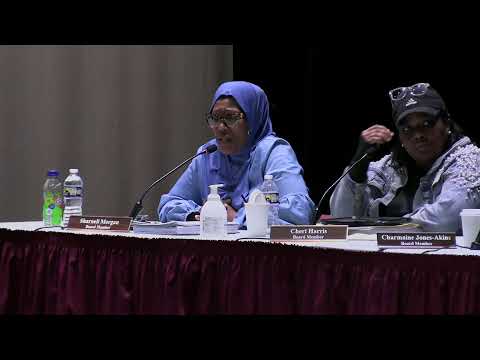
The Pleasantville Board of Education rejected a combined motion to accept the superintendent’s report and the district’s preliminary 2026–27 budget, after hours of discussion about rising fixed costs, staffing reductions and emergency one‑time funds.
Dr. Marilyn Martinez, the superintendent, and Dale White, the district business administrator, presented the budget package and described a constrained fiscal outlook driven by rising mandated costs (tuition for charter and out‑of‑district placements), salaries and benefits. Martinez said state general education funding in the proposed budget is $97,373,844 and the proposed local tax levy increases to $13,019,224 — an increase the administration tied to a health‑care cost adjustment and other fixed obligations.
Martinez warned that the district had exhausted one‑time federal COVID relief funds and would need to use about $7.4 million in prior‑year surplus (fund balance) to stabilize next year’s spending. She said administrators modeled a conservative per‑pupil tuition estimate and emphasized the limited local control over charter and placement costs. “These rising uncontrollable costs are a substantial and recurring pressure on the budget,” Martinez said during the presentation.
Board members pressed for specifics. One member asked whether proposed reductions would affect instructional offerings; Martinez said the administration aimed to protect core daytime instructional programs and that after‑school and some extracurricular funding would bear more of the reductions where grant funding could be applied. On staffing, the administration said the budget contemplates a maximum of about 40 positions reduced primarily through attrition — retirements and unfilled vacancies — before layoffs would be considered.
Opponents of the combined motion argued the superintendent’s report should not be voted on tied to the formal preliminary budget submission. After debate and a roll‑call vote, the initial combined motion failed. The board later rescinded and separated the items and approved the superintendent’s report without explicitly approving the preliminary budget for submission. A later motion to submit the preliminary budget (agenda items 3.1–3.4) also failed in roll call.
The failed votes mean the county superintendent will likely review the district’s submission and could prescribe changes or request resubmission, board members noted. Several members said they wanted more itemized bills and additional transparency on specific legal and contract line items before agreeing to forward the preliminary budget to county officials.
During public comment, residents urged caution on new levy increases and pointed to visible facility problems, including a playground slide that has been wrapped with caution tape for an extended period and thermostats showing error codes in at least one school. Priscilla Noel, a local resident, asked whether recent state aid could be used to avoid raising local taxes for one year.
What happens next: the board can still act to submit a preliminary budget before the county deadline, but several line items were pulled for review and the county superintendent will have a role in the next steps. The administration said it will continue to share program lists, itemized invoices on request, and follow up with board members on specific questions about bus‑route reductions, positions under review and planned capital projects.