Get email alerts on the Electric Cip topic
No spam. Unsubscribe anytime.
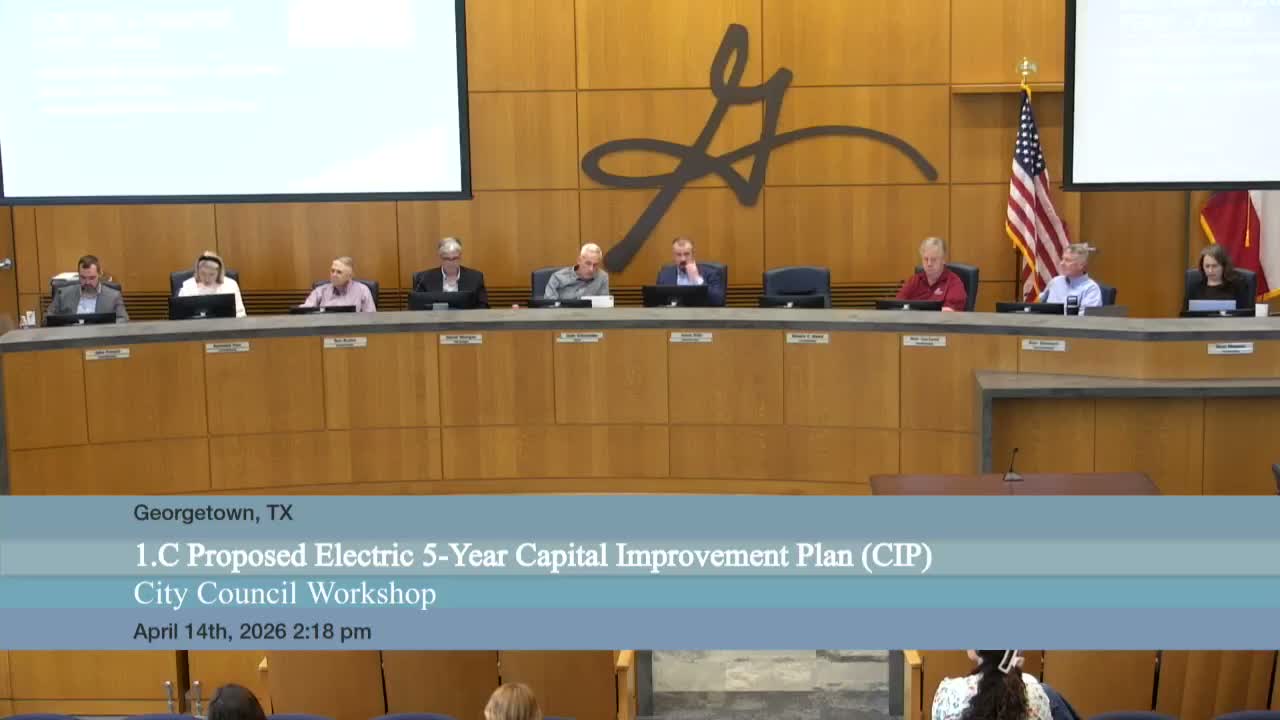
Georgetown utility unveils $331M five‑year electric CIP; AMI replacement and utility operations center planned
Summary
Electric utility staff presented a five‑year capital improvement plan totaling about $331 million — roughly 75% electric plant — that includes an AMI meter replacement in FY27, an aviation substation in FY27, capacity upgrades in FY28, and proposed land acquisition and construction for a utility operations center.
City electric utility leaders presented a five‑year capital improvement plan (CIP) that staff say is driven by rapid customer growth and large commercial loads.
"Over the 5 year period, we are looking at $331,000,000," said Daniel Dattapudi, general manager of the electric utility, describing a CIP with roughly 75% of spending on electric plant and the remainder on general plant such as facilities and equipment. He said about 20–25% of the plan is related to a proposed utility operations center and related land acquisition.
Why it matters: the plan is intended to support growing demand and large commercial and industrial customers that can materially change load profiles. Staff described a funding strategy that mixes cash and debt and identified several multi‑year projects that could affect rates or long‑term borrowing.
Major projects and timing: staff listed an aviation substation to serve North Georgetown expected in FY27 (pushing up FY27 costs), capacity upgrades in FY28 to deliver that power to customers, and a completion of an overhead‑to‑underground voltage conversion program that staff said is set to finish in FY26. Daniel told the council the utility expects to earmark about $1.5 million annually to strategically underground parts of the system.
AMI and operational technology: Ian Milne, an electric engineer with the system planning group, said the utility's AMI (advanced metering infrastructure) replacement is scheduled for FY27 and will require replacing meters for all customers. "It does require so for we do have an AMI system right now, but that AMI system...is at the end of the life, and so we have to replace it with a newer system," Ian said, and added the rollout will begin with a pilot (about 100 meters) and proceed regionally.
Utility operations center and fleet: Daniel said the city is budgeting about $7.8 million in 2027 for land acquisition and about $45 million in 2028 for construction of a utility operations center. He also noted fleet investments (bucket trucks and specialty vehicles) of roughly $6.6 million over five years.
Financial assumptions and rate implications: Michael Simpson, portfolio analyst, walked council through assumptions underpinning the financial forecast and bond model: multi‑year escalation factors for operations and personnel, an assumed conservative long‑term native load growth rate (about 4.14%), and modeling that uses a 50% materialization rate for large‑customer requested growth. He said the model assumes the successful implementation of a transformation reserve to allocate transformation costs to very large commercial and industrial customers and that the plan's stress tests show a plant investment fee coverage above 1 (exceeding about 1.1 in the forecast period).
Council questions focused on whether cash includes development fees (staff confirmed development fees are counted as part of cash sources) and on how combined water/electric rating treatment will be displayed in future reports. Presenters closed by reiterating these are planning numbers and that no formal approvals were taken at the workshop.
Next steps: staff will return with further modeling and a second reading as part of the budget process and capital planning workshops planned through May and June.
AI generated
The text on this page is AI generated. Summaries, highlights, analysis, and video transcripts are all produced from the original source material.
AI can make mistakes, so if you spot one, and we will fix it for everyone.
Note: the source content is unaltered by us. Any content source we link to, be it a video, an audio recording, or a document, is presented exactly as its publisher released it. That publisher is usually a government body, sometimes an individual official or another organisation.