Get Full Government Meeting Transcripts, Videos, & Alerts Forever!
Get email alerts on the Budget topic
No spam. Unsubscribe anytime.
White County budget committee weighs 3% COLA, retiree benefit amortization and EMS vehicle strategy
Summary
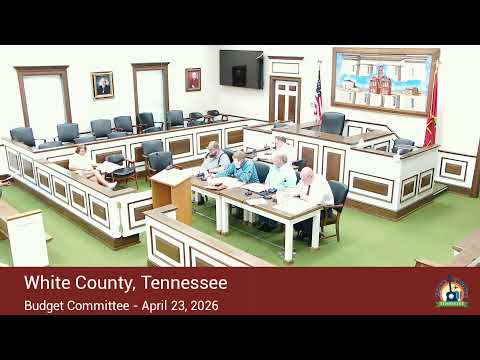
At a White County Budget Committee session, Director Chad Markham presented FY27 options including a 3% cost‑of‑living adjustment for general‑fund employees (estimated at about $350,000), a 10‑year amortized TCRS retiree COLA option (about $730,000/year), and a proposal to buy one new ambulance annually to free roughly $100,000 in EMS funds for equipment. The committee asked staff to draft a budget showing those choices and a realistic deficit for the next meeting.
Chair (S2) opened the meeting and asked Director Chad Markham to explain draft materials for the county's FY27 budget. Markham said he split the draft into two sheets — payroll/benefits and non‑payroll — to clarify tradeoffs.
Markham presented compensation scenarios for general‑fund employees, saying a 3% cost‑of‑living adjustment (COLA) for general‑fund staff would be "just shy of $350,000" and that a 5% increase would be roughly $558,000. "That is an across the board COLA for all existing employees," he said, noting the figures applied specifically to the general fund rather than to other funds such as road or school payrolls.
He also described item 52, a proposed TCRS improvement (retiree COLA and commission credit) structured as a 10‑year amortization. "That is a 10 year amortization, and it would be about $730,000 a year over 10 for every year for 10 years," Markham said, adding the contribution would revert to the county's required contribution rate after amortization.
On insurance, Markham added item 53: extending paid medical insurance more broadly across general‑fund employees. He said his estimate assumed 95% participation at the employee‑only level and noted the county currently contributes different percentages depending on coverage type (he cited about 92% for employee‑only premiums and about 65% for family plans). "There's about 11 people that have family coverage that we contribute," he said, and cautioned changes would materially affect those employees.
The committee discussed options to free one‑time or recurring funds. Chair (S2) proposed shifting EMS procurement from remounts to buying one new ambulance a year, a change he said would free roughly $100,000 annually in the EMS budget. The committee and Markham debated tradeoffs — new vehicles bring full warranties and newer drivetrains, while remounts replace boxes on older chassis — and noted fleet mileage and lifecycle implications. Markham said an EMS director may buy remounts or new units within his line‑item budget, but moving funds between line items would require Committee approval.
Members also reviewed vehicle funding in the sheriff's budget and identified modest per‑car savings from current price changes that could be reallocated. Markham flagged recurring, nonnegotiable costs that must be considered, including roughly $44,000 for additional license‑plate‑reader (LPR) camera costs and two servers for communications.
A member asked whether selling surplus county property off the tax roll could generate revenue; Markham said proceeds would go to the general fund but that county staff would need to check Tennessee code on restoring property to the tax roll and related limits.
At the close, the committee directed Markham to prepare a draft FY27 county budget that incorporates the committee's priorities (a 3% COLA scenario, EMS procurement option, election commission increases, LPR cameras, sheriff/jail items, courthouse roof and parking‑lot maintenance) and to return with a near‑term meeting that includes a realistic deficit estimate. The meeting ended with a motion to adjourn that carried by voice vote.
The committee did not adopt a final budget or take a formal vote on the COLA, TCRS amortization, or EMS procurement approach during this session; members requested further staff modeling and a follow‑up meeting.