Get Full Government Meeting Transcripts, Videos, & Alerts Forever!
Get email alerts on the Residential Schools Funding topic
No spam. Unsubscribe anytime.
Residential program leaders back SB 257 to tie stipends to BSA after audit shows per‑student costs roughly double statutory stipend
Summary
Residential and CTE program directors told the task force audited FY24 expenses averaged about $25,700 per residential student while FY15 statutory stipends average about $12,900; the Alaska Residential Schools Coalition supports SB 257 to link stipends to the Base Student Allocation and double current amounts.
A panel of residential and CTE program leaders told the task force that Alaska's small network of residential boarding and variable‑term programs require structural funding changes and supported Senate Bill 257, which would tie regional stipend amounts to the Base Student Allocation (BSA) to right‑size funding and index future increases.
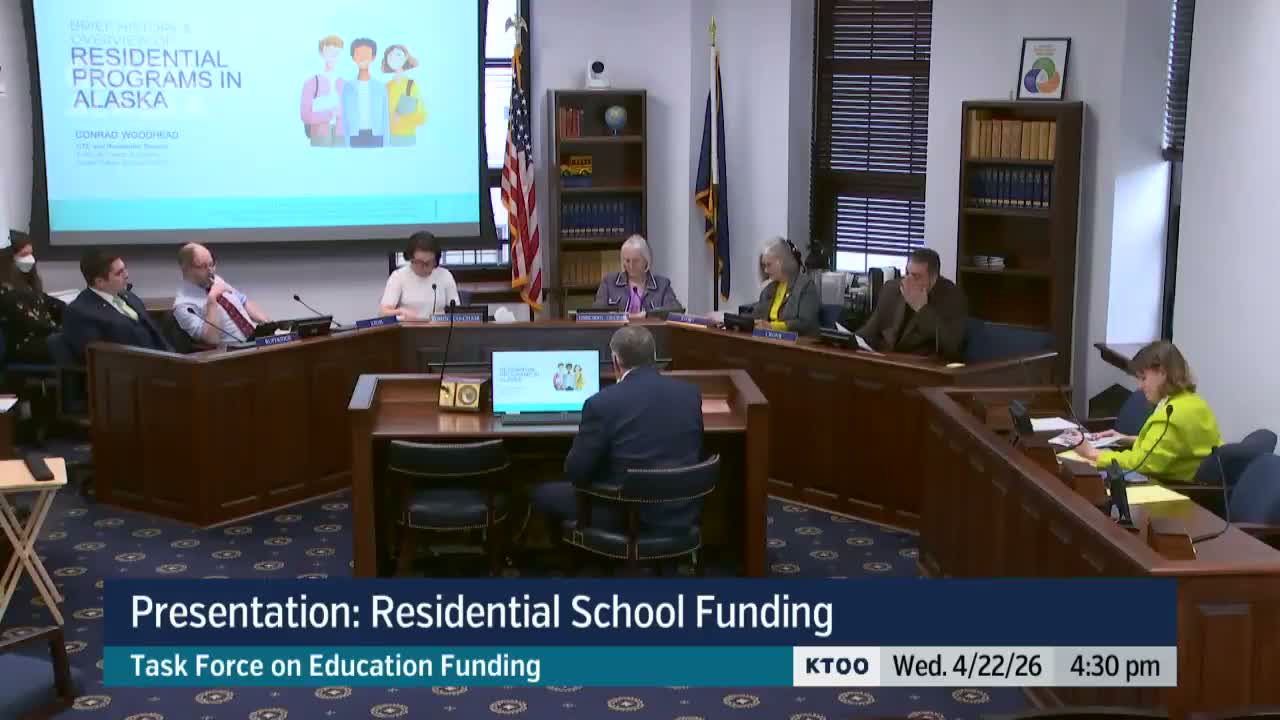
Conrad Woodhead, CTE and residential director at Kuzovac Career Academy, described multiple residential models—week‑long intensives, quarterly or semesterly sessions and year‑round boarding—that serve students who cannot access CTE and other pathways in their home communities. “These programs are one of the clearest ways we create real access for students, especially those from remote regions,” Woodhead said, and the coalition listed programs from across the state that serve from 6 to 163 students (FY26).
Dr. Doug Walrath, director of the Northwestern Alaska Career and Technical Center, described industry partnerships that deliver aviation, health, construction and other pathways and emphasized that residential programs deliver life‑skill and cultural components as well as technical training.
The fiscal pitch: Jim Mariner (Galena City School District) summarized the coalition's recommended statutory fix—amending AS 14.16.200(b) to replace fixed regional stipend amounts with a percentage multiplier of the BSA so stipends rise automatically when the BSA increases. Mariner cited a 2024 consultant review of seven districts' audited residential expenses that showed average FY24 per‑student audited expenses near $25,700 versus FY15 statutory stipend average about $12,900. “By asking for doubling, it's actually not what we probably need,” Mariner said; the doubling request was intended to close most of the gap.
Representatives pressed for technical details: Representative Story asked how variable‑term programs count students; Woodhead described a residential count night (the Friday of early quarter 1, roughly Oct. 20) that snapshots facility occupancy and is used to report capacity and claim stipend funding. Mariner explained the SB 257 multipliers (for example, Region 1 would use BSA × 37%) were chosen to approximate a doubling of current fixed dollar stipends.
Policy trade‑offs: Senator Tobin asked about tying stipends to the BSA if the BSA is held down or changed in future legislative action; Mariner acknowledged the concern but said coalition members sought a reliable structural mechanism rather than repeated one‑time legislative increases.
What happens next: No formal votes were taken. Presenters asked the task force to consider statutory changes to link residential stipends to BSA movement; members signaled interest in following up on program counts, per‑student expense breakdowns, and how regional multipliers were derived.
Sources: Presentations and Q&A with Conrad Woodhead, Doug Walrath, Steven Culkin, and Jim Mariner (SEG 1151–SEG 1477); discussion of SB 257 multipliers and audited expense figures (SEG 1478–SEG 1662).