Get AI Briefings, Transcripts & Alerts on Local & National Government Meetings — Forever.
Task force told correspondence programs now enroll roughly 18% of Alaska students; members press for better data and accountability
Loading...
Summary
Presenters told the joint legislative task force that Alaska correspondence programs now enroll about 18% of students and are funded at 0.9 ADM, while participation in standardized testing has fallen into the low teens—raising questions about accountability and how funding formulas should respond.
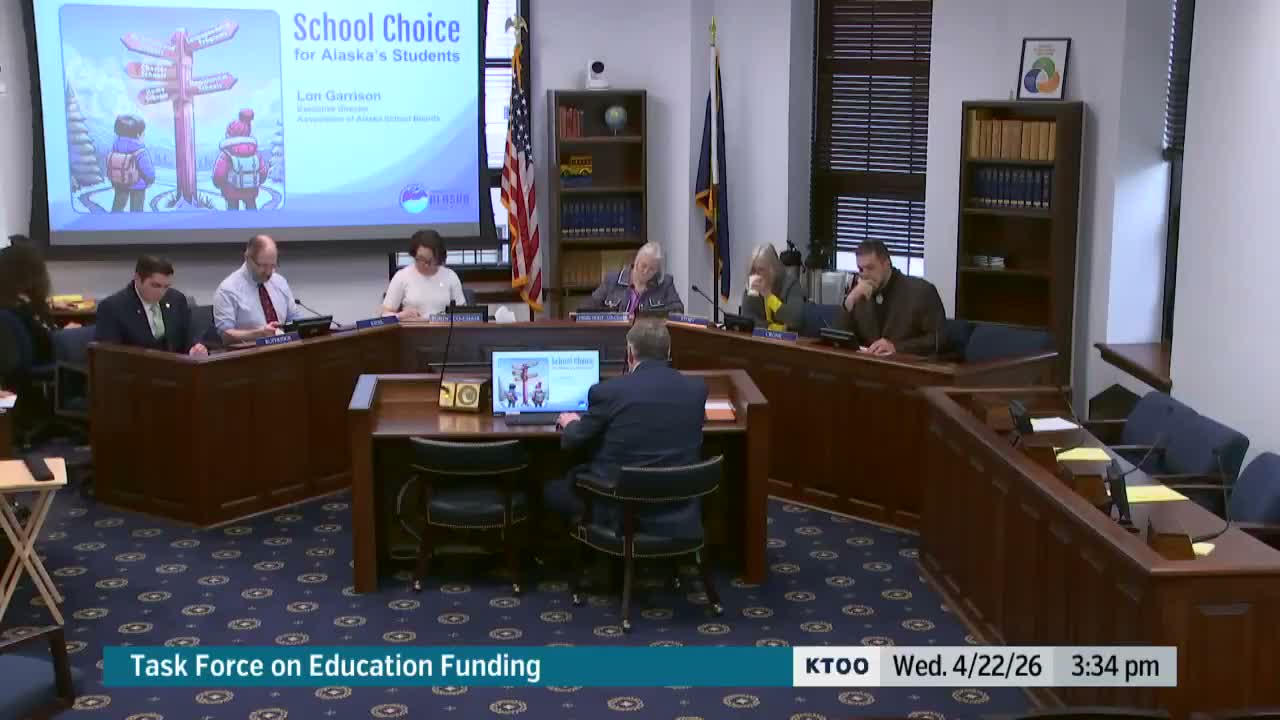
Co-chair Hemschute convened the task force on April 22 in Juneau to examine school‑choice funding as Lon Garrison, executive director of the Association of Alaska School Boards, laid out the growth and funding mechanics of correspondence programs across the state.
Garrison said correspondence programs have become a major statewide option since a 2014 statutory shift that permitted student allotments and individualized learning plans. “Now there's at least 34 correspondence programs in Alaska,” he told the task force, and the five largest programs together enrolled 15,357 students in 2025. “In 2025 that accounted for nearly 23,000 students,” he added, equating to about 17–18% of the state's student population.
Why it matters: Task force members said those enrollment and funding shifts have substantial budgetary and accountability implications for districts that still operate traditional brick‑and‑mortar schools.
Garrison summarized funding mechanics: a full‑time correspondence student is funded at 0.9 ADM of a regular full‑time student and correspondence funding is not subject to the usual foundation formula factors; instead, correspondence students are counted separately and re‑added at the end of the calculation. “Full‑time correspondent student is funded at 0.9 ADM,” he said. That 0.9 rate, he said, must cover administration, staffing, allotments, special‑education services and curriculum materials.
Questions from lawmakers focused on outcomes and measurement. Senator Tobin urged better data and suggested the task force consider directing the Department of Education or commissioning an Institute of Social and Economic Research (ISER) analysis to assess whether the parent‑directed model is producing the statutory outcomes Alaska expects. “We often run up against the inability to collect some accurate information and some very detailed analysis about student outcomes,” Senator Tobin said.
Garrison and other members noted participation in standardized assessments among correspondence students has fallen since the 2014 changes. “From 2019 to the present we really see a fairly low participation rate in standardized testing that can vary anywhere from 10 to 20%,” Garrison said, adding that testing declines make comparisons to brick‑and‑mortar students difficult.
Senator Cronk pushed back that different correspondence programs serve different populations (for example, credit‑recovery students) and pointed to graduation‑rate measures as an accountability signal: using district‑reported figures for the larger correspondence providers, he said some programs show four‑year graduation rates near or above statewide averages (IDEA cited at about 74% including credit recovery). “If you just look at them straight as that, that's some outcomes right there,” Senator Cronk said, urging careful reading of data and how program composition affects results.
Task force members pressed for more program‑level detail—how many students take assessments, how dual enrollment is counted, and how individualized learning plans (ILPs) differ by program. Garrison said ILPs vary by district and program and that no single statewide ILP standard was presented at the meeting.
What happens next: The task force left the issue of correspondence accountability and data collection open for further work; members suggested inviting correspondence program operators and DEED staff back to explain practices that boost assessment participation and to provide the granular reporting necessary to evaluate outcomes and fiscal effects.
Sources: Presentation and Q&A with Lon Garrison, Association of Alaska School Boards (SEG 044–SEG 571); follow‑up questions from Senators Tobin and Cronk and Representatives on correspondence participation and funding (SEG 572–SEG 714).