Get Full Government Meeting Transcripts, Videos, & Alerts Forever!
Get email alerts on the Water Rates topic
No spam. Unsubscribe anytime.
City staff propose shifting water costs to volumetric rates to ease base-rate pressure
Summary
CFO Lee Wallace proposed lowering the share of fixed water costs recovered through the base charge (from 65% to 50%) and increasing recovery through volumetric tiers to reduce base-rate increases; staff modeled a baseline 9% annual water‑minimum increase versus a proposed ~4% base increase with higher volumetric increases, and the Water Advisory Board recommended the shift 4–1.
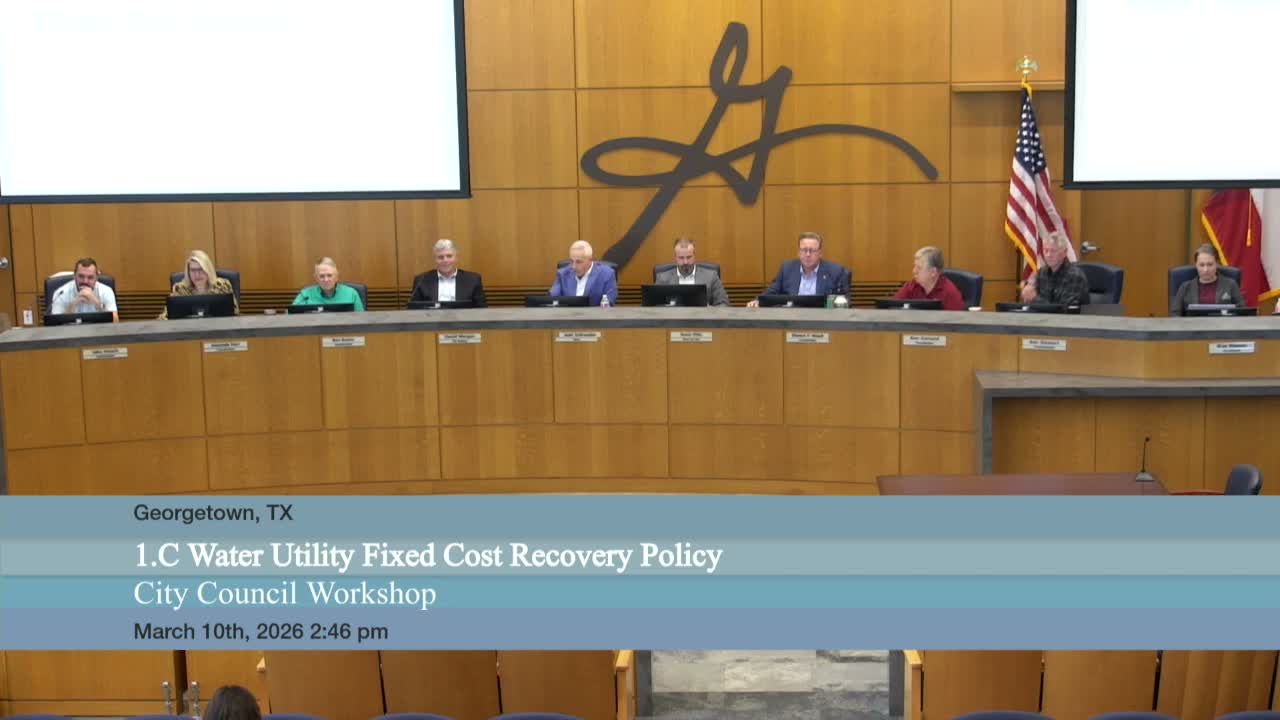
Lee Wallace, the city’s chief financial officer, presented a draft change to water‑utility fiscal policy that would lower the minimum fixed‑cost recovery collected through the base charge and shift more recovery to volumetric (tiered) rates.
Wallace said the city’s preliminary five‑year forecast shows fixed costs rising from roughly $64,000,000 in 2025 to about $138,000,000 in 2030 because of capital projects and water‑supply obligations. "We are proposing that we change the policy from 65% through the base rate to 50% through the base rate and 90% through the base rate and first tier to 75%," Wallace said, explaining model scenarios through 2030.
Staff modeling shows the difference materially affects how increases are allocated: under a baseline policy staff illustrated, the water minimum charge would rise about 9% per year; under the proposed shift, the base rate would increase roughly 4% annually while volumetric rates would rise faster (staff estimated about 14% per year for volumetric increases in the modeling example) but total revenue and required coverage ratios would still be met.
Who it affects: Staff said residential customers using 12,000 gallons or less per month would see slower bill increases under the proposal (an example showed a 12,000‑gallon user’s projected 2030 monthly bill falling from $78.20 under baseline to $67.80 under the proposed policy), while very high‑volume users would pay more as volumetric tiers rise faster.
Risks and safeguards: Wallace acknowledged drought years or wetter years that reduce consumption could lower volumetric revenue. He said the city’s strong reserves and days‑cash policies are buffers and that staff would monitor and adjust rates as needed. Wallace noted the model includes reservation payments for one groundwater supply deal but does not assume the full CCN groundwater supply in this version of modeling.
Process and next steps: Wallace told council the Water Advisory Board considered the policy in February and again in early March and voted 4–1 (two members absent) to recommend the change to council. Staff asked for council feedback to update rate modeling and planned to return rates and the policy document to the May 9 advisory‑board meeting and the May 26 council workshop.
Council members asked clarifying questions about modeling assumptions, impacts on commercial and multifamily rate schedules, and how the city would manage the revenue variability caused by conservation or unusually wet years. Several members expressed support for the concept while asking staff to follow up on specific threshold and equity questions.
No formal council vote was taken; staff recorded consensus direction to proceed with modeling and follow‑up.