Get Full Government Meeting Transcripts, Videos, & Alerts Forever!
Get email alerts on the HB235 Pfas Testing Liability Remediation topic
No spam. Unsubscribe anytime.
House panel considers annual PFAS testing, liability for manufacturers and permits for thermal remediation
Summary
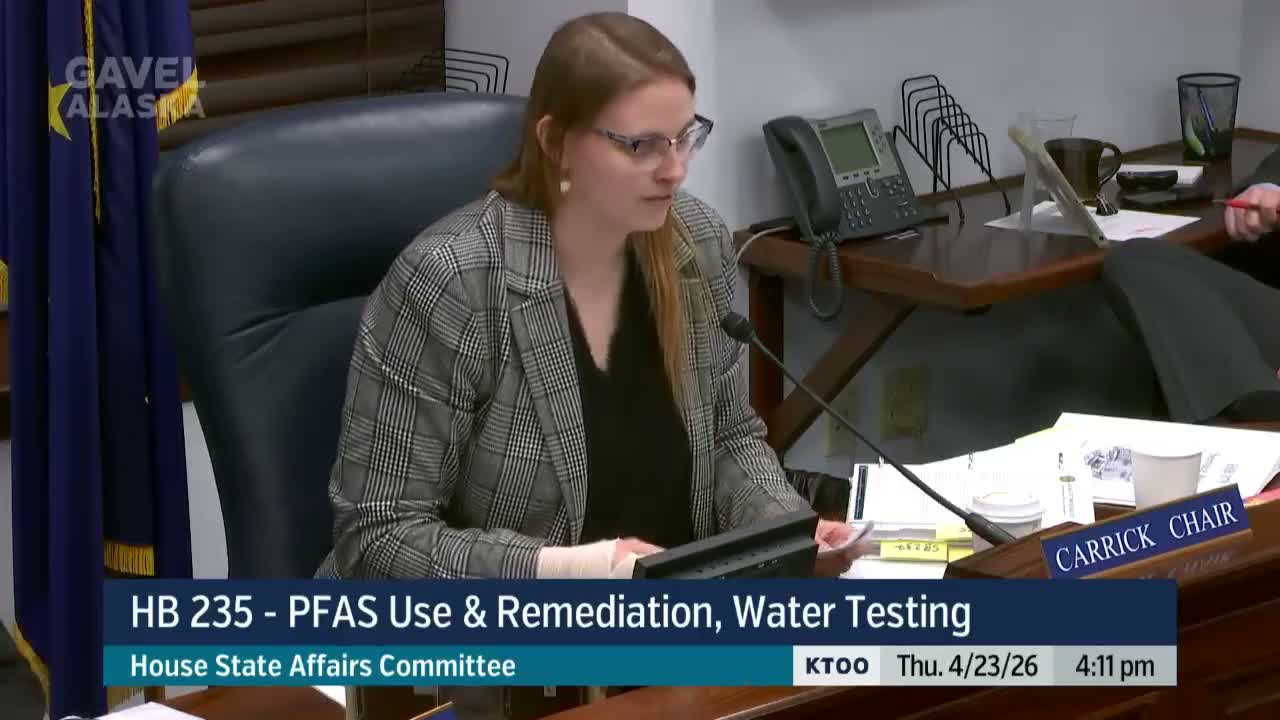
Representative Carolyn Hall told the House State Affairs Committee on April 23 that HB235 would require annual PFAS testing of all public water systems, set safety limits aligned with 2024 EPA guidance, impose liability for responsible parties and manufacturers, and require DEC permitting of thermal remediation; DEC officials said the bill would double current testing obligations and estimated fiscal impacts approaching $19 million.
Representative Carolyn Hall said HB235 is designed to identify the scope of PFAS contamination across Alaska and ensure safe drinking water for impacted communities. "HB 235 proposes to do four things," Hall told the House State Affairs Committee: establish annual PFAS testing for all public water systems, align safety limits with the 2024 EPA guidelines, impose liability on parties responsible for contamination (including manufacturers), and require the Department of Environmental Conservation to permit facilities that use thermal remediation.
Committee members focused on cleanup responsibility, remediation methods and the bill's costs. Hall acknowledged the bill "looks at providing the scope of the problem, but it isn't addressing the full removal of the PFAS in this bill," and said she favored ensuring the state does not inadvertently spread contamination by permitting only appropriate technologies.
Shandy Perry, director of DEC's Environmental Health Division, explained the testing consequences: Alaska has roughly 1,300 public water systems and just over 600 of those are required to be tested under the EPA PFAS rule; HB235 would extend testing to all public systems and require annual monitoring, effectively doubling the state's testing workload. Perry said much of the additional monitoring would fall outside EPA grant coverage and would therefore require state general funds. When asked about costs, Representative Hall said DEC's outreach produced fiscal notes that together "are approaching, I believe, $19,000,000." DEC staff described the current notification and compliance timeline under the EPA rule: systems testing over the EPA MCL of 4 parts per trillion must provide notice and, under the rule's schedule, compliance monitoring and reporting accelerate starting in 2027, with compliance treatment obligations by 2029.
Members discussed permitting for thermal remediation and whether the bill should favor or require technologies that destroy PFAS rather than concentrate it. DEC staff and the sponsor welcomed follow-up work to refine permitting language and cost details. The committee set HB235 aside for additional work and requested written follow-up from DEC on testing logistics and costs.