Get Full Government Meeting Transcripts, Videos, & Alerts Forever!
Get email alerts on the Rural Impacts topic
No spam. Unsubscribe anytime.
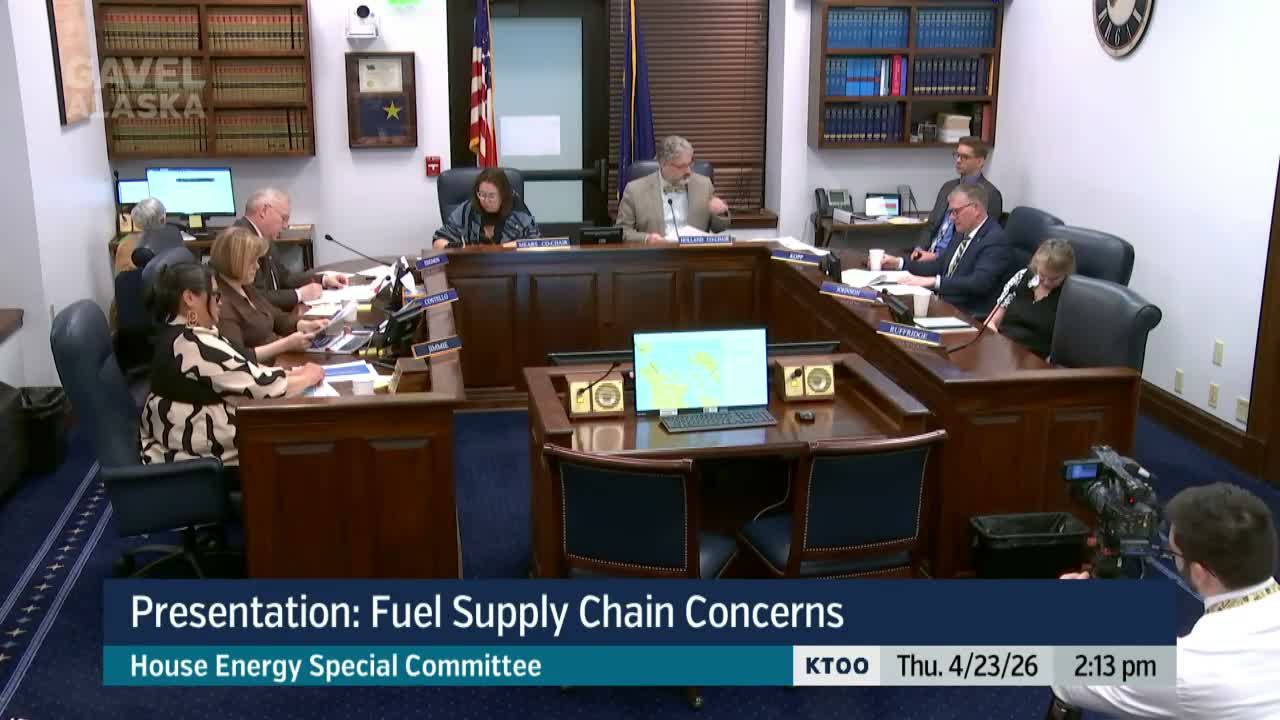
Rural utilities warn diesel shortages could make life unsustainable in small villages; Kotzebue to add battery storage
Summary
Kotzebue Electric and the Alaska Center for Energy and Power told lawmakers that small villages face outsized energy burdens and that diesel price spikes could force reduced services; Kotzebue is installing a 4 MW battery expected to displace significant annual diesel consumption.
Tom Atkinson, CEO of Kotzebue Electric, told the House Energy Committee that some of his region’s communities are already short of fuel and that the single annual barge delivery model means buyers get one critical purchasing window.
"This is a crisis, I believe there will be a crisis... It’s a matter of survival for some of these villages," Atkinson said, describing quotes as high as $17 per gallon where fuel must be flown in and noting direct pass‑through of costs to utility customers. He outlined consequences including higher food and ticket prices, potential loss of heating capacity and risks to medical travel.
Atkinson also reported that Kotzebue is bringing a new 4 MW battery to the community (expected to arrive on the late summer barge and commission in early 2027) that his utility expects to multiply the fuel‑displacement benefits of their existing 1 MW battery (which displaces roughly 80,000–90,000 gallons annually).
Gwen Holben of the Alaska Center for Energy and Power presented modeling and historic PCE data showing rural per‑person fuel use on the order of 1,200 gallons per year and stressed that energy burden is already high in many regions. Holben’s team modeled order‑of‑magnitude impacts: a $1/gallon increase across the rural fuel base corresponds to roughly $100 million in direct energy costs; a $5/gallon stress scenario would scale much higher.
Committee members pressed on local sourcing and refinery capacity; witnesses pointed to Canadian and Gulf Coast sources, limited Alaska refining capacity, and the need for long‑term investments in local refining or greater renewable and storage deployment to reduce dependence on diesel.
The exchange underscored divergence within Alaska: larger hubs can better leverage bulk purchases and financing, while very small communities face the largest proportional threats.