Get AI Briefings, Transcripts & Alerts on Local & National Government Meetings — Forever.
Panel hears bill to raise state employee per diem; lawmakers consider tying rates to federal schedule
Loading...
Summary
Representative Sarah Hannon introduced HB300 on April 23 to raise in-state short-term per diem from $60 to $82 and long-term from $33.33 to $45, with triennial CPI adjustments; several public witnesses and union representatives supported the increase and committee members discussed potentially tying state rates to federal/DOD locality schedules.
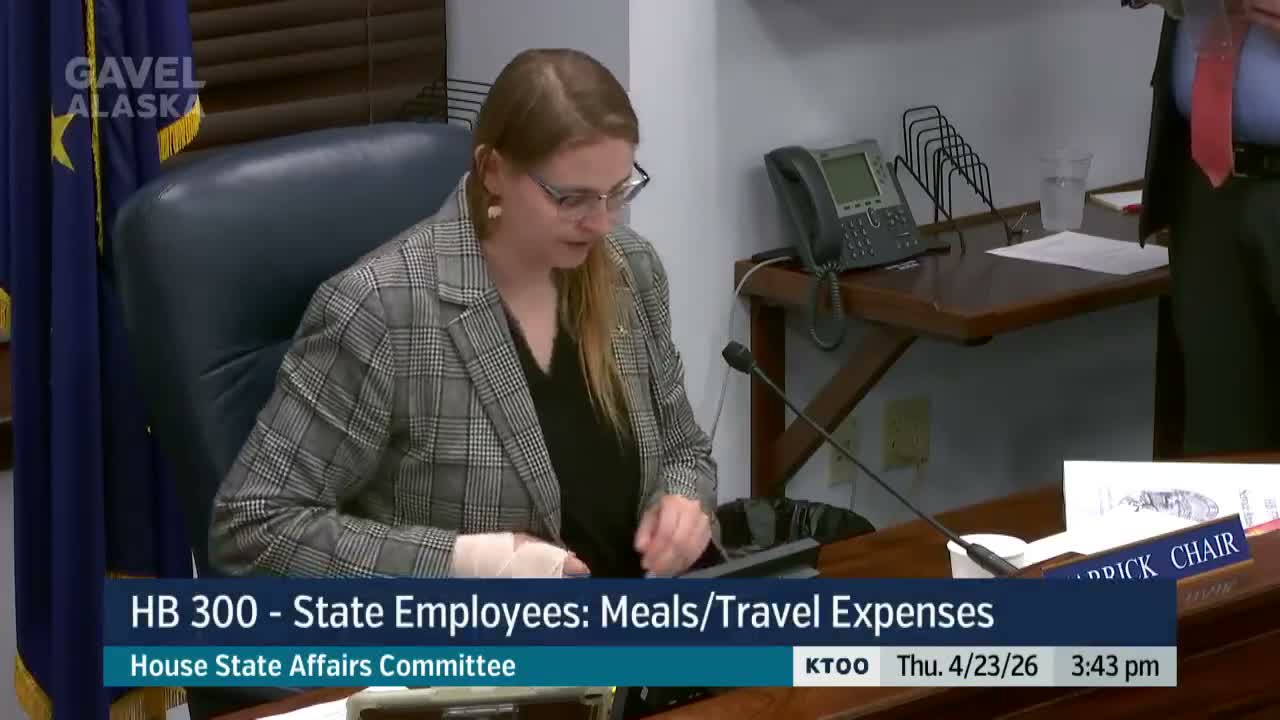
Representative Sarah Hannon told the House State Affairs Committee that House Bill 300 would update statutorily set in-state per diem rates that have not changed since 2010. "The current meals and incidental per diem rates for state employees for traveling in-state for work has not changed since 2010," Hannon said. She said HB300 would raise the short-term rate from $60 to $82 per day and the long-term per diem from $33.33 to $45, and require that every three years the rates be adjusted for inflation using the Alaska Urban Consumer Price Index.
Public witnesses supported the measure. Scott Lee, a 29-year Department of Transportation employee, described the high cost of food and supplies in remote Alaska and told the committee he could not live on $33 a day during longer assignments. "A sandwich and a cooler at the tribal store cost $12," Lee said, arguing that per diem increases and indexing would help employees avoid subsidizing state operations out of pocket. Flynn Casey, a Juneau resident and state employee, said she collected 43 digital signatures in support and cited a 40% rise in the Alaska urban CPI since 2010. Jesse Sloan, president of a supervisory unit representing about 2,500 state supervisors, said HB300 "is the most significant improvement to state employee per diem in a generation," while noting it is not full parity with federal rates.
Committee members pressed the sponsor about alternatives. Representative McCabe said tying state per diem to federal tables (IRS/DOD/GSA locality rates) "makes a whole lot of sense" and offered to propose that amendment; Hannon said she would be open to increasing the bill's figures or tying rates to federal schedules. Staff told members that fiscal notes are generated after the first hearing; the sponsor expected multiple fiscal notes from agencies, plus notes from the university and courts.
The committee closed public testimony and set HB300 aside to return early next week; members indicated they will set an amendment deadline so the committee can act the following Thursday.