Get Full Government Meeting Transcripts, Videos, & Alerts Forever!
Get email alerts on the Fiscal Outlook topic
No spam. Unsubscribe anytime.
Legislative Finance director warns of revenue timing risk as ACFR shows FY‑25 surplus; outlines FY‑27 scenarios
Summary
Alexi Painter, director of Legislative Finance, told the Senate Finance Committee that oil‑price volatility and timing of federal reimbursements make revenue unpredictable; the ACFR showed an unexpected FY‑25 surplus and Painter presented FY‑27 scenarios including a senate surplus if conservative oil and placeholder assumptions hold.
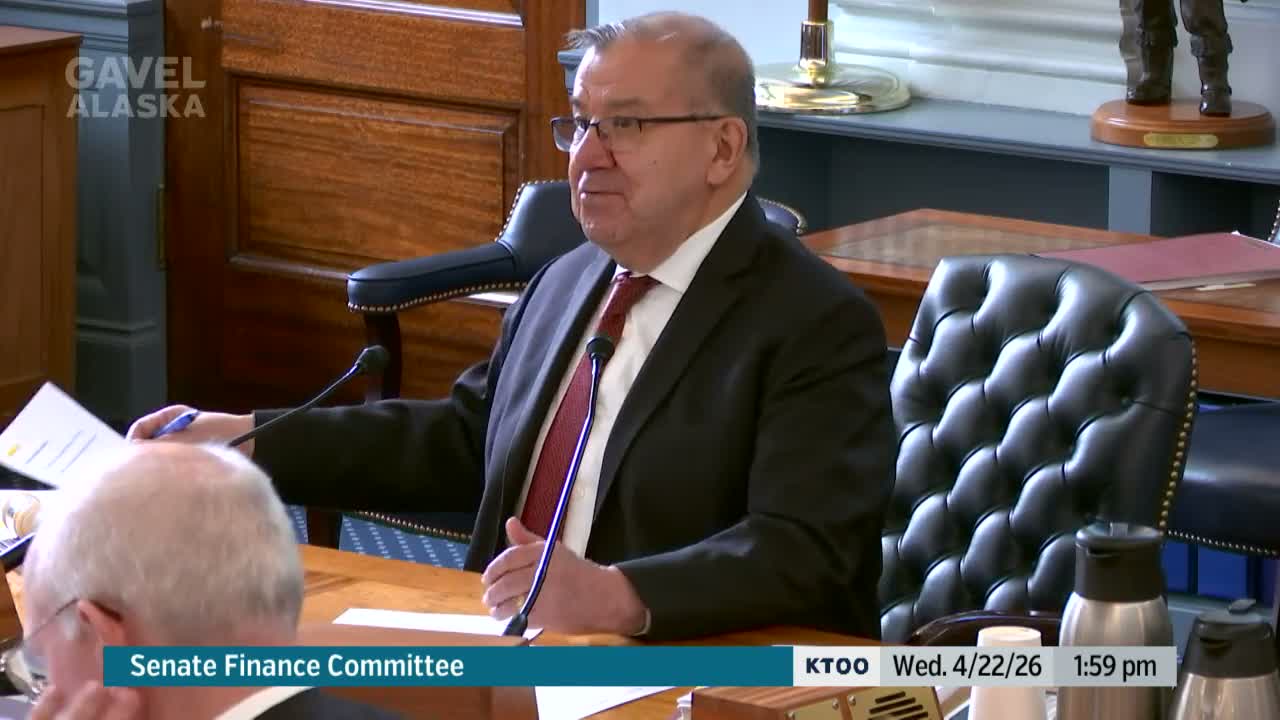
Alexi Painter, director of the Legislative Finance Division, briefed the Senate Finance Committee on April 22 about short‑term revenue volatility and the implications for FY‑26 and FY‑27 budgeting.
Painter opened by noting oil prices have been volatile since the spring forecast and that short‑term revenue is especially uncertain because payments‑based revenue (for example, corporate income tax) may not match liability timing: "oil prices have remained volatile ... the assumption in the spring forecast was that oil would average just over $91 between March and June," he said, adding that price swings of $10 a day have occurred and that revenue translation is uneven in the short term.
Painter explained the ACFR for FY‑25 surprised budget writers by showing an approximate $160 million surplus after post‑audit revenue adjustments, release of agency encumbrances and receipts that materialized after initial projections. That surplus affects whether a previously appropriated $129.6 million transfer to the Higher Education Fund counts as an FY‑26 expenditure or as a FY‑25 reversal; Painter said the administration and auditors are still determining how to treat that item and that the resolution could materially change FY‑26 finances.
He presented several FY‑27 scenarios: using current appropriation assumptions, the governor’s budget shows a deficit (~$1.16 billion), the House position shows a deficit (~$111 million) and the Senate bill (as presented) shows a surplus (~$236.8 million). A co‑chair scenario that budgets at $73 per barrel of oil rather than $75 reduces revenue by about $68.8 million and leaves the Senate with a smaller surplus consistent with a $50 million buffer the committee target sought to retain.
Painter emphasized caution in budgeting and recommended using a backstop fund rather than spending every dollar of projected revenue: "I would encourage the legislature to generally adopt some caution, not try to spend literally every dollar that's projected to be available," he said, noting the constitutional budget reserve has historically been used as a backstop.
Committee members asked about steps to reduce ACFR delay; Painter cited staffing and the administrative work needed to reconcile swept balances and agency accounting as primary drivers of the lag and said the Division of Finance has been working to improve timing. Committee discussion also touched on efforts to quantify a standard variable to account for revenue volatility; Painter said work has been ongoing for years but progress is limited by staffing.
Ending development: Painter concluded with modeled scenarios showing the Senate bill’s topline compared with the governor and House positions and cautioned that additional governor amendments and final accounting treatment could change outcomes; the committee took no immediate action beyond receiving the report.