Get Full Government Meeting Transcripts, Videos, & Alerts Forever!
Get email alerts on the State Budget topic
No spam. Unsubscribe anytime.
Senate Finance Committee adopts operating‑budget committee substitute with $13.83B topline, $1,000 PFD and energy relief
Summary
The Alaska Senate Finance Committee adopted a Senate committee substitute for the operating budget that totals about $13.83 billion and includes a $1,000 permanent fund dividend, $96 million in energy relief, up to $100 million in one‑time K‑12 grants, increased community assistance and disaster relief funding, and several contingency and staffing items.
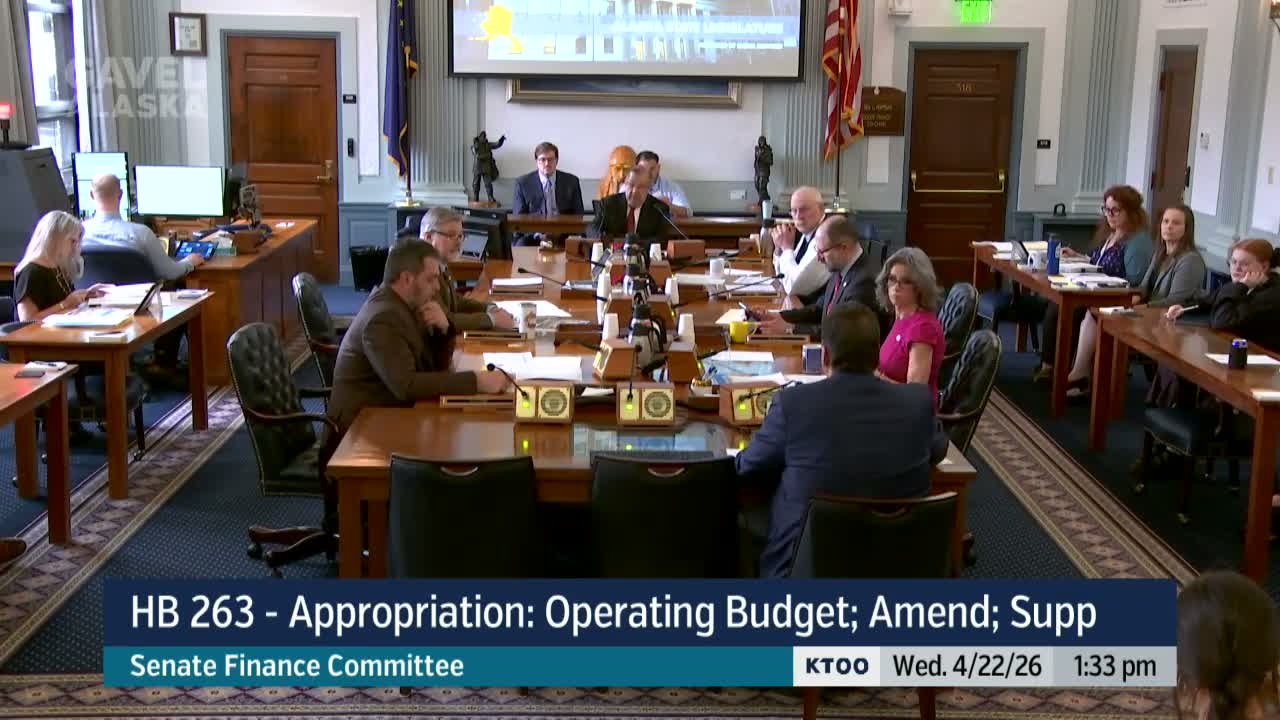
The Alaska Senate Finance Committee on April 22 adopted a Senate committee substitute for the FY‑27 operating budget that appropriates about $13.83 billion in combined funds and adds targeted supplementals for energy relief, education, disaster response and agency needs.
Committee staff member Pete Eklund told the committee: “The CS in front of you appropriates the following amounts … 6,210,000,000 of unrestricted general funds, 1,040,000,000 of designated general funds, 2,060,000,000 of other funds, [and] 4,520,000,000 of federal funds for a combined total of $13,830,000,000.” The motion to adopt was made by Senator Stedman and adopted as the committee’s working document after no objections were heard.
Why it matters: the substitute moves a full market‑value transfer of roughly $3.997 billion from the Permanent Fund to the general fund for FY‑27 and sets a $1,000 permanent fund dividend, while reserving $50 million as a buffer for next year. The CS also directs an immediate $150 per‑person energy relief payment funded through the dividend (estimated at $96 million) and provides up to $100 million of one‑time general funds to be distributed to school districts outside the base student allocation formula.
Key allocations and policy changes described by staff include a $650,000 independent cost‑driver study for the Department of Corrections (to be procured by the Legislative Budget and Audit Committee), a reversal of previously proposed decentralization of payroll and shared services for the governor’s office, creation of a new lieutenant governor appropriation, and insertion of standard abortion‑prohibition language into the Department of Health number section. The CS also increases the disaster relief fund from $24 million to $48 million and adds $5.3 million to the renewable energy fund.
The CS includes several personnel‑ and contract‑related actions: additional staff in the Department of Revenue (an assistant chief economist and two commercial analysts), salary‑and‑benefit contract approvals for multiple bargaining units (including correctional officers and Fairbanks firefighters), and a DOA cap of $18.5 million on lapse authority to target reserve balances for the group health and life benefits fund.
On Power Cost Equalization and community assistance, staff said the CS sets the PCE program estimated full cost at about $56.1 million, establishes a backstop using prior PCE earnings to cover an estimated $88 million program cost if necessary, and adds $10 million (plus a separate $20 million subsection) to boost community assistance payments for high‑cost communities. The CS also reallocates certain program receipts and carries forward language intended to reduce future sweep impacts.
Several appropriations in the CS are contingent or informational: a $15 million federal (and $750,000 university) appropriation for a critical mineral accelerator at UAF is contingent on a National Science Foundation grant to UAF in calendar year 2026; language provides estimated investment‑management costs attributable to specific funds for informational purposes; and multiple language‑section supplementals (judgments, settlements and multi‑year legal defense) were described.
What the committee said: after Eklund’s presentation, Chair Senator Hoffman opened the floor to questions and then removed his objection; with no further objections the CS was adopted as the committee’s working document. Senator Stedman moved adoption. A rollcall vote was not recorded on the transcript; the record shows adoption by unanimous consent (“Seeing none, that CS is adopted”).
Next steps: the committee set the CS aside for further consideration; amendments to the operating budget were due to Pete Eklund by 4 p.m., and the committee reconvenes the following morning for further business.
Ending note: the CS contains a mix of immediate FY‑26 supplementals and FY‑27 number‑section appropriations; staff emphasized several items are contingent on later federal receipts, grant awards, or administrative accounting determinations that could affect final costs.