Get Full Government Meeting Transcripts, Videos, & Alerts Forever!
Get email alerts on the Student Assessment topic
No spam. Unsubscribe anytime.
Bullitt County presents spring benchmark data: elementary gains, mixed middle/high school results
Summary
Chief Academic Officer Dr. Brandon Howard told the board that elementary students showed notable gains on spring benchmarks and iReady projections, with about 60% on grade level in elementary and areas for growth in reading comprehension, while middle and high school performance was more mixed; the district plans curricular steps including CommonLit expansion and math HQR adoption.
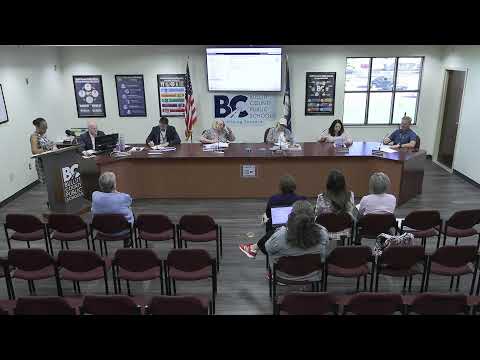
Chief Academic Officer Dr. Brandon Howard presented the district's spring benchmark data and iReady projections during the superintendent's report, highlighting measurable gains at the elementary level and persistent challenges in middle and high school.
Dr. Howard said elementary scores reflected an increase: "elementary had an increase of about 6% from KSA, but an increase overall throughout the year of 23," and reported that roughly 60% of elementary students are on grade level, with 29% one grade level behind and 12% two or more grade levels behind. He singled out kindergarten and third grade as strong performers: "kindergarten though 88 percent of our kiddos are on grade level" and third graders were performing very strongly.
Middle school reading showed roughly 38% on grade level, with 24% one grade level behind and 39% two or more grade levels behind. Dr. Howard noted that middle-school projections were in line with last year's spring results and that the district will expand a CommonLit pilot to all middle-school units next year.
On high school performance, Dr. Howard said ninth-grade projected proficiency dipped from 41% to 35% in the spring projection, while tenth graders — who take the KSA — showed a 4% proficiency increase from fall to spring in some measures. He described a new ability to view results "by period" in high school, allowing more targeted interventions.
In math, elementary schools showed strong novice reduction with approximately 52% of elementary students on grade level in math; middle and high school trends were more variable. Dr. Howard said the district is considering a math HQR to promote student discourse and problem-solving and will maintain alignment with revised KDE secondary modules and standards.
Superintendent and board members asked about parent-facing data. Dr. Howard said individual student letters are sent after each assessment and the district will explore more holistic, school-level reporting in newsletters.
The presentation closed with plans to use the remaining six weeks of the school year for targeted interventions and for the district to continue monitoring projections ahead of KSA testing.