Lifetime Citizen Portal Access — AI Briefings, Alerts & Unlimited Follows
Mid Prairie tells Waseca County board it expanded mobile crisis coverage, eyes voluntary gun-storage pilot
Loading...
Summary
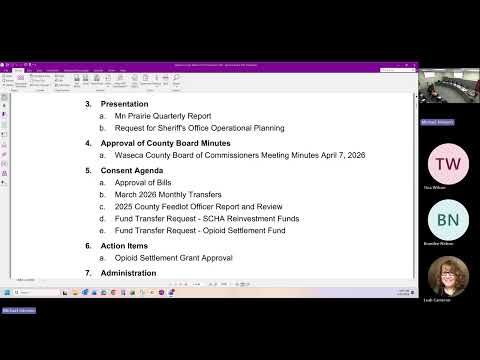
Mid Prairie presented a quarterly report to the Waseca County Board on May 20, outlining expansion of mobile crisis coverage across four counties, SERC admission updates, widespread Narcan distribution at community events, and a planned AI assistant to speed eligibility work. The agency also described challenges placing youth and state-driven child-welfare changes.
Mid Prairie staff briefed the Waseca County Board on May 20 about recent expansions to mental‑health crisis services and several operational initiatives, including a voluntary weapon‑storage pilot and an AI assistant intended to speed eligibility work.
Tara (Mid Prairie staff) opened the presentation and introduced three program managers. Tina Rentz, program manager for adult and disability services, said Mid Prairie became the fiscal host for mobile crisis services covering Dodge, Steele, Waseca and Le Sueur counties in January 2025 and that Sparrow is the contracted mobile crisis provider. Tina said the region has worked to connect schools, law enforcement and community partners to the mobile crisis pathway and that SERC, an intensive crisis residential unit in Rochester, now requires a mobile crisis assessment before admission to ensure wraparound services and linkages to stabilization supports on discharge.
On preventing crisis escalation, Tina described an exploratory, voluntary weapon‑storage pilot coordinated with Sparrow and local law enforcement to offer temporary, secure storage for individuals undergoing significant mental‑health crises. "One thing that we lack in our area is a place for people that are having a mental‑health crisis to store weapons when they're going through that situation," she said, and staff reported DHS gave a positive initial response to the concept.
On substance use and overdose prevention, Mid Prairie reported it has received nasal naloxone kits from the state under a referenced statute and used them for outreach. Staff said 24 kits available at a recent Dodge County expo were exhausted within two hours and that law enforcement has reported using two to four kits per overdose response. "Narcan can help save lives," the presenter said, noting the medication is appropriate for accidental prescription opioid events as well as overdoses tied to substance‑use disorder.
Child and family services manager Patty Harrelson highlighted kinship‑care work supported by a state grant (extended through Dec. 31) and said the county assigns permanency workers specifically to kinship families. She warned of challenges from proposed or pending legislative changes—such as altered juvenile classifications and tighter compliance in child protection—and stressed training and cultural‑competence work already underway.
Diane, manager of income and health care assistance, reviewed caseload and program metrics. She said the region recorded an average annual eligibility caseload of 11,444 cases in 2025 and processed about 410 new applications per month. On SNAP timeliness, Mid Prairie reported a 2024 performance of 94.4%, above regional and statewide averages. Diane also described a pilot rollout of an AI assistant called EVA with phone, desktop companion and rights‑and‑responsibilities interview components; staff said the implementation project was in early weeks with a target for implementation by June.
Speakers acknowledged constraints: outdated state systems, limits on county ability to break out county‑specific figures from centralized databases, and the difficulty of identifying local placements for youth with high needs. The board invited further county‑level breakdowns and follow‑up on the EVA timeline and the proposed weapon‑storage approach.
The presentation closed with staff offering to provide additional, county‑specific data and with board members thanking Mid Prairie for engagement and the detailed report.