Get Full Government Meeting Transcripts, Videos, & Alerts Forever!
Get email alerts on the Vegetation Ordinance topic
No spam. Unsubscribe anytime.
Eddy County Commission tables vegetation-nuisance ordinance after heated debate on buffers, enforcement and property rights
Summary
After a public hearing on proposed Ordinance O-26 §145, the Eddy County Commission voted to table the measure and form a rural-stakeholder committee to rework language on buffers, the 12-inch threshold and enforcement powers.
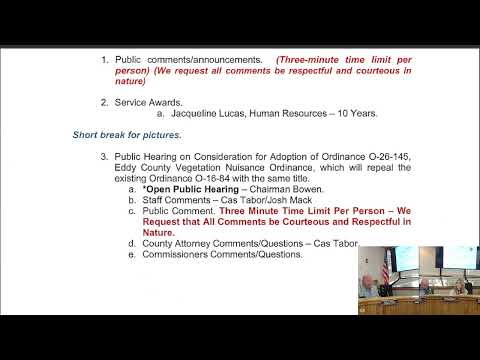
The Eddy County Commission opened a public hearing on proposed Ordinance O-26, Section 145 — a vegetation-nuisance ordinance intended to replace Ordinance O-16-84 — and after extended discussion voted to table the draft and form a committee of rural stakeholders to revisit the language.
Commissioners and members of the public clashed over three central issues: removal of an existing 300-foot buffer, a 12-inch height threshold for nuisance vegetation, and how the county would enforce compliance. Staff told the board the draft had been revised to clarify exemptions for parcels over three acres and to explicitly name who may issue citations — "the fire chief and/or fire marshal or inspector of any county fire and rescue compliance division, the county sheriff or deputy sheriff, constable, or other law officers," staff said during the presentation.
The chair warned that the removal of a 300-foot safety buffer risked broadening the county's reach over private land, saying, "I don't believe that the government should be able to tell you what or how to maintain it." Other commissioners echoed concerns about applying a 12-inch standard countywide, noting that 12 inches is typically a city-level standard and that rural parcels can reach that height rapidly during spring growth.
Cost and staffing were central practical objections. Commissioners and members of the public highlighted the potential financial burden on owners if the county had to mow or remove vegetation and then place a lien to recover costs; one commissioner framed the estimate as roughly "$100 an acre to mow," noting that the county lacks the staff resources to execute mass enforcement within short compliance windows. Staff said the draft requires owners to make corrections within a 10-day compliance period and gives the county manager discretion to decide next steps, including whether the county sends crews to remedy violations and place liens when owners do not pay.
Agricultural exemptions were discussed at length. Staff told the board it had coordinated with the assessor's office to understand how ag exemptions are applied and how they might be rescinded for neglected land; commissioners said properly framed exemptions are essential so that working farms are not unfairly penalized while the ordinance targets long-term neglect and 'bad actors.'
A motion carried to table the ordinance and send it to a newly formed committee made up of rural stakeholders (rather than planning-and-development alone) to refine the language and return recommendations to the commission. The motion to table was made and seconded on the record and passed on a roll-call vote.
Next steps: staff will convene the rural stakeholder committee, invite participation from rural residents and farmers, and return revised language and recommendations at a later commission meeting. The public hearing remains open until the commission takes further action.