Get AI Briefings, Transcripts & Alerts on Local & National Government Meetings — Forever.
Committee advances broad right‑to‑repair bill after heated amendments debate
Loading...
Summary
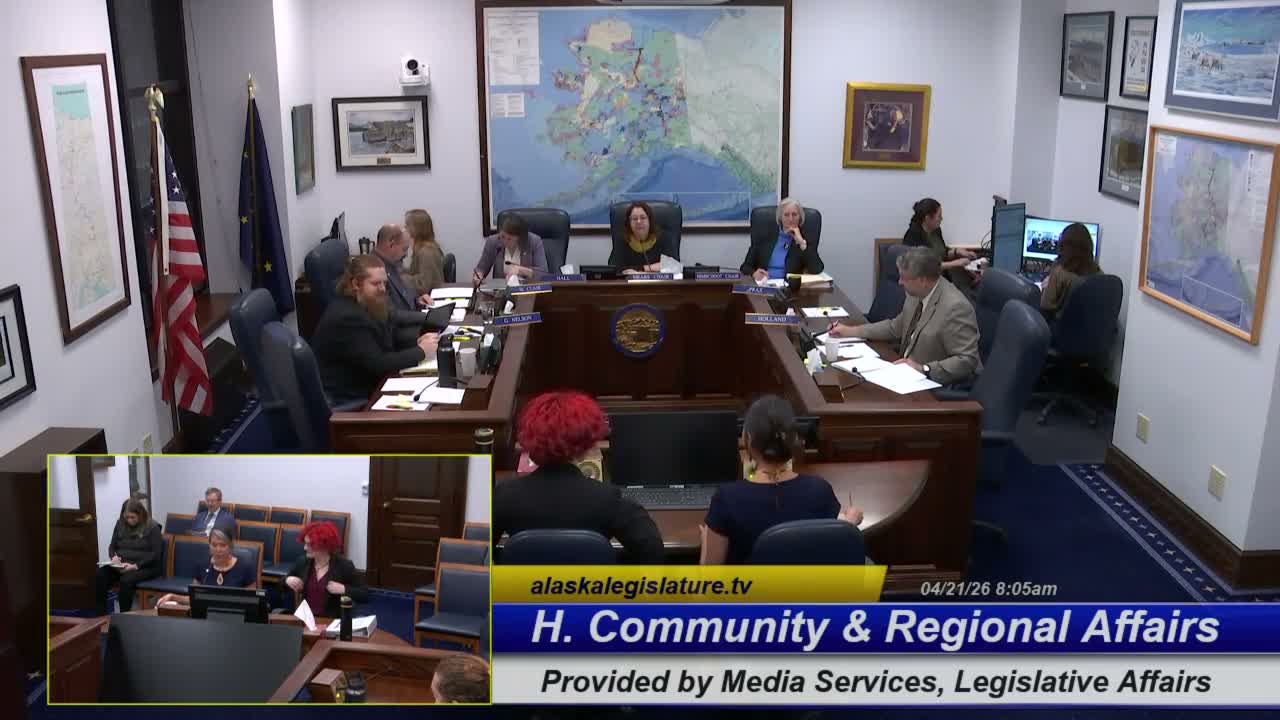
The House Community & Regional Affairs Committee on April 21 voted 4–3 to advance House Bill 162, a broad 'right‑to‑repair' measure by Rep. Maxine Divert, after adopting five of 10 proposed amendments including a change moving the bill’s effective date to 2029.
Representative Maxine Divert told the committee that House Bill 162 is intended to ensure Alaskans and independent repair providers can access the same documentation, parts and tools manufacturers make available to authorized repair networks. “When an Alaskan purchases a product, they should have a fair opportunity to maintain and repair that product,” Divert said, framing the bill as an access and competition measure with special relevance to rural communities.
Supporters said the measure would help people who live far from authorized service centers avoid costly shipping or travel for repairs, reduce waste going to landfills and support small Alaska repair businesses. Sponsor staff and outside advocates argued HB162 includes safeguards: it does not require disclosure of trade secrets, does not override anti‑theft or privacy protections, and does not force manufacturers to provide parts they no longer make.
The committee considered 10 amendments submitted by the deadline. Five were adopted and five failed or were withdrawn. Representative Garrett Nelson’s Amendment 1 (clarifying that only offending contractual provisions would be voided, not entire agreements) passed without objection. Amendment 2, adding an exemption for critical infrastructure as defined in statute, passed 5–2 after members debated security risks versus repair access.
A high‑stakes amendment (Amendment 3) to narrow the bill’s scope to consumer electronics and household appliances — sometimes described in debate as the "Bosch" carve‑out — was rejected 3–4 after members split over whether Alaska should adopt a targeted, consumer‑focused standard or a broader statute with enumerated exemptions. Several members argued the bill is currently broader than other states’ laws and that narrowing it would sacrifice benefits for many Alaskans.
Parts‑pairing language was a flashpoint. Representative Steve St. Clair’s Amendment 7 removed provisions that would allow manufacturers to require serialized or paired parts that only work with authorized equipment; proponents called parts pairing a tool manufacturers use to monopolize repairs. Sponsor staff warned pairing can be necessary for device configuration and safety, but the committee adopted Amendment 7 by a 4–3 vote.
Members also debated whether manufacturers should be allowed to recover hosting or distribution costs for software, firmware or documentation. Amendment 8, which permits reasonable charges under specified conditions, passed 4–3 after members said hosting and support infrastructure have legitimate costs.
Representative St. Clair’s Amendment 9, which would have exempted powersports (ATVs, snow machines and similar equipment), failed 3–4 amid testimony that many rural Alaskans rely on those vehicles and that modern units include digital controls that can require manufacturer tools to repair safely. Amendment 10 — which changes HB162’s effective date — was amended on the floor to set an effective year of 2029 and adopted 4–3; sponsor staff said the later date was acceptable to give manufacturers additional lead time if necessary.
After the amendment votes, Co‑chair Rebecca Himshoo moved HB162, as amended, out of committee with individual recommendations and an attached fiscal note. The motion passed 4–3 on a roll call, sending the bill to the Labor and Commerce Committee. The committee clerk recorded the aye votes and nay votes during the roll call.
What happens next: HB162 will go to the Labor and Commerce Committee for further consideration and any additional amendments. The committee noted the bill has had multiple hearings (this was described as the bill’s sixth hearing) and that sponsors and staff will continue to refine statutory language if the bill proceeds.
Quotes from the hearing
• Sponsor: “This bill is about access, fairness, and making sure our markets are working the way they should.” — Representative Maxine Divert
• On parts pairing: “Parts pairing has increasingly been used … to monopolize repairs. Manufacturers force consumers to go to their authorized repair providers in order to get parts serialized, which prevents them from installing or replacing parts that they would otherwise be able to do.” — Sponsor staff (Emma Sloczynski)
• On timing: “If it’s necessary to gain the support of the committee, then … we do support 2029 over 2031.” — Sponsor staff (Sarah Snowberger, reading for the sponsor)
Votes at a glance
• Final committee vote on HB162 (as amended): 4 ayes, 3 nays — motion to report to Labor and Commerce with individual recommendations and fiscal note (passed).
• Amendments: 10 filed; 5 adopted, 3 failed, 2 withdrawn. - Amendment 1 (t.8) — adopted without objection. - Amendment 2 (t.10) — adopted, 5–2. - Amendment 3 (t.7) — failed, 3–4. - Amendment 4 — withdrawn. - Amendment 5 — withdrawn. - Amendment 6 — withdrawn. - Amendment 7 (t.3) — adopted, 4–3 (removed parts‑pairing language). - Amendment 8 (t.4) — adopted, 4–3 (allows reasonable charges for hosting/distribution in limited cases). - Amendment 9 (t.5) — failed, 3–4 (powersports exemption not adopted). - Amendment 10 (t.6) — adopted, 4–3 (effective date amended to 2029).
Context and who it affects
HB162 would require manufacturers to provide to independent repair providers and product owners the same parts, tools and documentation they give authorized service providers under fair and reasonable terms, subject to trade‑secret, privacy and anti‑theft exclusions the bill preserves. Supporters said it’s especially important for rural Alaskans who face long travel distances and high shipping costs for repairs; opponents raised concerns about security for critical infrastructure, intellectual property and impacts on small businesses that rely on dealership business models.
Next steps
The bill moves to the House Labor and Commerce Committee for further consideration. If advanced out of that committee, it could proceed to the House floor for additional debate and votes.