Get Full Government Meeting Transcripts, Videos, & Alerts Forever!
Get email alerts on the Solar Policy topic
No spam. Unsubscribe anytime.
Commissioners weigh solar limits, decommissioning bonds and farmland protections
Summary
Planning commissioners reviewed MACO draft standards and a county exercise mapping transmission corridors and preservation areas, discussed a 2,000‑acre county cap on utility solar, and raised legal and financial concerns about allowing developers to deduct salvage value when calculating decommissioning bonds.
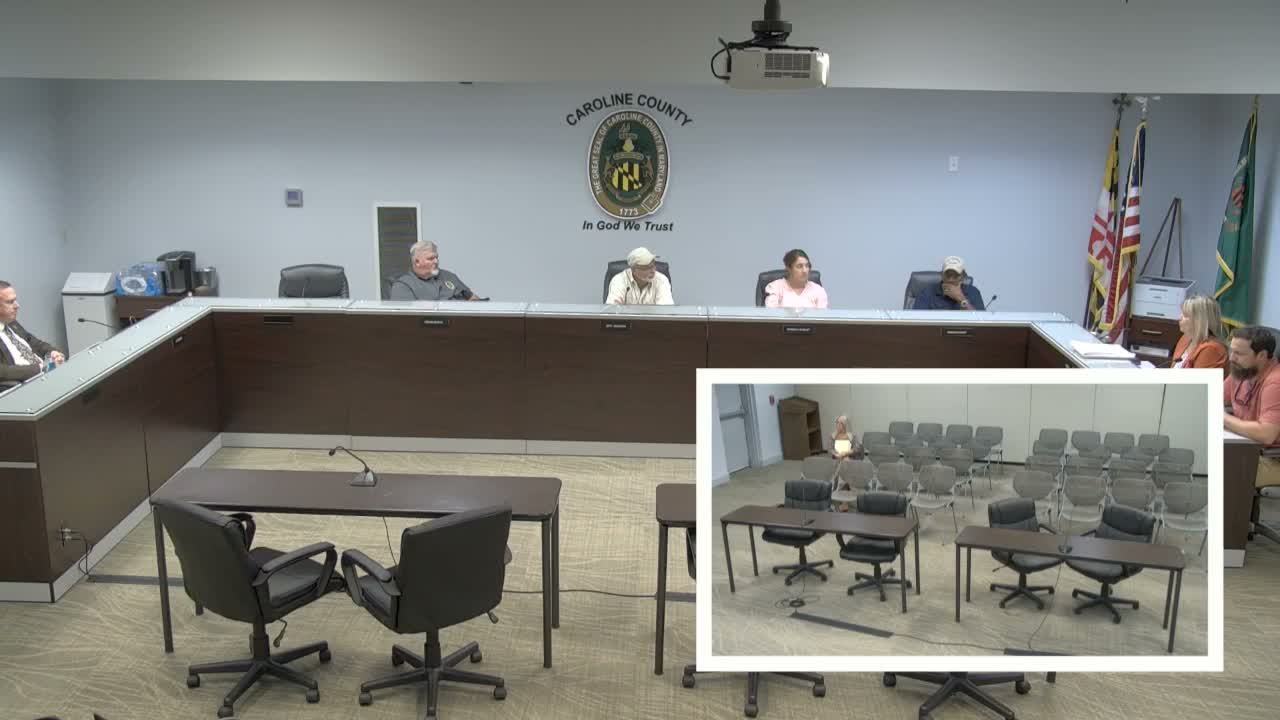
Caroline County planning commissioners spent a large portion of their September meeting reviewing regional and state-level work on utility-scale solar siting and exploring local strategies to protect prime farmland and preserve county control.
Staff summarized Maryland Association of Counties (MACO) work-group draft standards that suggest prioritizing siting within a two‑mile corridor of major transmission lines. Commissioners asked staff to run a county mapping exercise that layers transmission corridors, preservation areas (wetlands, critical areas, forest‑conservation easements and town growth areas) and buildable urban footprints so the county can quantify urban vs. rural potential acreage and make an evidence-based policy case.
Commissioners said the county currently has a 2,000‑acre cap for utility-scale solar and reported staff was instructed to turn away projects that would exceed that cap. Several members urged an "offense" strategy—preparing data, testimony and legal arguments in advance to defend local siting choices if the state or the Public Service Commission seeks to limit county authority.
County staff also described an exchange with the Maryland Public Service Commission about decommissioning requirements. Staff said Cherrywood Solar submitted plans that deduct salvage value from the total decommissioning cost, reducing the bond amount. A county official responding to the PSC warned this approach can leave counties exposed if a developer later goes bankrupt, because equipment is often encumbered by a financing statement and the county is not guaranteed recovery from salvage proceeds. "It's smoke and mirrors to deduct salvage value from a decommissioning bond," the county official said, adding that a full-value bond better protects the public and lessors if a developer abandons equipment.
Commissioners and staff reviewed county agriculture data and soil-classification layers. Staff reported Caroline County holds roughly 91,000 acres of prime farmland and 51,000 acres of statewide‑importance farmland (about 142,000 acres identified as priority farmland out of the county’s roughly 200,000 acres). Commissioners asked staff to model scenarios showing how much energy could be produced if the county steered projects toward rooftops, parking lots or highway medians, and to calculate the megawatt yield of available urban acreage versus rural fields.
Several commissioners also requested outreach to farmers and landowners so they understand lease terms and long-term implications for property taxes and land use if they sign long-term leases for solar. The commission discussed potential county and regional coordination with the Department of Agriculture and suggested bringing MACO legislative staff and other experts to brief commissioners in future sessions.
What happens next: staff will prepare mapping and capacity exercises, continue communication with MACO and the commissioners, and coordinate possible briefings from legislative staff and ag‑sector representatives so the county can refine its local strategy ahead of the legislative session.