Get Full Government Meeting Transcripts, Videos, & Alerts Forever!
Get email alerts on the State Legislation topic
No spam. Unsubscribe anytime.
Renton staff outline wins and shortfalls after 60‑day state legislative session
Summary
City staff told the council the session produced a mix of outcomes for Renton: $500,000 for a local resource center and a scope change that unlocked bike‑lane capital funds, but no new state money for city‑run indigent defense and ongoing transportation funding pressures. Staff urged sustained outreach to legislators ahead of 2027.
Eric Perry, the City of Renton's government affairs manager, told the council the recent short (60‑day) state legislative session produced both victories and setbacks for the city.
Perry said Renton secured $500,000 for a resource/stabilization center, including a $206,000 reappropriation from the housing repair and assistance program, and unlocked a scope change that released earlier capital dollars for the Southeast 168 streets bike lanes and safe crossings project. "We will spend that money," one presenter said, describing the city’s intent to move the funds into programming and services.
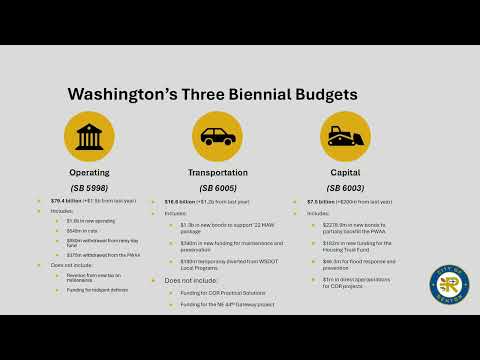
At the state level, presenters described broader fiscal strain: three supplemental budgets increased in size but were balanced amid negative revenue forecasts, high interest rates and inflation. David Foster, the city’s contract lobbyist, said the budgets relied on shifting dollars and some bonding, and he corrected an earlier typo to note the session authorized about $278,000,000 in new bonds.
Perry flagged several outcomes with direct implications for municipal operations: the Legislature tightened rules around the use and public‑records disclosures for automatic license plate readers (ALPRs), adding exemptions and standards for volunteer use and creating a civil cause of action tied to arrests when officers wear face coverings. "It was a bill of compromise," Perry said about the ALPR package and thanked state senators who engaged with cities’ concerns.
On indigent defense, Perry said the session produced no new funding for city‑managed services, no policy clarification about the Supreme Court’s caseload authority, and no task force to study sustainable options — outcomes Renton will continue to press in future sessions.
The session also produced a statewide income tax on very high earners (referred to in testimony as Senate Bill 6346). Foster cautioned the council that court challenges and possible voter referenda could delay any collected revenue: if upheld, the law would not take effect until 2028 and would begin producing funds in 2029, he said.
Housing and land‑use changes were also significant. Presenters described Senate Bill 6026 (mixed‑use development rules) and House Bill 2266 (requiring jurisdictions to allow 'step housing' in certain zones). Renton staff said they secured carve‑outs to preserve commercial areas and transit‑oriented development protections but will need to update local strategies and the comprehensive plan over time.
Perry also reported a legislative win: the council’s goal to stop a statewide preemption on local regulation of urban encampments (noted as House Bill 2489) succeeded this year. Other session outcomes included a new statewide work group on electric motorcycles and changes to small works roster caps to reflect rising labor and material costs.
Councilors pressed staff on next steps. Several members urged a sustained summer‑and‑fall outreach plan — including tours of local projects and coordinated meetings with Renton’s legislators — to build greater understanding in Olympia of the city’s needs. Foster noted 2026 is an election year for many legislators and said the next legislative session will begin Jan. 11, 2027, running through April 25.
Perry and Foster said they will continue to press for funding on transportation priorities and indigent defense and will brief the council on follow‑up steps and opportunities for local engagement.
The council did not take any formal votes during the presentation.