Get Full Government Meeting Transcripts, Videos, & Alerts Forever!
Get email alerts on the Running Start topic
No spam. Unsubscribe anytime.
Students and board members raise concerns as running-start course caps limit summer access
Summary
Student representatives and board members said the running-start cap enacted in the 2026 session will reduce summer course access; the board discussed constitutional funding constraints and whether WEA should play a role in supporting dual-credit programs.
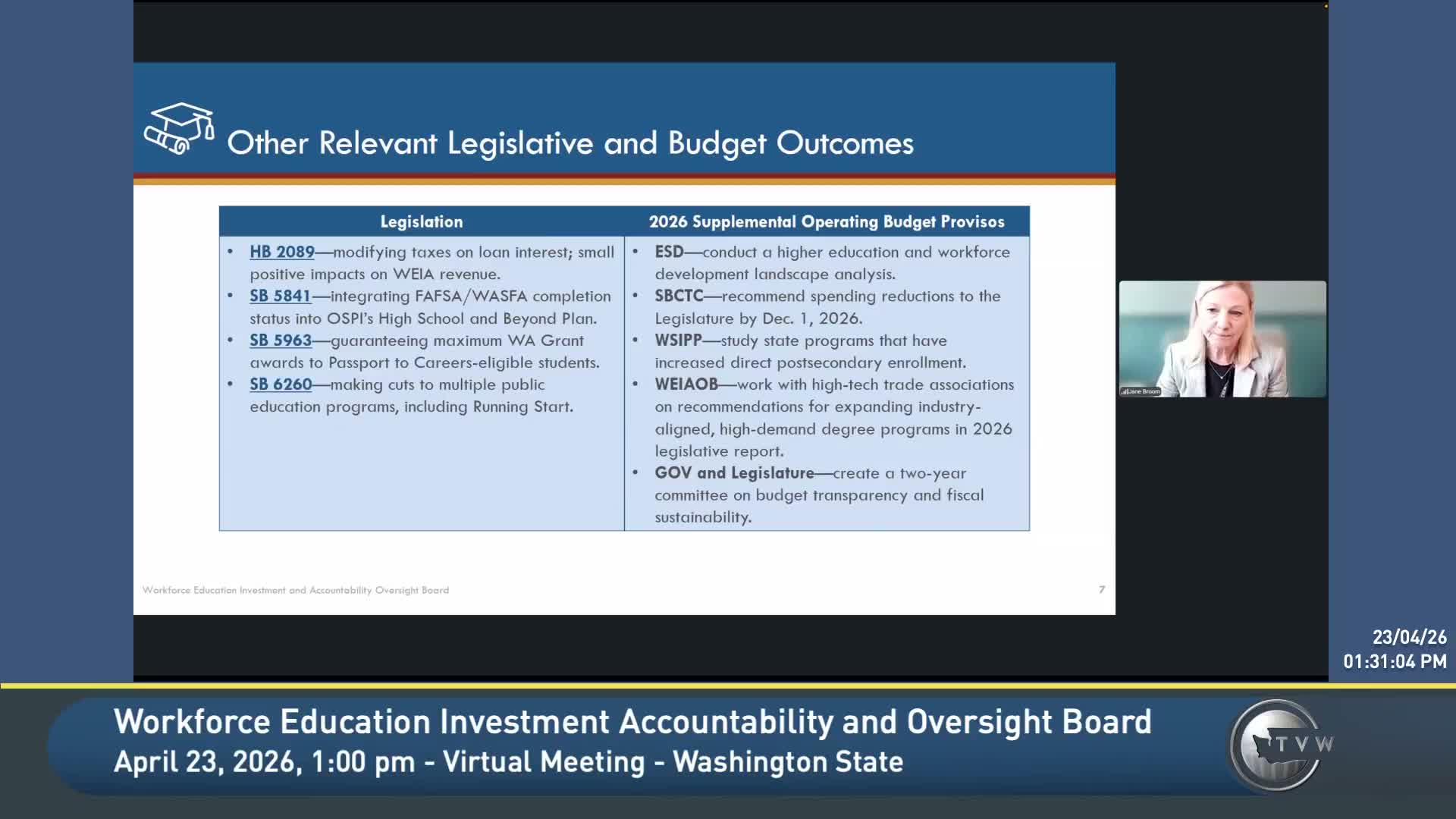
Students and board members at the WEA board meeting expressed concern that the running-start cap in the 2026 budget will constrain students’ ability to take multiple summer courses, and they discussed whether WEA funds should be used to support dual-credit programs.
Molly Kuahara, the student representative, said students she spoke with at Tacoma Community College were "disappointed" by the restriction and noted that running start summer offerings previously allowed more credits. "From all the students who I have talked to on campus...everybody is disappointed by running start being more constricted," Molly said.
Board members and partners cautioned that running start is funded through basic education appropriations and that routing general-running-start funding through WEA risks supplanting constitutionally protected K–12 dollars. Reuben Flores noted that "running start is directly funded through BEA dollars," and said WEA could consider supporting related costs (for example, materials) but that core running-start funding is tied to K–12 formulas.
Jeff Vincent and other members discussed principles of non-supplanting and the board’s role. Jeff said he was "open minded" to ways WEA might support dual-credit programming while maintaining the board’s statutory commitment not to supplant other funding sources.
Members and students agreed the change will disproportionately affect summer running-start participation and urged the board to track downstream access impacts. The board did not adopt a funding change in the meeting but asked staff to examine options and to provide further analysis on whether WEA appropriations could be used in limited, non-supplanting ways to support dual-credit access.
The board’s conversation flagged both the policy constraint (constitutionally protected K–12 funding formulas) and practical impacts (reduced summer credits), and it directed staff to follow up with more precise options analysis before pursuing any funding recommendations.