Get AI Briefings, Transcripts & Alerts on Local & National Government Meetings — Forever.
Board of Equalization approves audits and procedural corrections; adopts AAB work‑group recommendations
Loading...
Summary
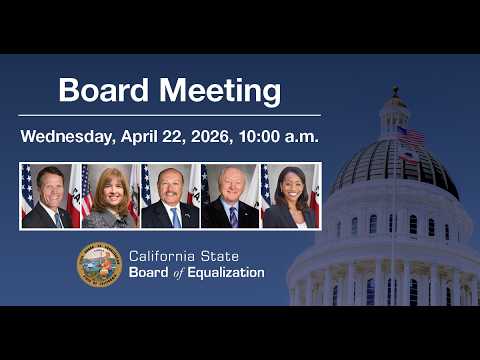
At its April 22 meeting the State Board of Equalization approved role corrections and two state-assessed property audits, accepted work‑group minutes and unanimously adopted three recommendations to streamline appeals processes; several items passed by roll call with one member absent.
The State Board of Equalization on April 22 voted to adopt a series of staff-recommended corrections and audit findings and approved a package of work‑group recommendations intended to streamline assessment appeals.
Members approved a staff role correction to remove improperly retained improvement values from the 2023 state-assessed roll after Jack McCool, chief of the State Assessed Properties Division, explained the change followed a lease termination that had already moved land value to county jurisdiction. Member Vasquez moved the correction, Member Schaefer seconded, and the board approved the motion by roll call; Chair Lieber, Member Vasquez, Member Schaefer and Controller Cohen voted yes and Vice Chair Gaines was recorded absent.
The board also adopted two completed state-assessed property audits. Staff presented an audit of DCR Transmission LLC recommending changes in assessed values for 2024 and 2025; Member Vasquez moved adoption, Member Schaefer seconded, and the motion passed by roll call with the same yes/absent pattern. A second audit, covering US TelePacific Corp., recommended value changes for 2021–2024; that motion likewise passed by roll call.
On the consent agenda the board approved the March 25, 2026 meeting minutes.
Separately, the board accepted the minutes and report of the AAB (Assessment Appeals Board) work group and unanimously approved three detailed recommendations developed by the group: directing the executive director to consider testimony during the next annual form review to explore simplification of the appeals application; developing advisory guidance (including a list of factors) for AAB members on "good cause" determinations for postponements or continuances; and affirming existing scheduling-coordination guidance encouraging clerks and assessors to share strategies while preserving clerks' scheduling authority. Member Vasquez introduced the motions and board members discussed timing, outreach and legal options before approving each motion.
Where the record shows roll calls, the clerk called each member's vote on the record. For items where a roll was recorded the votes were: Chair Lieber — Aye; Vice Chair Gaines — absent (or not present); Member Vasquez — Aye; Member Schaefer — Aye; Controller Cohen (or Deputy Controller depending on item) — Aye. The board recorded each action as adopted. The meeting moved on to executive reports and other agenda items after the votes.
What happens next: staff said counties and stakeholders will be engaged on form revisions during the regular annual review process and that guidance on postponements would be developed for board consideration; audits will be processed per existing notice and appeal timelines.