Get AI Briefings, Transcripts & Alerts on Local & National Government Meetings — Forever.
Board of Animal Services subcommittee proposes 'Owl in the Hood' pilot to install nesting boxes
Loading...
Summary
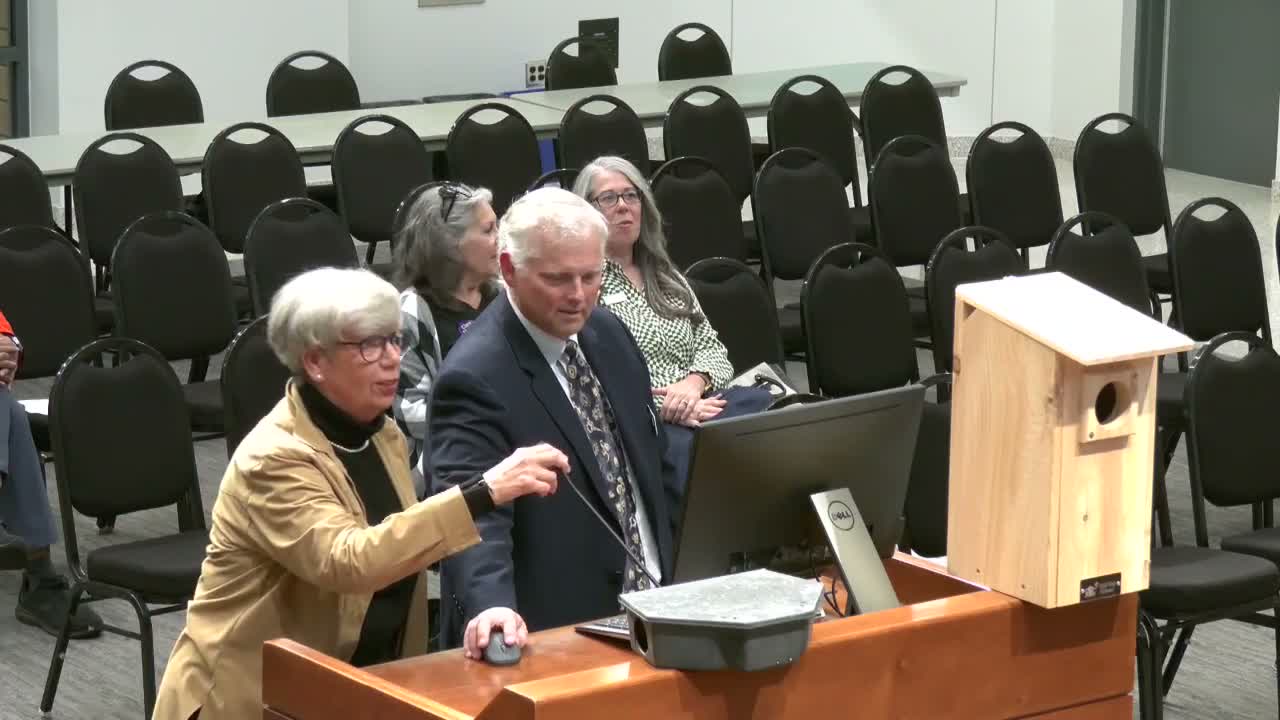
Members of the Board of Animal Services subcommittee presented 'Owl in the Hood,' a pilot to install owl nesting boxes on willing private properties in Flower Mound, enlist Eagle Scout volunteers to build roughly 20 boxes by September, and reduce rodenticide use; presenters stressed coordination with Parks & Recreation and household maintenance responsibilities.
Corina Vanleigh, speaking for a Board of Animal Services subcommittee, told the Flower Mound Historical Commission that a new pilot program called “Owl in the Hood” will place owl nesting boxes on interested private properties to boost biodiversity and reduce use of rodenticides.
"Installing owl houses promote ecological balance by reducing rodent population naturally without harmful rodenticides," Vanleigh said, describing a small/medium/large owl sizing guide and an information packet the subcommittee will distribute to residents.
The project will rely on local volunteers: Vanleigh said two Eagle Scout troops have committed to build about 20 owl houses by September and that residents may email the subcommittee with their address, phone number and a photo to request an evaluation. "We can provide you a house, but then it will need to go to the other commission because Eagle Scouts are not allowed on property of the town," she said, stressing that installation on town parks requires Parks & Recreation approval.
Commissioners and residents asked how species and placement would be determined. Vanleigh recommended starting with screech-owl boxes and conducting a site-assessment process to avoid clustering boxes in unsuitable locations and to ensure maintenance. "We're doing a lot of questions and answers... what would work best in our community," Bruce Monroe, a subcommittee member, said, describing plans for community events and possible on-site build activities at the animal shelter.
David McCarty, a local resident who works with raptor rehabilitation activities, described how screech owls and larger raptors use cavities and how species differ. "We have mom and dad coming in all night, every night... bringing in rats, lizards," McCarty said, noting that screech owls are opportunistic cavity nesters and that placement and height matter for success.
Presenters acknowledged responsibilities for ongoing maintenance: volunteers and residents must inspect and care for boxes similarly to birdhouses. They asked residents to contact the subcommittee by email for site visits and sign-ups; contact details were shown on the presentation slide. The commission thanked the presenters and encouraged coordination with Parks & Recreation and the town’s upcoming board-and-commission work session.
The commission did not take formal action on the pilot at this meeting; presenters were invited to seek feedback and to return with further placement and maintenance plans.