Get Full Government Meeting Transcripts, Videos, & Alerts Forever!
Get email alerts on the Municipal Budget topic
No spam. Unsubscribe anytime.
Council narrows reconciliation options: utility tax debate, grants increases and a hand vote to pause research on commercial licensing fee
Summary
Councilors discussed multiple reconciliation proposals: a proposed jump in the utility tax, narrower alternatives, adding funds to community grants and emergency assistance, and a majority hand vote to direct staff not to pursue additional research on a commercial occupancy licensing fee.
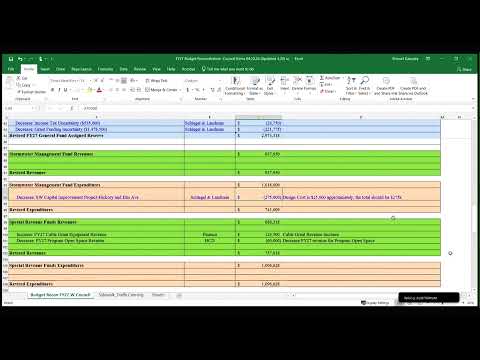
Councilors and staff moved from sidewalk discussion to detailed budget reconciliation questions, comparing two reconciliation spreadsheets and highlighting recent changes: an updated utility-tax revenue estimate and a $45,000 proposed decrease in public-parking revenue.
Paul Huebner and other public commenters questioned police spending in the proposed budget; Paul Huebner asked whether line items would recreate an emergency response team and urged council scrutiny of police equipment purchases. Melanie Starkey and other residents urged the council to reassess the size and value of a municipal police department in light of county services.
Councilors debated raising the utility tax as a revenue source: one proposal would increase the assessable rate to $5 (modeled on a neighboring municipality), while another more modest proposal would raise the rate to $2 (a 25¢ increment), producing very different revenue outcomes. Deputy staff confirmed the utility tax change would be reflected across a utility’s service area (not limited to Takoma Park), and staff noted Takoma Park represents a small share of PEPCO’s regional base (~0.65%).
Separately, councilors discussed a dormant commercial occupancy licensing fee (in the municipal code but never implemented). Staff described the administrative effort required to stand up the fee. After debate about staff capacity and priorities, council member Hansack moved and the council took a hand vote directing staff not to perform additional research on implementing the fee at this time. The motion carried with a majority in favor and three abstentions according to the record.
Councilors also discussed increasing community quality-of-life grants and emergency assistance to cover immigrant support and short-term income disruptions. Staff recommended routing certain cash-assistance programs through nonprofits for privacy and verification; several councilors suggested modest, immediate increases (for example, an additional $10,000 to emergency assistance and $60,000–$100,000 to community grants) while noting staffing and grant-administration constraints. The council will finalize revenues and appropriation adjustments during the reconciliation vote at the next meeting.