Get Full Government Meeting Transcripts, Videos, & Alerts Forever!
Get email alerts on the General Plan Review topic
No spam. Unsubscribe anytime.
General Plan Advisory Committee reviews San Anselmo draft plan; members press for clearer implementation, equity actions and map fixes
Summary
The San Anselmo General Plan Advisory Committee reviewed a draft comprehensive general plan, asked staff to clarify implementation timing and costs, urged stronger, measurable DEI actions, flagged map and table errors in open-space and land-use sections, and heard public comment critical of state-driven housing overlays.
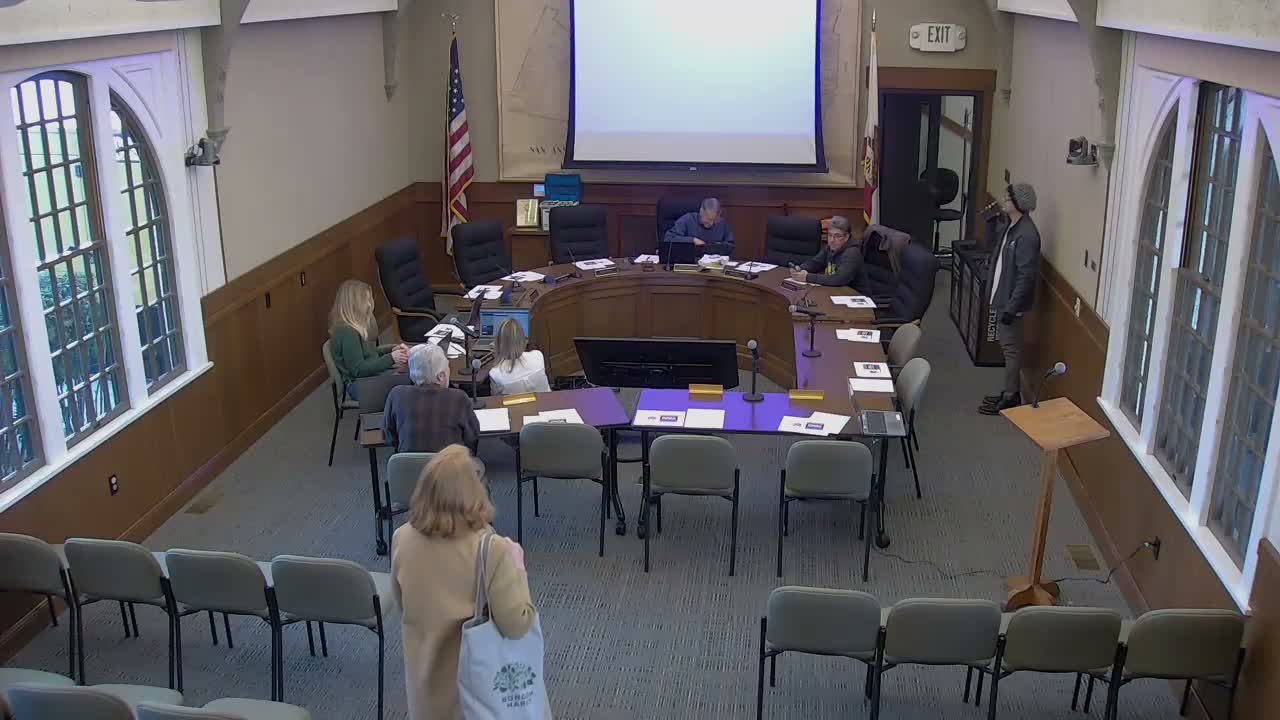
The General Plan Advisory Committee of San Anselmo Town reviewed a draft comprehensive general plan in a meeting marked by technical difficulties and detailed discussion about implementation, equity and mapping accuracy. Committee members heard staff and consultant presentations, took public comment from the town’s open-space co‑chair, and approved the previous meeting’s minutes by roll call.
Committee members and staff framed the session as an element-by-element review of the draft plan and its implementation matrix, which assigns responsible departments, timing (short-term/ongoing/long-term), and cost ranges (under $50,000 to over $1,000,000). Presenters said the Crestron AV system was down and that the meeting was being recorded on Zoom; they asked participants to enunciate so the posted recording would be a clear official record.
The committee’s discussion focused on three priorities: making the implementation plan easier to navigate and monitor; translating the plan’s equity and inclusion language into more specific, measurable actions; and correcting factual or mapping errors called out by the public and members. Members proposed that implementation entries show cost ranges or timelines inline with each action (to reduce cross‑referencing) and recommended a mix of annual reporting and a periodic five‑year check‑in to ensure the plan is actively tracked rather than shelved.
Several members praised the plan’s DEI language but said the implementation plan offered only a single action (training) tied explicitly to equity and inclusion. Speakers urged adding concrete measures — for example, requirements that town committees and council apply an equity lens to actions under their purview, clearer data-collection commitments, and protocols that move beyond training into operational checks and measurable targets.
Public comment came from Jonathan Ryan, co‑chair of the town’s Open Space Committee, who identified numeric errors in the open‑space tables (flagging Hawthorne Canyon Preserve acreage and other subtotals), said some special‑status species lists appear incomplete, and recommended adding a concise history of the town’s open‑space acquisitions. Ryan also criticized the land‑use narrative for not clearly acknowledging that recent high‑density mapping changes stem from state housing mandates rather than purely local choices; staff and committee members agreed to clarify language to better reflect that distinction.
Committee members raised a range of editorial and technical corrections: clarify greenhouse‑gas axes (label metric tons), consolidate repetitive action bullets (combine near‑identical items), add short explanatory text on reserve‑area maps, and use consistent terminology (for example, replace the word “beautification” with “streetscape design and improvements” to encompass traffic calming and infrastructure work). Staff said the EIR and existing‑conditions reports include longer historical context and that they would fold a concise paragraph about open‑space acquisition history into the general plan where appropriate.
On procedural business, the committee moved to approve the previous meeting’s action minutes (recorded in the transcript as moved “By Kim”). The roll call recorded a majority of yes votes with one member (Michaels) voting no and two members absent; the motion carried. The committee concluded by scheduling a June 11 meeting to review the plan together with the draft EIR after the Planning Commission and Town Council have considered it; final adoption is expected later in the year following public hearings.
What’s next: staff will correct factual errors called out during the meeting (table subtotals and map labels), add clearer metric labels and glossary entries, expand implementation items that operationalize equity goals, clarify where state housing requirements influenced land‑use designations, and return a revised draft to GPAC on June 11 alongside the draft EIR.