Get Full Government Meeting Transcripts, Videos, & Alerts Forever!
Get email alerts on the Water Infrastructure topic
No spam. Unsubscribe anytime.
Parker council backs using impact fees and bonds to build new water tower
Summary
After a months‑long design effort, Parker council directed staff to pursue financing that pairs $3.0 million in utility impact fees with revenue bonds — and to apply for state grants — to build an elevated storage tank estimated at $7–8.5 million. Council said the project is time‑sensitive to restore water pressure.
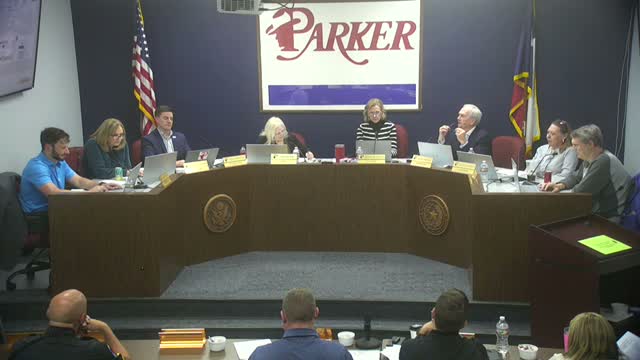
Parker’s city council on April 21 directed staff to pursue detailed financing proposals to build a new elevated storage tank, approving a recommendation that combines utility impact fees with revenue bonds and seeks grant funding where available.
The council’s finance subcommittee and staff presented a range of options, including paying for the project with cash, bonds, or a mix; the recommended approach was to use $3.0 million in utility impact fees as a down payment and issue revenue bonds for the balance, pursuing grants where possible. Councilmember Pilgrim, who chaired the subcommittee, summarized the recommendation and said the approach would preserve operating balances for other needs and spread the cost over the useful life of the facility.
“The design and engineering is virtually complete,” Pilgrim said. Estimates presented to council ranged from about $7.0 million on the low end to $8.5 million on the high end; construction time was estimated at 18–24 months. Staff noted that a rate study is required to set any changes to water rates once bond terms are determined.
Councilmember Sharp stressed urgency: “We are out of water pressure effectively,” he said, and argued that delay would raise costs and create service risks. Staff confirmed that bond market conditions and inflation argue for moving now rather than accumulating cash over multiple years.
Staff also told council there is an open state program (the WISIG allocation from the recent legislative session) that could award up to $5 million to shovel‑ready water supply projects. Staff recommended engaging a grants consultant and the city’s financial advisor to prepare a bond plan and a grant application; the council directed staff to proceed and return with firm bond proposals, bid documents and a timeline.
What’s next: staff will coordinate with a financial advisor to scope bond options (term, structure and projected rate impact), finalize construction bidding documents, and return to council with a recommended financing package and a water‑rate study showing the projected revenue requirement.
Funding and impacts: the subcommittee recommended using impact‑fee cash first and limiting use of utility construction reserves for maintenance and other non‑growth items. Councilmembers said they prefer revenue bonds for a long‑life asset so future beneficiaries help pay for it. Final debt amounts and rate impacts will be set after bids and the rate study are complete.