Get AI Briefings, Transcripts & Alerts on Local & National Government Meetings — Forever.
Michigan Supreme Court hears arguments in People v. Jennings over double-jeopardy standard
Loading...
Summary
The Court heard competing views on whether Michigan’s double-jeopardy clause should depart from the U.S. Supreme Court’s Kennedy test in favor of a broader bad-faith or overreaching standard; defense counsel said prosecutors 'weaponized' a defendant’s silence, the prosecutor urged the Kennedy test as workable, and an ACLU amicus urged abandonment of the 'compelling reason' barrier to independent state-constitutional interpretation.
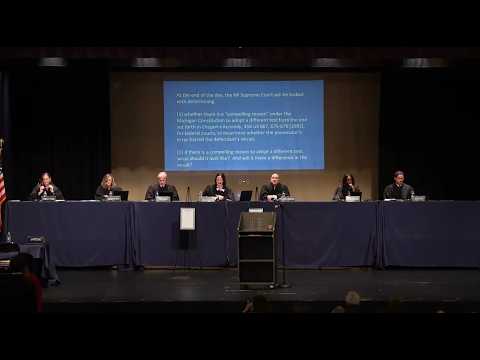
The Michigan Supreme Court on April 25 heard argument in People v. Jennings, a case that asks whether the state constitution provides broader protection against retrial than the U.S. Supreme Court’s decision in Oregon v. Kennedy. Defense counsel Jason Eggert told the justices state constitutions can and should be interpreted independently and urged the court to apply a bad-faith or overreaching test, not the narrower Kennedy standard.
"State courts and constitutions play a vital role in protecting and defining individual rights," Eggert said, arguing that Kennedy "frustrates [the] purpose" of the double-jeopardy clause because it requires proof that a prosecutor subjectively intended to provoke a mistrial. He told the court that, in his view, the prosecutor in the underlying trial "weaponized Mr. Jennings’ silence against him" and that the conduct was part of a preplanned strategy that included questioning, closing argument, and trial exhibits.
The prosecutor opposing relief responded that the Kennedy test, while demanding, provides a clear, workable standard that centers on demonstrable prosecutorial intent to induce a mistrial. The prosecutor warned that returning to a broader bad-faith inquiry would be "ill defined" and risk inconsistent results across cases depending on whether defense counsel objected during trial or raised the issue on appeal.
An attorney for the American Civil Liberties Union of Michigan, appearing as amicus, urged the Court to stop treating the so-called "compelling reason" framework as a gatekeeping threshold that deters independent state-constitutional analysis. The amicus brief argued that the Michigan Constitution should be the starting point for interpretation rather than litigation over whether a departure from federal precedent is "compelling."
Throughout two rounds of argument and extensive questioning by the justices, several themes recurred: whether the Michigan Constitution was intended in 1963 to be read coextensively with the federal Fifth Amendment; whether a bad-faith or overreaching test is sufficiently administrable for trial and appellate courts; and how to treat trial-court fact findings that the prosecutor’s conduct was unintentional.
One justice asked whether adopting Eggert’s broader test would require overruling prior state precedent such as Dawson and whether stare decisis concerns counseled caution. Eggert said prior decisions left the standard an open question and argued that a narrow focus on prosecutorial intent to provoke mistrial was not the only way to vindicate the double-jeopardy right.
Prosecutor counsel countered that appellate review depends on a manageable standard, and that Kennedy’s focus on provocation supplies a clearer rubric for courts and practitioners. He cautioned that expanding the bar could create disparities, for example where a post-verdict retrial would be barred if an earlier mistrial motion succeeded but allowed if the issue was not noticed at trial.
After oral argument the bench announced the case "will be submitted." The justices did not indicate a timetable for a written decision; a brief order could issue in weeks, but a published opinion could take months, depending on whether the Court crafts new precedent.
The argument was part of a community-engagement program at Bay City Central High School. After the constitutional arguments concluded, justices and counsel remained for a 25‑minute student debrief and Q&A on appellate practice and careers in law.
What the Court will decide is narrow in procedural terms but broad in consequence: if the Court accepts a more protective state-constitutional test, it could alter when retrials are barred in cases alleging prosecutorial misconduct; if it endorses Kennedy, current appellate practice emphasizing prosecutorial intent will remain the governing standard.
The Court has taken the case under its docket number and will issue a binding ruling that could clarify how Michigan courts balance the double-jeopardy protection against retrial with the need for a workable standard for judges and litigants.