Get Full Government Meeting Transcripts, Videos, & Alerts Forever!
Get email alerts on the Lease Interpretation topic
No spam. Unsubscribe anytime.
Property owner asks court to review ruling that climbing-wall panels belong to tenant
Summary
Diceman Capital urged discretionary review of a summary-judgment ruling that Summit Everett owns climbing-wall panels affixed to the building, arguing the trial court misread lease terms and that the ruling restricts Diceman’s use of its real property; Summit says Diceman misrepresented ownership and quitclaimed the building.
Diceman Capital asked the appellate court to grant discretionary review of a partial summary-judgment order that determined Summit Everett owns climbing-wall panels affixed to a building, arguing the trial court misapplied the parties’ leases and that the ruling restricts Diceman’s use of its property.
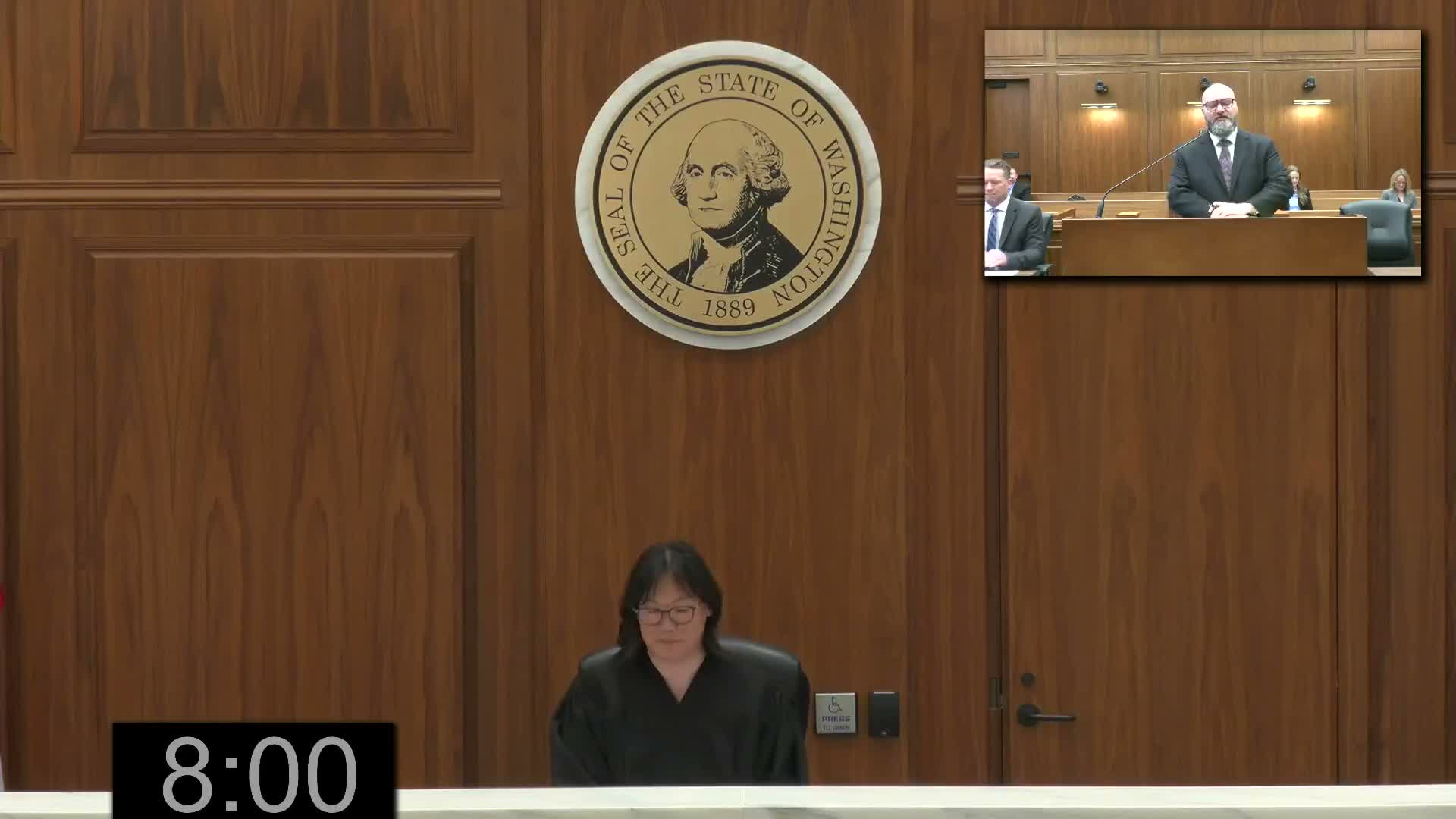
James Weir, counsel for Diceman Capital, told the court that Diceman had transferred the building during the pendency of the litigation to a wholly owned subsidiary and now directly owns about 92% of that company’s interest. "It is improper to say that it wholly owns the real property," Weir said, and added that the briefing should instead state Diceman is the "vast majority owner of the real property." Weir said that, even though Diceman painted the panels to mitigate damages, the court’s finding that Summit owns the panels nonetheless prevents Diceman from establishing a climbing gym because the panels remain affixed to the walls.
Nathan Payne, counsel for Summit Everett, said the trial court’s order was grounded in undisputed facts and the plain language of the applicable lease. Payne noted that, since briefing closed, the court dismissed all of Diceman’s claims with prejudice and that the remaining contested issue is the replacement value of the painted panels. "Diceman testified that it in fact no longer owned the building where Summit's climbing wall panels remain to this day," Payne told the court, and he said Diceman quitclaimed the building to an entity recorded on 07/24/2025 as "Whale l f t y 0 4 7 7 Dow LLC." Payne argued those developments undercut Diceman’s contention that the summary-judgment ruling changed the status quo outside the courtroom.
The parties disputed how the 2015 and 2022 leases should be read. Payne pointed to paragraph 7.4 of the 2022 lease, which he said expressly carved out Summit’s trade fixtures from improvements that would become landlord property at termination, leaving trade fixtures as Summit’s personal property. Weir countered that the 2015 lease terminated on 02/01/2022 and that there was a period of holdover tenancy before the parties executed a new lease with a backdated commencement date; he said there is at least an issue of fact about whether the 2022 lease nullified the legal effect of the 2015 lease’s termination.
The Presiding Judge questioned how Summit’s counsel’s representation that Summit would not seek return of the panels factored into whether the summary-judgment order produced an immediate, real-world effect; Weir said such representations do not eliminate the possibility that Summit could seek relief later and that the court’s finding already constrains Diceman’s use of its property. The hearing concluded with the Presiding Judge saying a written ruling will be issued and the matter recessed.
The court heard argument on discretionary review; no appellate ruling was announced at the hearing.