Get AI Briefings, Transcripts & Alerts on Local & National Government Meetings — Forever.
Hollywood City commission signals support for core $786M utility overhaul, asks staff to plan Waterworks 2050 design with 50% debt
Loading...
Summary
At a April 22 workshop, commissioners directed staff to continue planning the Waterworks 2050 septic‑to‑sewer design while leaning toward a 50% debt financing approach for a roughly $786 million core utility investment; commissioners pressed staff for analyses on equity, non‑ad valorem assessments, and low‑income relief.
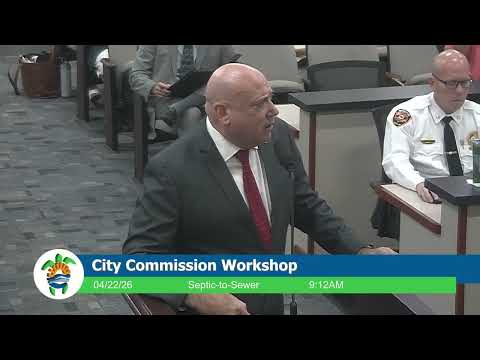
Hollywood City commissioners moved toward a financing direction for large, near‑term repairs and a long‑term septic‑to‑sewer program at a April 22 workshop, asking staff to return with detailed alternatives on assessments, millage and protections for low‑income households.
Vin Morello, director of utilities, told the commission the city faces roughly $786,000,000 of core water and wastewater needs driven by deferred maintenance and regulatory requirements. "The orange line represents the urgently needed repairs for the core infrastructure program. That's the $786,000,000 that we've referred to before," he told commissioners as he summarized four options for financing and rates.
Why it matters: the plan addresses immediate operational risks at the wastewater plant and PFAS‑related water treatment upgrades, but comes with steep near‑term rate increases in the department’s models. Under the core 50% debt scenario staff modeled a 25% increase in water and sewer rates each year for the first three years — a path that produces a roughly 112% cumulative increase for the typical residential use case by 2031. Adding the Waterworks 2050 planning increment raises the modeled cumulative increase further.
Key details from staff: the $786 million core need includes about $222 million for the water system (including roughly $95 million tied to PFAS treatment upgrades) and $560 million for wastewater plant and critical infrastructure. Staff proposed a $45 million investment to design the first two phases of a 25‑year septic‑to‑sewer program, a step intended to make projects shovel‑ready for favorable financing. Morello said the department modeled both a conventional 50% debt/50% cash approach and a 60% debt approach; the 60% option reduces near‑term annual rate increases modestly but increases long‑term debt service pressure and reduces borrowing flexibility.
Commissioners asked targeted questions about who bears costs. The presentation assumed large industrial or regional users would shoulder about one‑third of some plant upgrade categories (consent‑order compliance, biosolids upgrades, regional buy‑in and reuse expansion), but consultants cautioned that how much of those costs are passed through to retail customers depends on each large user’s internal cost structure. "If we figure about a third of the increase that we're proposing gets handed passed down to the large users, you know, that's an additional 9 or 9 to 10% of cost increase that we would be passing down to the large users annually," consultant Eric Grama said.
Affordability and equity questions dominated the discussion. Commissioners cited local statistics on cost‑burdened households and raised repeated concerns about seniors on fixed incomes and large families who would see sharper monthly increases than the typical‑usage example. "We have to remember that many of the residents in Hollywood don't make the median and are more of the 25% level, and the impact on them," the mayor said, adding “doing nothing is not an option” because of plant vulnerability and regulatory timelines.
Alternatives requested: commissioners asked staff for work to quantify alternatives to steep near‑term rate hikes, including longer smoothing horizons (10–15 years), a general millage or non‑ad valorem assessment to spread costs across property owners, targeted assistance or grant options for low‑ and moderate‑income residents, and procurement approaches such as design‑build or public‑private partnership structures for parts of the work. Deputy Director Phyllis Shaw confirmed the current CIP renewal set‑aside is about 4% and roughly $15,000,000 in fund balance; staff noted that raising that to 10–15% is likely necessary for sustainable renewal funding.
Where commissioners landed: there was not a formal vote, but the mayor and a number of commissioners signaled preference for continuing with Waterworks 2050 planning while pursuing the core program and using a 50% debt financing posture for the initial five‑year rate plan. Some commissioners said they favored 60% debt to lower early year bills, but the majority underscored the value of preserving borrowing flexibility and pursuing grant opportunities.
What comes next: the commission asked staff to return with a five‑year rate resolution and detailed analyses that include (1) an equity comparison of non‑ad valorem assessment vs. rate impacts across household types and businesses; (2) longer‑horizon cost and financing projections for the full 25‑year program; (3) options for targeted relief programs or external grants for low‑income customers; and (4) procurement scenarios (design‑build, P3, or RFQ/competitive design) with guardrails to avoid conflicts of interest. No final adoption occurred at the workshop; staff will refine models and present an implementable rate plan and accompanying options to the commission for future action.